
A stalwart group of advocates has made it their mission to raise awareness about the safety and efficacy of hyperbaric oxygen therapy (HBOT) for helping veterans alleviate post traumatic stress disorder (PTSD) and traumatic brain injury (TBI). Retired U.S. Navy SEAL John ‘Sandy’ Pidgeon, Vietnam-era tanker pilot Dr. Robert Beckman, Co-founder of TreatNOW, and U.S. Air Force C-141 Flight Engineer and National Director of TreatNOW State Legislative Efforts Eric Koleda spoke with the Special Operations Association of America (SOAA) about their mission to bring HBOT to the population of veterans with brain wounds related to their military service in order to fight back against the veteran suicide epidemic, which has claimed more than 140,000 lives since 2001.
TreatNOW is a coalition of veterans, academics, researchers, civilians, and veteran service organizations working together to advocate for veterans’ access to HBOT. The group says it has successfully supported 33,000 citizens, service members, and veterans, including over 12,500 veterans and 800 special operations forces (SOF) personnel, with HBOT access.
Advocates believe this number is not enough.
Beckman says that TreatNOW wants the population of roughly 18 million veterans “to hear, to understand, [and] to educate themselves” about how they can assist with brain wounds and traumatic brain injury that “can lead to depression, suicide, and significant loss of quality of life.”
Accessing HBOT for Veterans
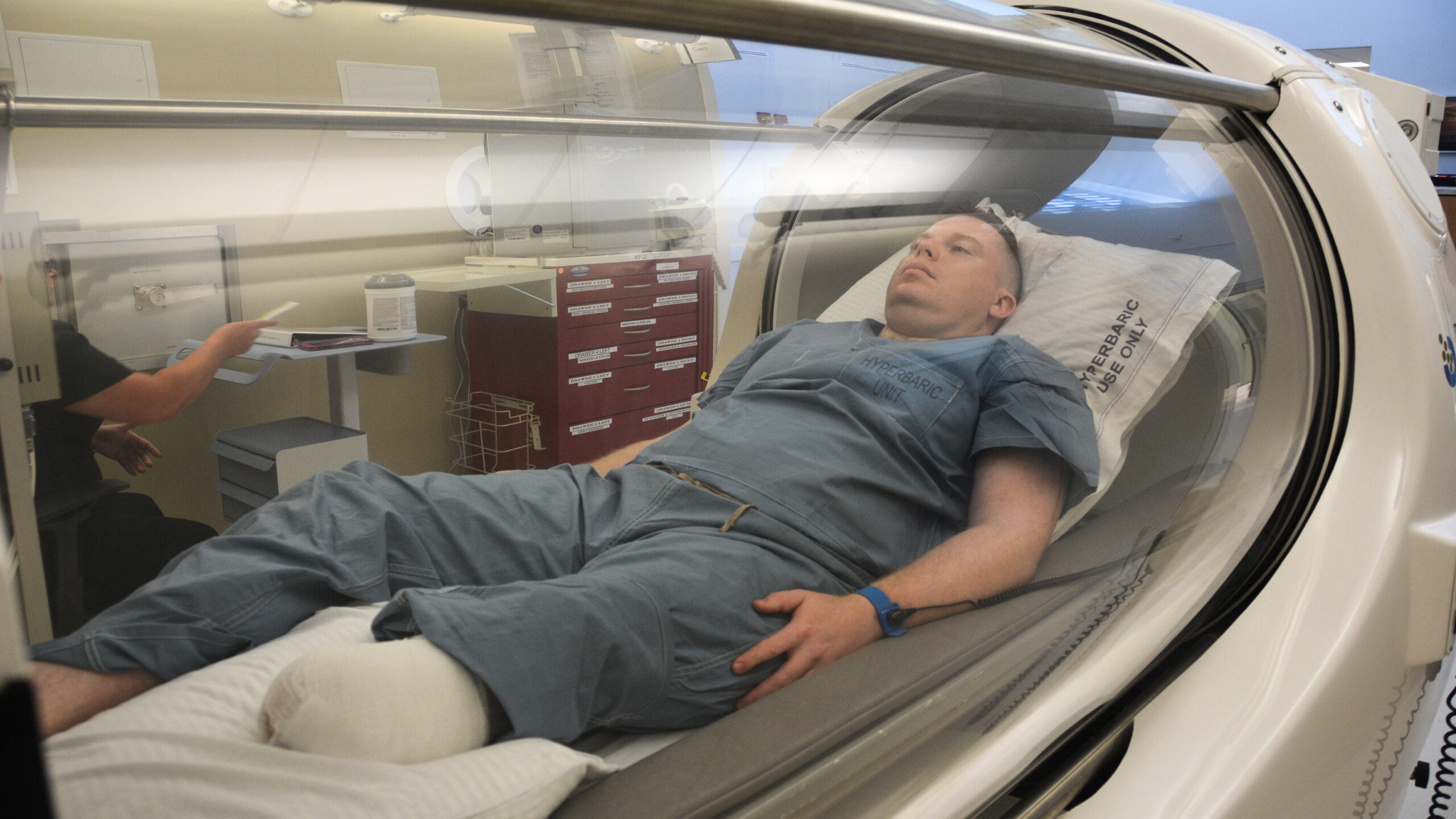
During HBOT, patients enter a chamber in which they breathe 100 percent oxygen delivered at higher than normal air pressure.
HBOT is FDA-approved for 14 indications, including carbon monoxide poisoning, necrotizing infections, wound healing, burns, and radiation injury. It has not been approved for PTSD or any other conditions conventionally thought to be linked with mental health.
However, according to Beckman, there are “28 clinical studies showing [HBOT’s] efficacy” since 2008.
Among these is a 2023 study published in Frontiers in Neuroscience. Following an exhaustive review of the mechanisms in HBOT thought to support brain repair, researchers stated that “pre-clinical and clinical trials have shown that HBOT can induce neuroplasticity and improve clinical outcomes of veterans with treatment-resistant PTSD.” Of ten clinical trials, including six controlled trials, cited in the article “all…studies indicated positive effects on PTSD symptoms.”
SOAA asked the Department of Veterans Affairs (VA) whether it would provide veterans experiencing PTSD or TBI with HBOT. A spokesperson told SOAA that the “FDA has neither approved nor cleared the use of HBOT to treat traumatic brain injury or PTSD. VA continues to review emerging research and incorporate new findings into clinical practice guidelines to deliver Veterans safe, proven, and patient-centered treatment options.”
HBOT to Treat Brain Wounds
Advocates who spoke to SOAA emphasized that they believe that while PTSD is often considered a mental health diagnosis, it typically results from TBI, which they refer to as a “brain wound.” Concussive forces from heavy weapons overpressure, artillery and rocket back-blasts, improvised explosive devices, close-quarters small arms fire, breaching explosives, accidents, and injuries can radiate, Beckman explained, creating a conglomerate of physiological, behavioral, psychological, and moral impacts, “any one of which, when neglected, leads to dysfunctions that negatively affect all the others.”
Though a variety of treatments are emerging which can assist with PTSD and TBI, Beckman says that it is best “to diagnose and heal the brain first.” On this score, Beckman says HBOT “has worked for decades,” including at over 183 TreatNOW Coalition clinics and hospitals nationwide.
Congressional Support for HBOT
SOAA spoke to Rep. Greg Murphy, MD, (R-NC) about the Veterans National Traumatic Brain Injury Treatment Act, H.R.1336, legislation he sponsored which passed the House of Representatives’ Veterans Affairs Committee in May 2025. If the legislation is passed, it will require the VA to conduct a five-year pilot program to provide veterans who experience TBI or PTSD with access to HBOT.
Murphy explained that he has “spent the better part of a decade” looking into HBOT, and that he is “as a scientist, convinced, especially after talking with so many veterans who’ve had such a good response for this, that this is a treatment that is there for veterans when nothing else is working.”
In addition to looking at the science, Murphy says that he has “visited HBOT centers, [and] spoken with advocates,” and concludes that HBOT “is something I truly believe as a physician that our VA should be offering.” Unfortunately, Murphy noted, “I think those who are controlling some of the things at the VA are scientists who are stuck in data from either the ‘60s, ‘70s, or even ‘80s that did not at the time show a benefit, but so many different protocols, new protocols are being done, new treatments modalities are being done, where I really believe this moves the needle.”
For the Veterans National Traumatic Brain Injury Treatment Act to come to fruition, Murphy said that it must get onto the House floor and acquire more co-sponsors. Murphy urges interested parties “to call their member of Congress, and ask them to get on this bill, because it’s a notification to leadership. If there are a lot more co-sponsors, that means there’s a lot more interest in it.”
Murphy noted that there is a companion bill on the Senate side sponsored by Sen. Tommy Tuberville (R-AL) “who believes in this.”
“Truth be told, I don’t think the VA needs to do a study, it just needs to read the most recent literature and understand that the preponderance and overwhelming amount of evidence shows the efficacy of HBOT for PTSD and TBI,” Murphy said. “They just need to do their job.”
Getting the HBOT legislation passed is “one of the things that I would like to have done,” Murphy explained. “I truly believe it helps those who have literally nothing else to turn to… We can’t accept the numbers that we still have every day for veteran suicide.”
State-Level Support for HBOT
One impediment to helping veterans access HBOT is its expense. Advocates note that it costs between $230 and $450 per hour for the therapy, and that a typical treatment requires 60 to 100 hours in a hyperbaric chamber. They also believe that costs will decline as HBOT infrastructure expands.
Koleda noted that he has worked extensively at the state level to help veterans access HBOT. One state where he has had great success is Kentucky, where veterans with PTSD can have their HBOT covered through $1.5 million in state funding through 2028. Koleda says that in Kentucky, 64 percent of veterans he has treated “are either back to full-time or part-time school or work.”
In the 14 states that have enacted laws, Koleda said that about “1,955 state lawmakers voted ‘yes’ [for HBOT] to five ‘no’s.’” Koleda says that another 10 states are working on HBOT legislation. Seven of the 14 states that have passed legislation have assembled over $33 million in HBOT funding, but Koleda emphasized that “the fiduciary responsibility for the treatment of veterans should lie with the U.S. government and the VA.” Koleda said that “Congress is not standing up and doing what they need to do to provide the best care for” veterans with PTSD and TBI.
“Despite the VA, we’re having success. We’re winning, just not fast enough,” Beckman reports. Beckman wants veterans to understand that they “do not have to live a diminished life,” and that “legislators will start to pay attention to the extent that veterans make their voices heard.”
Sandy Pidgeon is a 20-year Navy SEAL Officer, who qualified as a diving supervisor in open circuit, O2, mixed gas, and SEAL Delivery Vehicles (Mk-8 and MK-9). He was also a hyperbaric chamber operator/co-pilot of the Advanced SEAL Delivery System..