
It took retired U.S. Navy SEAL Dr. Reynaldo Baviera three attempts to pass Basic Underwater Demolition/SEAL (BUD/S) training over a decade of service in the U.S. Navy. One of our newest Special Operations Association of America (SOAA) board members tells us about his relentless journey to becoming a SEAL, and what the trident taught him about humility.
When he first entered the Navy in July 1992, Baviera’s Armed Services Vocational Aptitude Battery (ASVAB) score was not high enough to provide a pathway to BUD/S. But while he served on a Navy ship outbound from his home state of Hawaii, Baviera was transfixed by the stories of a crewmate who had previously gone through the notoriously difficult SEAL training regimen. “He inspired me at that moment to give it a shot,” Baviera said.
First accepted to enter BUD/S in 1996, Baviera quit the training program at week four, on day one of infamous Hell Week, when trainees undergo five and a half days of testing their mental and physical stamina in cold, wet conditions on just two hours of sleep.
“I didn’t really give it the chance I should have,” Baviera said. “My heart was more about getting out” of the Navy.
When Baviera attempted to go through the course again about a year after transitioning to the U.S. Navy Reserves, funding shortages stood in his way. But when he reenlisted two years later in 1999, Baviera says he “went straight to BUD/S.”
This time around, with just two-and-a-half weeks to go before graduation, Baviera was dropped from BUD/S on account of weapons violations.
Baviera still owed the Navy four more years of service. After 16 months of limited light duty due to an injury, the Navy sent Baviera to Italy as part of the security force it was standing up around the world in response to the heightened global terror threat post-9/11.
When he arrived overseas, Baviera realized that many of his fellow security force members had also attempted, but not passed, BUD/S. Two years into his Italy tour, a colleague named Chris told Baviera he was going to make another attempt to become a SEAL.”He basically was just pestering me,” Baviera said. And the pestering worked.
In total, five members of Baviera’s security team traveled back to the U.S. to undergo BUD/S together in 2004. Attrition happened quickly. Only Chris and Baviera made it through Hell Week. Baviera alone made it to graduation in September, 12 years after he entered the service.
Over the next year, Baviera completed jump school and Seal Qualification Training. In 2005, he was sent to SEAL Team 3’s Task Unit Bruiser as part of Delta platoon, led by renowned author and podcaster Jocko Willink.
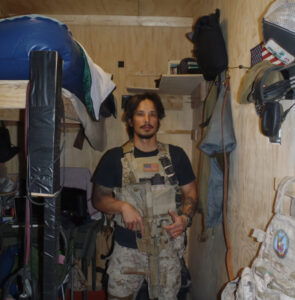
Learning Humility Under Fire
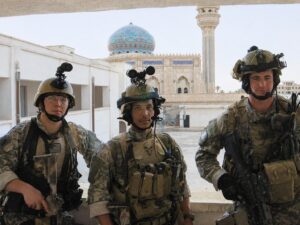
Baviera’s first deployment with Task Unit Bruiser during the Battle of Ramadi in Iraq in 2006 has been commemorated in detail, on account of the “ferocity and intensity of conflict,” and the bravery of unit members like ‘American Sniper’ Chris Kyle and Michael Monsoor, posthumously awarded the Congressional Medal of Honor for leaping atop a grenade to save two fellow SEALs.
For Baviera, the deployment was also a lesson in humility.
The late commander of Task Unit Bruiser made the decision for SEALs in Ramadi to “blend in and be more like our Army brothers.”
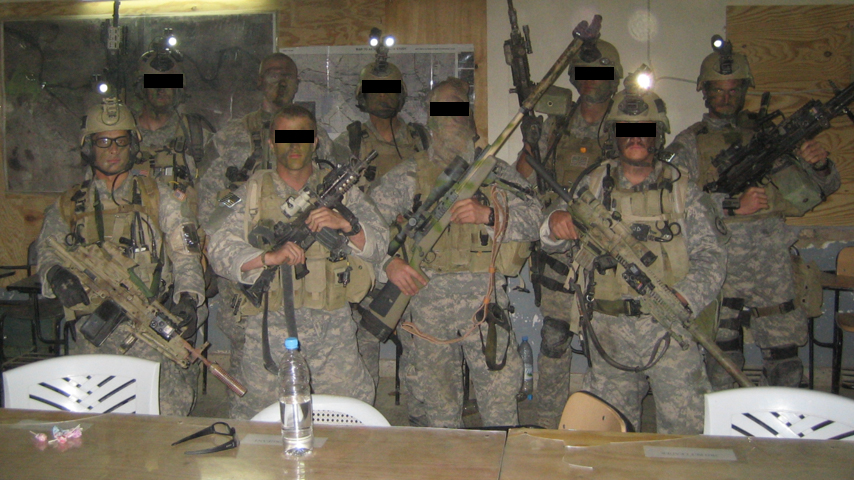
“We like to use a lot of flair [and] grow our hair long, beards, and that kind of stuff,” Baviera said, but by “ditch[ing] our uniforms, no mismatching, no extra patches,“ and going “to Army standards,” including shaving their hair and wearing Army Combat Uniforms, “the only thing that made us different was our kit and helmet.”
Eventually, an Operational Detachment Alpha (ODA) team arrived in Ramadi. With their mismatched uniforms, a different variety of boots, and long hair, the Green Berets looked like “what everyone sort of thinks that a SOF operator looks like,” Baviera explained. “There was this sort of contention” between the units, Baviera said, as the ODA refused to fit in with the Army standards and attempted to push the SEALs out of the area of operations.
It was Lt. Col. Ronald Clark, then Commander of the 1st Battalion, 506th Parachute Infantry Regiment (PIR), who “decided to keep us there on station rather than the ODA, primarily because we just knew how to play ball.” Baviera says Clark “even started calling us the Army Frogmen.”
One memento of that deployment holds lasting value for Baviera: a patch from the 506th PIR, who appreciated the SEALs so much that they “patched us in as their own.”
As Baviera progressed in his career and held roles in commands where not all members of his team were SEALs, the 506th PIR patch and his experience in Ramadi reminded him of the value of a joint force.
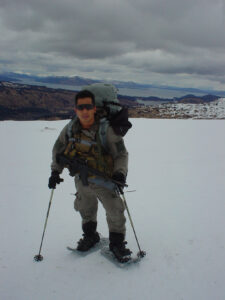
Progress and Lessons
Following his tour in Iraq, Baviera deployed once more with Seal Team 3 before joining a training detachment. When he came up for a leadership role, he went to Support Activity (SA) 1, the SEALs’ intelligence arm. After finishing his undergraduate degree at the National Intelligence University and earning a graduate degree in International Relations from American University, he returned to his prior unit, now renamed the Special Reconnaissance Team (SRT) 1.
After retiring from the military with 26 years of service and achieving his doctorate from the University of Southern California, Baviera joined the Space Force as an Intelligence Planner. In his current role, he ensures that the Space Force can offer SOF personnel more reliable communications.
While Baviera loves his civilian role, he said that he maintains his Navy SEAL work ethic. “Like we said in BUD/S, the only easy day was yesterday. That’s true, and that has stayed with me throughout my entire career.”
Through his “let’s win” mentality, Baviera is embodying “the way SOF should be represented, even though I’m not in uniform.”