
When U.S. Army Sgt. Maj. Toni Lavery arrived at basic training in 2001, she was sure that her rebellious attitude “was going to get [her] kicked out.” But as it turned out, the Army gave Lavery “the purpose and direction [she] needed” to excel.
Our newest Special Operations Association of America (SOAA) board member talks about her 25-year career in special operations, and the lessons that she learned as one of the first women to enter the male-dominated special operations forces (SOF) community.
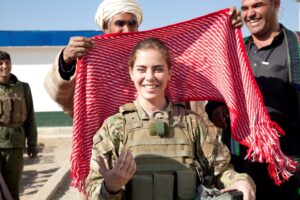
The Rebel Finds a Cause
During her childhood, Lavery was a serial contrarian. “I just didn’t want to do what everyone said,” she explained. Arrested at 13 and often getting in fights with students who would jump her and her sister in their high school, Lavery said that “my way of fitting in was through humor, and doing bad things.”
When she graduated high school, Lavery’s parents insisted she attend college. Forced to pay for classes herself, Lavery said she “hated every minute” of college, struggling to focus in classes she found unnecessary as an aspiring artist and dropping out after her first year.
In 2000, she enlisted in the U.S. Army Reserves, but was delayed entry because of her prior arrest. When she arrived at the Military Entrance Processing Station (MEPS) in 2001 and made her way through basic training, Lavery found that “very contrary to what I thought was going to happen, I totally kicked ass in the Army.”
Lavery discovered quickly that she wanted more than her role as a heavy wheel mechanic in the Reserves could offer. Compared to Lavery, her fellow soldiers seemed “nonchalant” about service. “On our drill weekends, it was always a four-hour process to figure out if people were going to show up to the commitment they made,” Lavery explained. “And if they did show up, it was in a half-assed uniform,” wearing “some version of the old battle dress uniform with a Carhartt jacket over it, and just totally against everything I was indoctrinated to believe.”
As a result of the lackadaisical attitude, Lavery said she “didn’t want to assimilate because I would never let my standards be those standards.”
While searching for a job that was “more challenging,” Lavery’s found motivation in her fellow federal security contractor coworkers, many of whom were U.S. Marines. When they weren’t on duty, the Marines would go running and work out with Lavery. When the Marines discovered Lavery could do pull-ups, they “thought it was cool,” which she said “totally boosted my confidence. They had me convinced that I wanted to switch over and join the Marines.”
Lavery arrived at the Marine Corps’ recruiting station, she learned that the Corps was not taking prior service members. Undeterred, Lavery returned to MEPS “and told [the Army recruiters] what I wanted to do.”
In addition to requesting a contact that would let her be airborne- and language-qualified, Lavery specifically asked for the recruiter to “give me a good challenge and really leverage my potential.” The recruiters returned with an offer that would guarantee everything Lavery requested: a role in Psychological Operations (PSYOPs).
Lavery didn’t hesitate, telling the recruiter, “Hell, yeah, I’ll take the job,” and asking “When do I leave?”
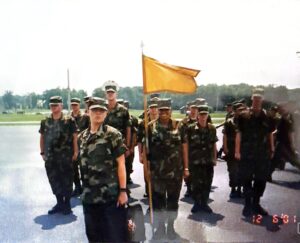
Finding Tribe in Unique Places
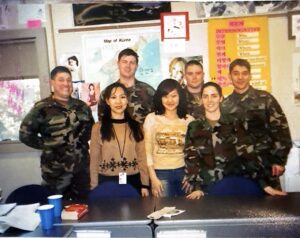
Lavery went through Airborne School at Fort Benning in 2003 before beginning an intensive six-month course in Korean under the instruction of a female teacher, a Korean emigre named Nam.
Nam “had two sons and she always wanted a daughter,” Lavery said. “I was her first woman student, so she treated me like a daughter. She’d bring me lunch, she’d show me how to cook bulgogi in the classroom. She even gave me her hanbok, the traditional Korean dress… It’s very intricate and pretty and flowy, and it’s something that’s usually passed down from generation to generation. It’s this very beautiful, personal thing, and she gave me hers.”
The relationship was important for both women. Nam had struggled to assimilate after arriving in the U.S. and had few close relationships outside of her family. Lavery said she “didn’t have a lot of friends” in the schoolhouse, where there was one woman for every 60 or 70 men among the hundreds of students. With her male classmates, Lavery said it was often “tough to discern whether somebody wanted to be my friend” and respected her, or was interested in her for different reasons. Lavery said her naivety about the male-female dynamics in the SOF community lasted “my first 10 to 15 years.”
But with Nam, “we both through unique types of isolation found insulation with one another.” The relationship between Nam and Lavery continues to this day, with Lavery bringing her entire family to Korea, where she met Nam’s family in 2019.
At the end of her training, Lavery was named the honor graduate for her class, which came with a unique benefit: membership in the Special Forces Association. Though Lavery said she had “a certain sense of pride” about earning the honor, not usually granted to women or those outside the Special Forces community, she also said that “I kind of expected it of myself to give it my all and so this was really just meeting my expectations.”
A Change of Plans
Because of her Korean focus, Lavery was assigned to a language-aligned battalion in the Pacific Command (PACOM) area of operations. She only stayed there “a few months.”
In 2004, “it was the height of the invasion of Iraq” Lavery said. “Tactical battalions that had been participating in Iraq and Afghanistan were looking for volunteers to support a next deployment to Iraq. I said, ‘Yes. Sign me up.’”
Lavery has been part of the U.S. Central Command (CENTCOM) line units “ever since January 2005,” when she made her first preparations to deploy to Iraq.
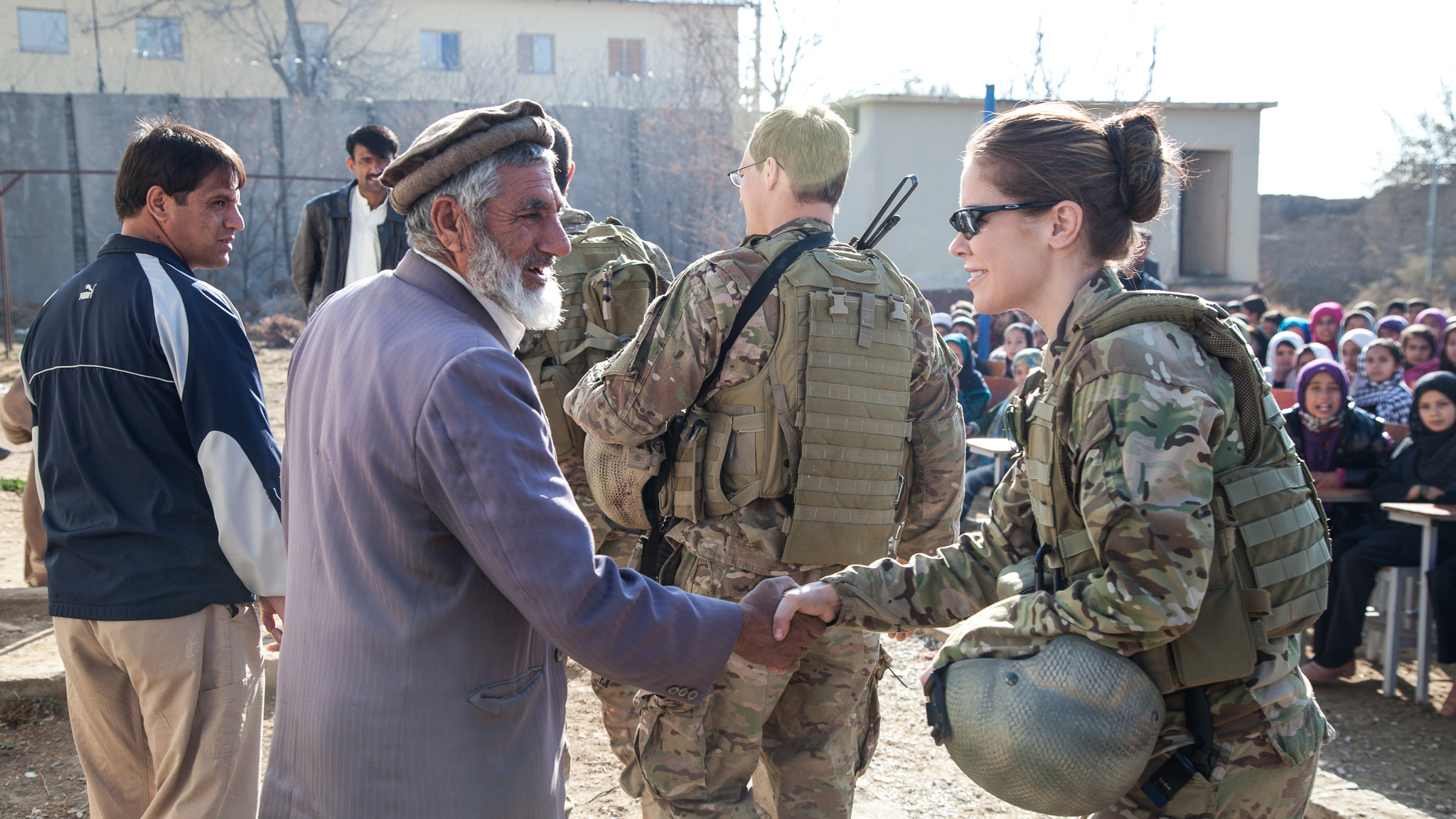
During her first Iraq deployment, a local interpreter helped Lavery learn basic Arabic writing, pronunciation, and vocabulary that would help her navigate society and build rapport with locals. Understanding the language helped Lavery transliterate for the teams as they put together information campaigns.
Lavery made subsequent Iraq deployments in 2007 and 2009 before being sidelined by a serious ankle injury.
In 2010, Lavery became the first woman to earn a place in the semifinals of the All Army Combatives Tournament. Unbeknownst to her, the opponent she faced in the first round of the semifinals was a prior Olympic Gold Medalist in wrestling. When he performed a takedown that Lavery couldn’t defend, she pulled guard, wrapping her legs around his body. Instead of driving forward, Lavery’s opponent reversed and flipped backwards, forcing both Lavery and her opponent’s weight on Lavery’s ankle. Not knowing that her bone had snapped in half, Lavery continued to fight through the pain.
When the referee announced her opponent as the winner, Lavery could no longer stand on her ankle. “He beat me by one point,” Lavery lamented. “And he didn’t submit me. It’s just that time ran out.”
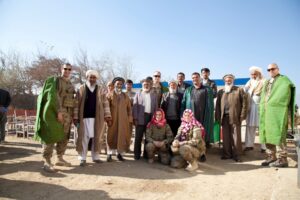
The Traumas Accumulate
After recovering from her injury, Lavery deployed to Afghanistan in 2012. From her position in Bagram, Lavery was supporting teams “stationed in one of the worst places in Afghanistan,” she explained, the eastern Chak Valley. During the nine month deployment, “I think we averaged at least one death a month.”
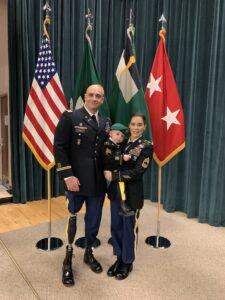
The “worst part of the deployment,” Lavery said, was when now husband, Nick Lavery, was injured. “We weren’t married at the time. Actually, people didn’t even know we were significant to one another, so when he got injured, I wasn’t privy to the updates on his status. I wasn’t allowed to know if he made it to Germany or Walter Reed and if he was still alive or not.”
For the three months following Nick’s injury, Lavery said she was “under complete duress, worried if he was alive or dead.” When Nick finally contacted her, the stress did not abate. The question became “how he was doing,” Lavery explained, because “the person I love the most in this world is dying and getting his leg incrementally removed, and I can’t really talk to him.”
Managing team life without Nick added its own new stresses, but when Lavery returned home, she received an invitation to take part in a “highly-visible, no-fail” pilot training pipeline to further integrate women into traditionally male-only roles in special operations following the decision to allow women to participate in combat operations.
Unable to turn down the offer, Lavery also recognized that the stakes were sky high. “They’re judging the future of women’s ability to do this based on my performance. So why not? Let’s do that,” Lavery said sarcastically when explaining her decision to add another stressor into her life.
After Lavery completed her training, she and Nick had gotten married. As she arrived at her unit, she was also pregnant, which meant that she could no longer take part in the deployment she had committed to. Her arrival was reinforcing “all the stereotypes” about women in service, Lavery said.
That initial experience “made for a very rough time” as Lavery tried to assimilate into her new environment.
Later, when Nick and Lavery began trying to have a second child, a string of pregnancies and miscarriages further alienated her from her teammates. “The unit had to know, because it was affecting my training. I couldn’t go to the demo[lition] range when I was pregnant, so I would have to tell them…but then I’d have a miscarriage. And then, how do you tell that…to a group of guys?” she explained.
Lavery continued to face challenges adapting to life within her new environment, but she acknowledges that her own reluctance to consistently invest in finding where she fit within the culture made the transition more difficult than it needed to be. Looking back, she recognizes that meaningful integration required persistence, humility, and a willingness to adapt alongside the organization.
She also observed that many of the other women serving in similar capacities quietly navigated alike challenges, choosing to shoulder those difficulties with professionalism rather than drawing attention to them. They understood that enduring the growing pains of integration was part of paving the way for the women who would follow, believing that their perseverance would help create greater opportunities for future generations of service members.
 Accumulating Stresses
Workplace stressors, her high-paced deployment cycle, and the unaddressed trauma of her husband’s injury began to have a compounding impact. “The final coffin nail” came when Lavery’s best friend’s son committed suicide after Lavery returned from her last deployment in 2022.
Without warning, Lavery began to experience unexplained vision loss. She saw a slew of doctors before seeing a specialist who diagnosed a stress-based eye condition that, unaddressed, would result in blindness.
Up until her diagnosis, Lavery realized that she had been “just dealing” and not noticing how the chronic headaches, body pain, mood volatility, and sleep issues were impacting her life. Because she was still going to the gym and going to training, Lavery was “still convincing myself that I was fine.”
Her family, though, had noticed the changes, even her youngest child who sometimes asked why his mom was “always so grouchy.”
“I just wasn’t watching until I knew I needed to pay attention,” Lavery said.
To repair the damage of chronic stress, Lavery began seeking out restorative therapies and healing retreats. The biggest changes came when she discovered her tribe, a group of women in the law enforcement, military, and first responder communities who united under nonprofit Fox Force Foundation to take on group challenges that utilize and sharpen their leadership expertise and resilience.
In addition to finding purpose in Fox Force, Lavery achieved great success through medication. It was after a dramatic drop in Lavery’s vision that she finally accepted a medical suggestion offered by about a quarter of the doctors she visited around the country: that her vision loss might be attributed to stress and post-traumatic stress disorder (PTSD).
Over eight days, Lavery went through four intensive ketamine sessions, which target the brain’s neuroplasticity, paired with a dual stellate ganglion block, which would calm the nerve that places the body in a state of fight-or-flight. The medical interventions, offered by Task Force Dagger, alongside a year of counseling through All Secure Foundation and Operation Healing Forces, “turned my life around,” Lavery said. Better still, she says they “turned my family’s life around.”
While Lavery prepares to depart the military and continue finding solutions to her ongoing eye condition, she feels she is equipped with the tools to continue her success.
For other women considering a SOF career path, she recommends that educating themselves ahead of joining the special operations community will help them manage expectations. More importantly, she notes the importance of having a clear sense of self, “and promising to yourself that you won’t waver from what that is, because there are going to be times when you’re definitely challenged.”