
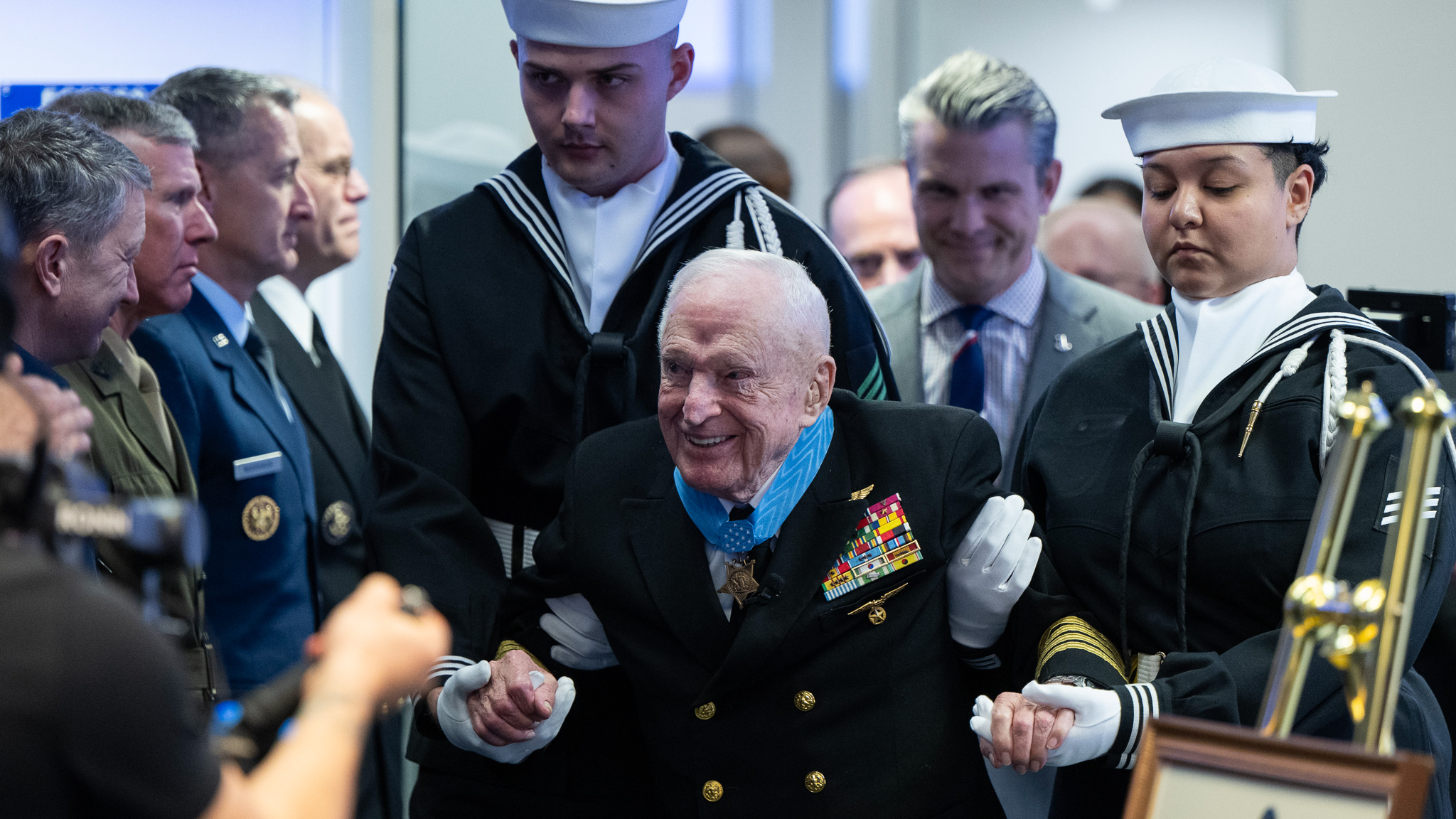
During his Feb. 24 State of the Union address, President Donald Trump bestowed the Congressional Medal of Honor on 100-year-old retired U.S. Navy Capt. E. Royce Williams, Jr., whose heroic actions during the Korean War remained secret for half a century.
Combat Air Patrol, Interrupted
A 27-year-old Lt. Williams was deployed aboard the USS Oriskany during the Korean War as an F9F-5 Panther pilot when he took off on a routine combat air patrol mission on Nov. 18, 1952 with fellow Panther pilots Lt. Claire Elwood, Lt. j.g. Dave Rowlands, and Lt. j.g. John Middleton. The Panthers were climbing steadily through blizzard conditions and low-slung clouds when they received a message from a secret team within the newly-formed National Security Agency that was stationed with their carrier task force aboard the USS Helena.
The NSA team reported that seven Soviet MiG-15s were heading towards the northern portion of the Korean peninsula. Believing the MiGs were sent to seek retaliation for an American attack near the Soviet border earlier in the day, Williams’ patrol was tasked with placing itself between the incoming Soviet fighters and the carrier task force. Not only were the Panthers outnumbered, but the Soviet jets were considered the best of their time, with airspeed and thrust that far outstripped the Panther’s capabilities.
As the four-Panther formation continued to gain elevation, an issue with Elwood’s fuel pump forced him to return to the Oriskany with his wingman, Middleton. Williams and Rowlands continued on to confront the MiGs.
The Soviet fighters had broken into two groups, hoping to “pin” the remaining Panthers. As four MiGs began their attack, Williams fired his 20-mm cannons at the final jet in the formation, hitting it directly. Rowlands broke off and followed the impacted Soviet jet as it fell in a spiral, leaving Williams to take on six remaining MiGs singlehanded.
Though military commanders aboard the carrier instructed Williams to avoid an engagement with the MiGs, the decision was out of his hands. “I am engaged,” he replied.
Six on One
Knowing that the MiGs held numerous advantages over the Panther, Williams said he knew that “the only thing I could do was out-turn them,” which he did often while maneuvering to evade incoming 23-mm and 37-mm cannon rounds and gain position to fire on the enemy jets.
Williams described his next moments as “swivel-headed” as he chased one three-jet formation, firing on one MiG until it fell out of his line of sight.
Next, Williams was confronted by a Soviet section leader and his wingman as they turned towards him to carry out a diving attack. As the leader executed the maneuver, Williams fired on his wingman, whose jet caught fire and dropped to the earth. When the section leader came back around to attack once more, Williams fired on him, causing the MiG-15 to plummet.
After scoring another hit on the next pursuing jet, Williams recalled how “a lot of pieces started coming off his airplane, and he had to maneuver rather drastically to avoid [them] swallowing him.”
While Williams found himself back on the defensive, a lucky MiG hit his Panther with a 37-mm round, severing the cable to the jet’s rudders and disabling the hydraulic system. Not only was his plane now difficult to maneuver, but Williams had run through all 760 rounds of ammunition he carried.
Return to the Oriskany
His plane suffering extensive damage, Williams attempted to descend as Rowlands returned to the fight to engage the MiG-15 in pursuit.
By the time he escaped the dogfight, Williams knew that he was too low to safely eject, and that the frigid temperature of the water beneath him would lead to his death.
As he approached the carrier task force, American destroyers mistook Williams for an incoming MiG and fired upon him. Commanders interceded, stopping the attack. Other troubles loomed.
Unable to maneuver to the left or right, landing aboard the Oriskany in its current orientation would be impossible. The carrier captain issued orders to turn the carrier to accommodate Williams’ disabled jet.
Still more problems awaited. Jets typically came aboard the carrier at a speed of about 105 knots. Williams was approaching at the much higher speed of 170 knots because operating at slower speeds caused him to lose control of the Panther. As Williams wrestled with the jet and gravity to lower his landing gear and tailhook, he raced across the flight deck and managed to stop by catching the final of three arresting wires.
Once Williams was aboard, a shipmate used a grease pen to mark the 263 holes, some up to 12 inches wide, in Williams’ jet. The Panther was then stripped of usable parts and pushed off the deck and into the ocean.
A Half-Century Silence
Williams debriefed the incident with commanding officers. The NSA confirmed that Williams’ had killed three MiGs during his 30-minute dogfight, and that a fourth had crashed inside Siberia. However, fear that publicizing Williams’ dogfight might ignite a third world war or divulge details of the newly-formed NSA, soon stripped the evidence of his skills and bravery away.
A false report was sent to Washington, which attributed just one MiG kill and one probable damage to Williams. Though he received the Silver Star for his role in shooting down three “enemy” aircraft, Williams was also told that he could never speak of the incident again.
Forty years later, in 1992, the Soviets released the names of the four pilots that Williams shot down, confirming that three were killed during the fight, and the fourth died while attempting a crash-landing.
After the mission was declassified, Williams was finally able to speak out about his role, first informing his late wife of his unprecedented MiG-killer status. He spoke of the incident in public for the first time at the Pensacola Naval Museum in 2002.
The NSA finally declassified their report of Williams’ heroism in 2015. Eight years later, Williams’ Silver Star was upgraded to the Navy Cross.
As word grew of his bravery, onlookers felt that Williams’ actions were deserving of a higher honor. Williams’ fellow American Legion members, members of Congress, an array of senior military personnel, and SOAA’s Chairman of the Board and former acting Secretary of Defense Chris Miller advocated for Williams’ award to be upgraded to the Congressional Medal of Honor.
SOAA is proud to stand with Williams as he receives an award befitting his immense heroism in placing the safety of his shipmates and fellow pilots above his own. It is fitting that, after so long a silence, word of Williams’ extraordinary courage has been broadcast across the nation.