
TEAM SAPO’s natural medicine and neurophysiological reconfiguration protocol is designed to help Tier One and special operations forces (SOF) personnel heal from treatment-resistant depression, post-traumatic stress disorder (PTSD), Operator Syndrome, and traumatic brain injury (TBI). What makes TEAM SAPO different from other nonprofits that offer healing through psychedelics is not only their use of complementary psychedelics 5-MeO-DMT and psilocybin, but the intensive preparation and integration work that are demanded of participants to stimulate enduring, brain-level change.
The founders of TEAM SAPO, Dr. Jeff Wozencraft and Sean Wilson, told SOAA about the evolution of the program and its latest achievements.
Getting Started
TEAM SAPO’s origin story sounds like the setup to a bad joke: two guys and a shaman walk into a Miami hotel room to smoke some toad medicine.
There was nothing funny about the life-changing experience that happened next.
Most veterans find psychedelics because they are searching for healing. But Wozencraft admits he “fell into it in a backwards way where I didn’t know how messed up I was until the medicine showed me.”
Wilson thought that immediately following Wozencraft’s first encounter with 5-MeO-DMT, “the cops were going to come because he was bananas.” Describing his immediate reaction to “this overpowering sense of uncontrolledness,” Wozencraft says he screamed, “Stop! No!” for about a minute and a half.
But after those 90 seconds lapsed, Wozencraft says he “went limp” and “broke into the largest smile.” When he woke up three minutes later, he reported feeling an overwhelming sense of peace and understanding. “I get it now,” he explained. “None of this matters. There’s nothing I can do about it.” What Wozencraft experienced is often called an ego fracture, when the ego “is trying to hang on” while your body “thinks it’s dying.”
Wilson had no trip during his first experience with the medicine, reporting that his fear response watching Wozencraft’s reaction was so great that the 5-MeO-DMT “had no effect at all.”
But during his second administration of the psychedelic, Wilson said that he felt he “died in a way that I really can’t even describe.” He explained that “once I was dead, I was with God and I was at absolute peace…I was no longer in my body, I was no longer alive, but I knew that my body was in that room.” Wilson said he also “knew it was all good because I also instantaneously knew everything about existence.”
When he realized that he had not, in fact, died, Wilson said that he cried for five minutes with gratitude for everything he had seen while under the influence of the medicine.
Starting TEAM SAPO
From the moment they went through the process, Wozencraft and Wilson began looking for a way to bring psychedelic medicine to others who needed them.
The first whiteboard retreat for creating the TEAM SAPO process and foundation took place a month after Wilson and Wozencraft encountered 5-MeO-DMT. While Wilson looked into other groups providing access to psychedelics to understand how they could begin the process themselves, Wozencraft worked on methods for preparing people for the transformative process and on integrating the effects into their lives after administration.
While Wozencraft worked on TEAM SAPO, he began doctoral studies on the ways in which psychedelic-assisted therapies have helped veterans who experience depression. He recently defended a doctoral dissertation on the topic.
TEAM SAPO’s program is not designed for what its founders call “journey chasers,” participants looking for access to a quick psychedelic treatment and a return to their regular life.
Each twelve-week TEAM SAPO program consists of six weeks of preparation and education on the neuroscience behind psychedelic treatments, followed by a four-day on-site session where participants meet and undergo treatment, and four additional weeks of integration to “hardwire all of the…habits in their new neuroplastic brain.”
Wozencraft calls the program “a full frontal assault where we need all of your attention…We’ll cut you [from the program] if you’re not taking it seriously,” he explained.
TEAM SAPO recognizes the role that heavy metals, microtoxins, low testosterone, and other physical factors can play in recovery. Participants go through a “full biological assessment,” including lab work, and receive a “customized optimization plan” to improve their body’s ability to function.
Talk therapy is a component of TEAM SAPO’s care package that Wozencraft says many veterans are skeptical about. “Ironically enough, by week three, they’re blowing up their coach, texting and calling [them]” he said.
TEAM SAPO’s coaching system is extensive, including a dedicated individual coach, a participant’s battle buddies within the cohort, and their spouse, whose buy-in is a non-negotiable component for married participants. Spouses are paired with their own coaches while their husbands go through the program so that they can also become a “tool” within the TEAM SAPO toolkit and understand how to respond to changes within their spouse.
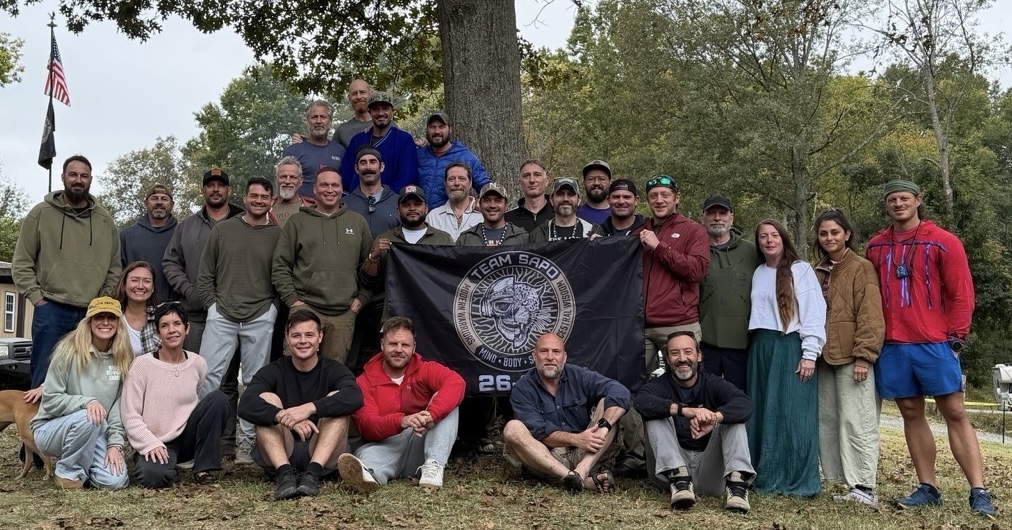
By the time that a participant undergoes the administration of 5-MeO-DMT and psilocybin, the relationships with the coaching team and fellow participants are well-established, creating a “critical” support system for the on-site segment of the TEAM SAPO program. Some participants have explained that the team environment makes them feel as though they’ve “found their [Operational Detachment Alpha] again.”
Future of TEAM SAPO
Wozencraft and Wilson said that more than 100 participants have gone through TEAM SAPO’s program. They report dramatic changes in their relationships with their spouses and children, sustained sobriety from alcohol, prescription medications, and marijuana, and an improved capacity for anger management.
Responding to a demand for additional assistance for the spouses of program participants, TEAM SAPO recently completed its first cohort tailored to operators’ spouses. Wilson says the program is fundamentally different from the protocol for operators.
The Science Behind the Psychedelics
TEAM SAPO’s founders explain that chronic trauma can leave operators in a persistent hyperactive state in which they are continuously noticing threats that do not exist, while their brain traps them in a pattern of constant rumination. In that state of neuroplastic rigidity, they say, new experiences are difficult to process.
According to the founders, the sequential administration of 5-MeO-DMT in the morning, followed by psilocybin that evening, can break those patterns. 5-MeO-DMT “hits you fast and acts on the 5-HT1A receptor,” effectively “breaching the door” for veterans who have been forced to “white knuckle” their way through utilizing a cocktail of medicines that have desensitized their neurotransmitter systems, Wilson said.
A high dose of psilocybin acts on a different 5-HT2A receptor, providing a four-hour experience that allows them to “peel back the onion and explore” what the 5-MeO-DMT ceremony revealed.
According to its own testing on a recent TEAM SAPO cohort, 36 hours after administration of psychedelic-assisted treatment, participants had, on average, a 47.78% change in brain plasticity, a 49.67% reversal of electrophysiological abnormalities, and an active rebuilding of 50.66% of functional network pathways in the brain.
One participant described the program as “nothing short of life-changing for me,” eliminating a years-long spiral into depression, avoidance, alcohol abuse, socially destructive behavior, and suicidal ideation and giving the participant “the tools and confidence to handle any traces that might still be there.”
If you or someone you know is in crisis, contact the Veterans Crisis Line: dial 988 and press 1, text 838255, or chat online at VeteransCrisisLine.net.