
Sitting alone in her vehicle in the parking lot outside work, Heidi Rippy felt as though she were watching herself from outside her body. Her thumb hovered over the number for the Veteran’s Crisis Line. The only thing stopping her from pushing “Call” was the stubborn thought that no one could help her.
As a woman who had fought to earn her place in the U.S. Army’s special operations community, she had trained to move towards crisis to help others survive. After working so hard to prove herself, asking for help meant showing weakness and vulnerability, and that seemed impossible.
In the depths of pandemic isolation, military transition, and divorce, Rippy had only one real conviction: that rescue was out of reach. She clung to her hopelessness, realizing that her hardest battles would be fought out of uniform.
Looking for a Challenge
Difficulty was a motivator for Rippy, who joined the Army at 17 looking to prove herself. “I’ve always loved it when people tell me I can’t do something,” she explained. “That challenge became fuel.” So when Rippy landed “in the middle range among [her] male peers” during basic training, she was spurred onward by knowing “there was more work to do.” Rippy’s hard work paid dividends as she regularly found herself nominated for Soldier of the Month and Soldier of the Quarter.
After making rank, Rippy was thrilled to be selected to undertake the rigorous Civil Affairs Qualification Course in 2015. Proud to make it through the notoriously difficult selection process on her first attempt, Rippy was assigned to the 97th Civil Affairs Battalion (A), supporting the U.S. Indo-Pacific Command. Eager to make it to the teams, Rippy was disappointed when she was sent instead to the Headquarters and Headquarters Company (HHC). She “still had so much energy and so much drive,” Rippy said, but the assignment made her feel the Army “viewed [her] as expendable.”
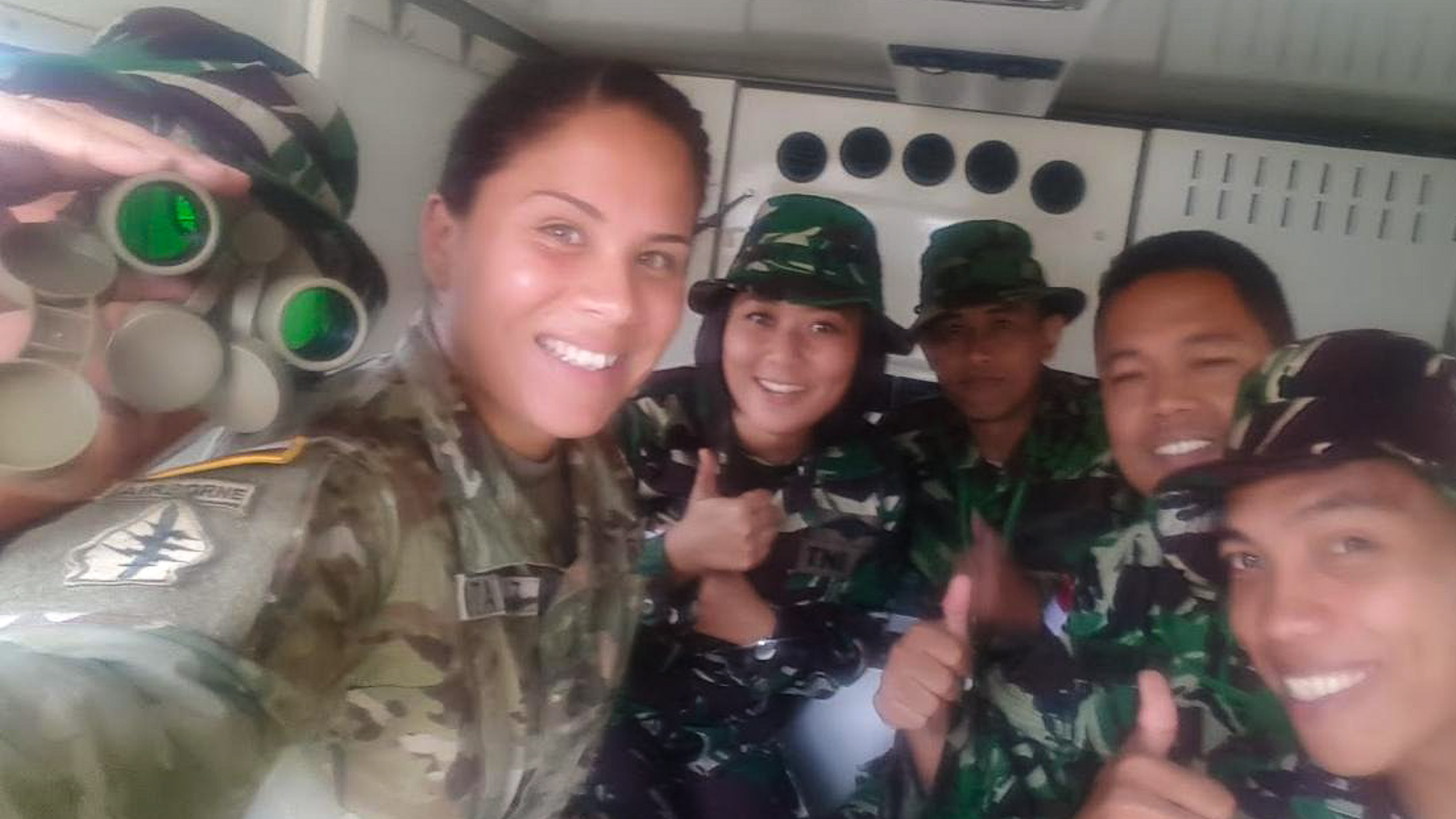
Everything changed for Rippy after she made her way onto a Joint Combined Exchange Training (JCET) to Indonesia as the lead medical trainer. Rippy made an impression on the partner force, and was “requested by name to come back.” Following her second successful JCET, Rippy got her long-awaited chance to deploy as part of a four-member team on a six-month deployment to the Maldives and Sri Lanka.
Being a woman in a team environment came with tense moments as Rippy fought for privacy as the only female sharing cramped living quarters with her male counterparts. Rippy found that some of her Civil Affairs teammates “just want[ed] to run and gun and kick doors down” rather than embracing “the human terrain side of things.” As a result, her interpersonal skills were called upon routinely when one team member’s demeanor made him persona-non-grata in some diplomatic environments.
While Rippy was high-performing in her career, she also knew that her mental health was suboptimal. She carried depression, anxiety, and periods of suicidal ideation that she rarely spoke of aloud, in addition to moral injury tied to experiences she had not fully processed. Though she was struggling to hold herself together, Rippy explained that it was an unspoken rule in the military that those who sought out medical treatment for mental health would find it difficult to deploy. “Essentially you can get treatment like talk therapy, but the minute you maybe have to take [Selective Serotonin Reuptake Inhibitors] or any other treatment, it’s very regimented on what you have to do in order to get the thumbs up to deploy.”
Instead of seeking help, Rippy coped with alcohol and a hard-charging work ethic until old injuries from her Airborne days forced her off the teams and back to the HHC. After a ten-year career filled with accolades, Rippy left the Army as a Staff Sergeant.
Preparing for Transition
When Rippy went through the Department of Defense’s mandatory Transition Assistance Program during the social distancing of the COVID-19 pandemic, she explained that the steps were administered haphazardly and not on a traditional timeline. As a result, she felt that the random assortment of skills she was taught was never tethered to the basic goal of helping her discern a new purpose and prepare for her post-military career.
Assuming that because she knew plenty of civilians, she would be able to join their ranks with ease, Rippy discovered the opposite was true. Her “entire adult life” had been “built inside the Army,” Rippy explained, which meant that every anecdote she brought up in normal conversation revolved around “training, deployments, [temporary duty travel], or some other experience from [her] time in uniform.” Finding commonality outside the tight-knit community of service members who had trauma bonded with her over shared difficulties was difficult.
Rippy’s transition also landed smack in the middle of an interpersonal tornado as she worked her way through divorce in the midst of Covid-19 isolation. She developed a habitual coping mechanism of gathering with her closest female friends, who would “just sit in each other’s driveways and cry together, drink together.” Though her friends offered advice about finding mental health help, Rippy said she “wasn’t in the place to really receive” their input.
The problem with drinking was that after a brief respite of happiness, Rippy inevitably rounded the border on anger, and, later, depression that she could not combat alone.
Rippy knew that she needed help. Though she had to sign up for Department of Veterans Affairs benefits as part of the transition process, she said that no one in her command had explained the process for getting medical care through the VA.
“I just didn’t know where to start and I didn’t know who to call, because I just felt like everyone was giving me the run around and then it would just spiral into anxiety, and then anger, and then self-medicating,” Rippy explained.
During her most intense moments of grief, Rippy turned to the Veterans Crisis Line. “The first time, there was actually a breakthrough,” she said, as the voice on the other end of the line set her up with a mental health consultation. However, she also was “astounded because the first appointment wasn’t available for four months after that call.”
Internal Purpose
Change arrived for Rippy “one random morning”; she says that she decided that she “want[ed] to be happy” and “needed to figure out what that looks like.”
For Rippy, that meant casting off the coping mechanisms that no longer served her and pursuing purpose.
Happiness did arrive when she realized how she could continue serving others in a civilian capacity by “making processes make sense.” Now pursuing her Masters in Business Administration, Rippy’s role as the VP of Development at the Special Operations Association of America (SOAA) gives her the opportunity to use her project management skills to give back to her special operations brothers and sisters in a new way.
Like so many veterans, Rippy never fully shed the version of her life that is centered on her past service. Though she rarely hears from the beloved teammates who were an integral part of her life in the Army, she says that if any of them were in crisis, she would be “on [her] way, no ifs, ands, or buts about it.”
Unfortunately, Rippy says those bonds are most often resurrected on the tragic and all-too-frequent occasions when a brother or sister takes their own life, causing team members to coalesce over the loss before returning to the lives they have forged after service.
With time, intention, and effort, Rippy has found her path forward towards a future that honors the parts of her character that the Army honed. Like so many veterans, she reports that transition is “an ongoing process.” She says she is “still becoming.”