
In the leadup to Operation Iraqi Freedom (OIF) in 2003, an elite group of special operations forces (SOF) and aviators known as Task Force 20 were training on joint close air support (JCAS) missions to support a series of twenty attacks that would culminate in a final mission to take on Saddam Hussein’s heavily-fortified palace at Lake Tharthar.
When the aircrew rehearsed the mission at Nevada’s Tonopah Test Range, it was an unmitigated disaster. On the first two attempts, none of the American F-14 Tomcats or Special Operations Aviation Regiment (SOAR) Direct Action Penetrator (DAP) helicopters survived the integrated air defense system that intelligence experts warned would be guarding the palace.
On their third shot, aviators had a 25% survival rate. After a final fourth run-through, half of the American aviation assets reached their intended destination before the rehearsals ended and participants in the classified program went off to their separate bases to continue preparations.
23 years later, four members of Task Force 20 gathered on a call to tell their stories about taking part in Task Force 20, how they ultimately achieved the objective at Lake Tharthar, and what the operations would mean for the future of the U.S. Navy’s participation in joint black SOF operations.
Preparing for the Mission
In the early 1990s, Capt. Dan ‘Darth’ Cain had been picked for a classified mission to orchestrate fixed-wing support to Delta Force personnel during nighttime close air support (CAS) missions. That mission evolved into working across branches to take part in JCAS operations that would allow more unified, effective support for any ground-based SOF in harsh environments.
Like other senior leaders tapped to lead an aggressive change to doctrine, Cain knew that the hornet’s nest he was stirring up would keep him from being elevated to a flag officer role. Still, he took his job seriously, creating his own miniature air force in the middle of the Nevada desert.
After the experiment came to an end, Cain moved on with his career. But in December 2002, the military came calling for Cain to “put the band back together” to run his JCAS program in real time to support the opening missions of OIF. “I essentially had 48 hours to leave my wonderful cattle farm in Pensacola, Florida, to head up to Fort Bragg to collect my M4 and my gear,” he said.
The renewed mission had a name: Task Force 20, after the 20 targets identified in the Joint Prioritized Integrated Target List (JPITL) as most vital in dismantling Saddam Hussein’s weapons of mass destruction, his family apparatus, and his highly-trained Republican Guard leadership.
As Navy SEALs, Delta Force, Army Rangers, and SOAR Night Stalkers prepared for the series of missions, it was incumbent upon Cain to decide which fixed-wing platform was best equipped for the mission. The U.S. Air Force declined to allow its F-15E Strike Eagle to be used for a Forward Air Controller-Airborne (FAC-A) role in Task Force 20. Cain had another fighter in mind, and so did Maj. Gen. Dell Dailey, former Night Stalker and commander of Joint Special Operations Command (JSOC), who told Cain, “You know we can’t do this without the Tomcats.”
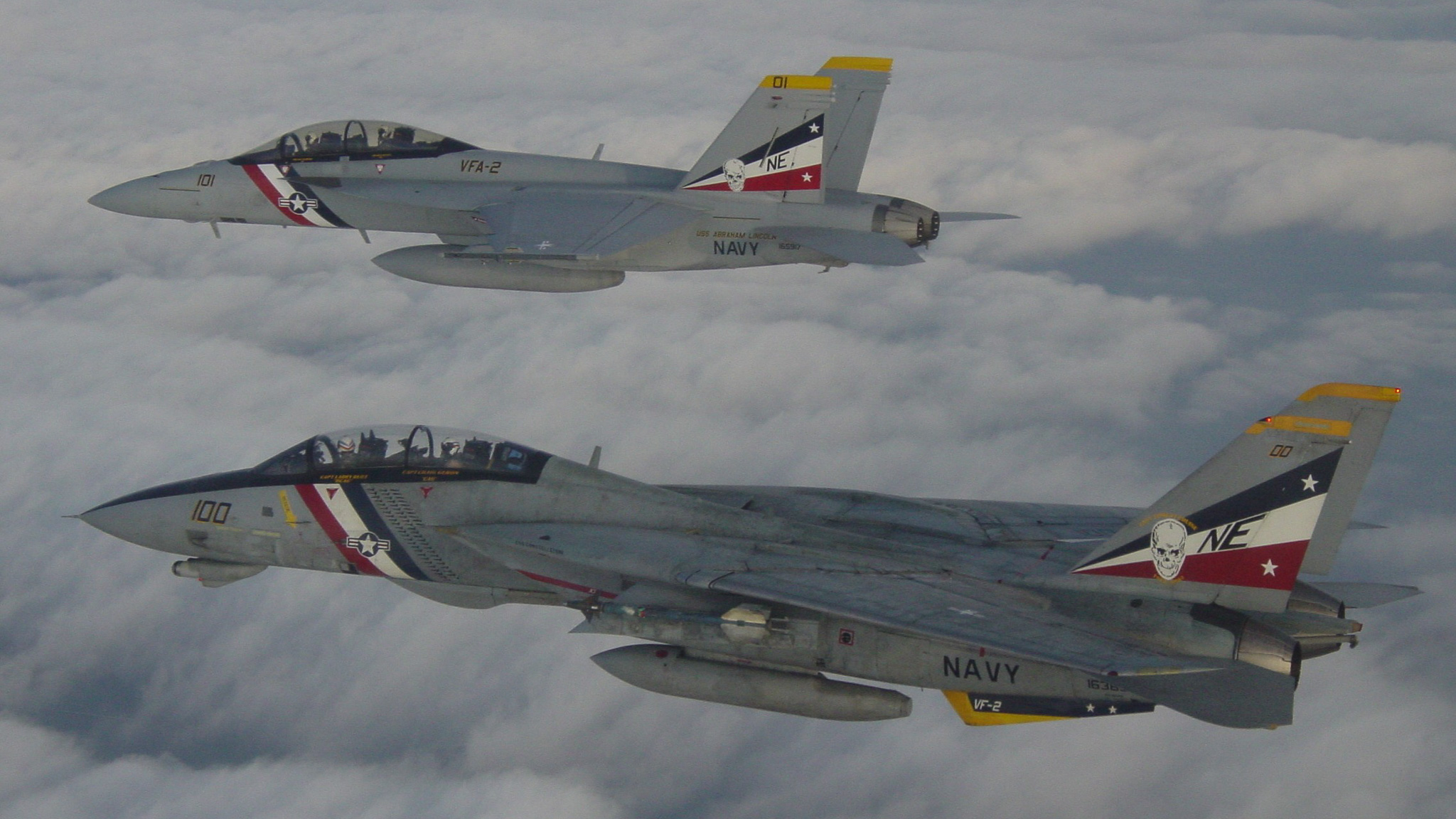
Deciding which of three currently operational variants of the Tomcat was best equipped for the job largely came down to choosing between the workhorse F-14A and the improved weapons system of the F-14D Super Tomcat. Cain was leery of the F-14D’s glass cockpit, but knew “you could put the F-14As anywhere and run the piss out of them and they wouldn’t break.” On the other hand, he “loved” the updated F-14D variant “more than anything,” but knew “some of the components in the Ds sometimes hiccupped.”
 Finding the Team
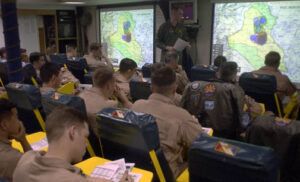
Picking aviators for Task Force 20 was another challenge. From his own time in the Tomcat, Cain knew it was important “to rob each squadron” of several fighters and aviators rather than pull from a single squadron. He especially sought out pilots and radar intercept officers (RIOs) with joint experience, who had earned FAC-A or Marine Tactical Air Control Party (TAC-P) qualifications, or successfully completed the Navy Fighter Weapons School (TOPGUN) or Strike Weapons and Tactics School Atlantic.
Once he’d picked his crew, aviators had to become carrier qualified on each of the three possible Tomcat variants. In the end, Cain decided against relying solely on a single Tomcat platform. Instead, he pulled some pilots from VF-154, the Black Knights, who flew the F-14A and others from VF-2, the Bounty Hunters, who flew the F-14D.
At the end of 2002, the aviators from VF-154 and selected Fighter Weapon School aviators assembled at Tonopah to rehearse the final mission of Task Force 20. At the western test range, there was a full replica of Hussein’s walled fortress at Lake Tharthar, complete with a copy of the Super Missile Engagement Zone (SUPER MEZ) believed to surround Baghdad with advanced anti-aircraft artillery (AAA) and surface-to-air missile (SAM) sites.
“We trained …out of Tonopah just to see how bad we were, and we were bad. And I mean, horribly bad,” Cain said. With their most successful run-through seeing just 50% of participants escaping with their lives, Cain said that the silver lining was that “Over the course of time, I got to find some really good aviators.”
Among the pilots and RIOs read into the highly-classified program were Lt. Cdr. Jim ‘Puck’ Howe, Lt. Cdr. Keith ‘Grumpy’ Kimberly, and Lt. Cdr. Michael ‘Tung’ Peterson. Each recalls the Tonopah missions with concern. There was little most of them could do about it.
Kimberly and Peterson, both part of VF-2, had been unable to participate in the Tonopah preparations while stationed aboard the U.S.S. Constellation, one of multiple aircraft carriers supporting OIF in the region.
Howe was one of several aviators training stateside to support Task Force 20. As the aviators prepared to leave for the boat, the death toll at Tonopah was not far from their minds. Howe, like a number of other U.S.-based personnel, called Navy Mutual Aid to take out a $1,000,000 life insurance policy before taking off for the U.S.S. Constellation.
Howe kept his humor about his preparation for possible disaster, wryly explaining to the carrier-bound aviators, “Don’t worry, guys. I’ll take care of your wives.”
H3 Air Base – A Day
VF-2 took part in three missions within Task Force 20. The first was at H3, an air base in the western part of the country.
As they prepared for the joint missions, Peterson noted the stark contrast between operations in 2001 Afghanistan, where ground forces calling in CAS had to go through a complicated game of translating map coordinates across the various service branches operating overhead. Not even two years later, Peterson said that “The coordinates were ironing themselves out. Everybody’s dropping Joint Direct Attack Munitions (JDAM),” smart bombs used across all branches that are precision guided to their targets in any weather.
To illustrate how heavily the U.S. relied on the munition, Kimberly noted that the JPITL for the first few days of Task Force 20 operations “showed nothing but JDAM,” though Peterson said that the Tomcats dropped purely laser-guided bombs during the course of Task Force 20.
Keeping the mission secret from other Tomcat squadrons operating in the region was not always easy. During one flight before Task Force 20 kicked off, Kimberly said that an F-14D from VF-213 came over the radio asking what he and his RIO were doing in the airspace. “Nothing, just having fun,” they responded back.
The H3 mission began on A-Day, the first day of OIF, March 19, 2003. According to Peterson, the eight-and-a-half hours he spent in the air was “the longest time I’d ever been airborne.” On the mission, he brought one “piddle pack” to relieve himself mid-air, three Red Bulls for his pilot, and extra sets of batteries for his and his pilot’s night vision goggles (NVGs).
From the air, Peterson watched on his Forward Looking Infrared (FLIR) as operators on six-wheeler all-terrain vehicles ingressed over land to the target area as a “stack” of aviation assets, including two Predator drones, waited overhead to support them, each with clearly delineated areas of operations.
“We had the ability to call in [High Mobility Artillery Rocket System] HIMARS if we needed to, and make grid squares go away with rocket-based artillery,” Peterson recalled, as a section of A-10s circled overhead every 10 to 15 minutes, ready to rain hell on the ground. Meanwhile, the Tomcats were “zipping and zorching” as they “jump[ed] into the game” between trips to the tanker.
With so many airborne assets, Peterson said it was “like a little kid soccer game…how many kids can run around and kick the ball at the same time?”
In one instance, he recalled dropping a GBU-12 500-pound laser-guided bomb on an enemy vehicle “doing about 80 miles per hour” in the battle space. “That target was immediately cleaned up. Let’s just say that,” Peterson explained.
Baghdad International Airport
VF-2’s second mission in Task Force 20 took place at Baghdad International Airport, where they were supporting ground forces who were in pursuit “of what they called ‘bug juice,’ whether it was chemical, biological, or nuclear [weapon] remnants,” Kimberly said.
During the mission, Kimberly recollected “a myriad of airplanes circling in a whirling dervish overhead,” though the Tomcats’ radar signatures were “all blacked out.” The traffic became a problem during a run to the tanker for fuel, when Kimberly said that the propellers of a P3 went right “over my head.” He explained that at the time, “I thought for sure we were dead. But thankfully he missed us and we missed him. The little airplane, big sky theory worked out for us.”
Cain would later enter Baghdad with Seal Team Six and see the aftermath of the airport strikes firsthand. While walking through a terminal, he said he saw “a frigging JDAM hanging from the ceiling, unexploded. I couldn’t get out of there fast enough.”
Tomcat Down
On April 1, there was also near tragedy during the epic operations, when one F-14A from VF-154 had a catastrophic engine failure that forced both pilot and RIO to eject over Iraqi airspace. Cain took off with U.S. Air Force Pararescuemen (PJs) on a rescue helicopter to pick up the air crew, first locating the RIO, who he said was “jumping up and down on one foot.”
When they finally found the Tomcat’s pilot, Cain said that he was “doing sand angels” and refused to get up, afraid that the Iraqis had found him.
Cain recalled that “the rest of the conversation on board the helo was pretty interesting” as the PJ asked which outfit the pilots worked for. The pilot, according to Cain, explained that he “shouldn’t say their name,” because they were not in a classified environment. When the PJs continued to probe, the pilot finally pointed to Cain and said, “I work for that fucker.”
Lake Tharthar
Hussein’s fortified palace at Lake Tharthar had just one access road, with a barracks at the southeast to house security forces.
Intelligence warned that the palace might house WMD remnants, or even members of Hussein’s family. Because of how momentous the mission was, Cain convinced leadership to allow him to leave the Tactical Operations Center and board one of the DAPs headed towards the heavily-defended fortress. It was a unique experience for Cain, who had spent most of his career as a Tomcat RIO after initially serving as a Marine Corps infantryman during the Vietnam War. “I was just hanging on for dear life,” Cain said, describing being jammed between two SOAR personnel as the DAP moved violently during gun runs and while evading the anti-aircraft artillery (AAA) batteries that came to life as soon as American aircraft entered the battle space.
The anti-air assets of the SUPER MEZ were active, but nowhere near as extensive and deadly as intelligence predicted. Overhead, the Tomcat aviators could hear ground-based radars “trying to lock us up” to target them with weapons, and they could see the spray of AAA fire from batteries around Lake Tharthar. Even in the high-intensity battlespace, Peterson reported being impressed that comms discipline among all the aviators roaring overhead remained “excellent.”
In preparation for ground forces to come on scene, one DAP shot a five-inch illumination rocket, which would create “a massive area like a spotlight on the ground” for SOF forces equipped with NVGs. AAA batteries immediately began targeting the illumination rocket.
To protect the helos and incoming ground forces, Peterson began preparing to drop laser-guided munitions on the AAA sites. Over the radios, he told the DAPs to move out from the AAA as they prepared to drop a bomb on one site. To this day, Cain jokingly claims that the DAP he was aboard only narrowly avoided being in the line of fire of Peterson’s munitions as the mission continued.
The Tomcats had flown out over water by the time ground forces prepared to infiltrate the castle. Peterson’s FLIR caught what happened next, as two DAPs came in doing clearing passes, softening the space up for “the clown car,” an MH-47 carrying what appear to be “a whole bunch of dots” that were SOF forces prepared to breach the fortress.
Given all the hype from intelligence about what Lake Tharthar was hiding, what SOF encountered on the ground was disappointing. “Really, no family, nothing to do with Saddam himself. Just the everyday average grunts,” Cain said.
Legacy of Task Force 20
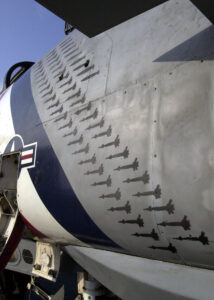
The importance of Task Force 20 was far greater than the final reveal on Lake Tharthar. It was evidence that multiple branches could work together to achieve joint success during perilous and vital national security missions.
For Cain, who went through an unbelievable number of “stop signs and bumps [that] were thrown up to try to prevent” his success as he established the JCAS system that enabled Task Force 20, it was hard to see beyond “the crap I was getting for this expeditionary force.”
His frustration continued after the missions wrapped up, when he suggested a total of 17 Distinguished Flying Cross awards for the aviators who enabled the operation’s success. Only the U.S. Air Force gave Cain’s suggested awards to its aviators. “The Navy killed every one of them,” he lamented.
Despite his overarching frustrations, Cain was clear that he felt “humbled by what I’ve heard ever since talking with [the aviators] who supported us.”
The respect is mutual.
Howe was unequivocal that Cain was “the driving force behind” the mission, which could not have happened without his leadership.
Kimberly explained that “the first guys through the door are always the ones that take it right between the eyes.” In his view, if Cain hadn’t taken on Task Force 20, then “the Navy’s going to get cut out [of the joint environment] and it’s just going to be an Air Force-Army game.” He said that it was thanks to Cain’s effort that there was “another opportunity for this connective tissue to continue to grow between fixed-wing and the black SOF community.”