
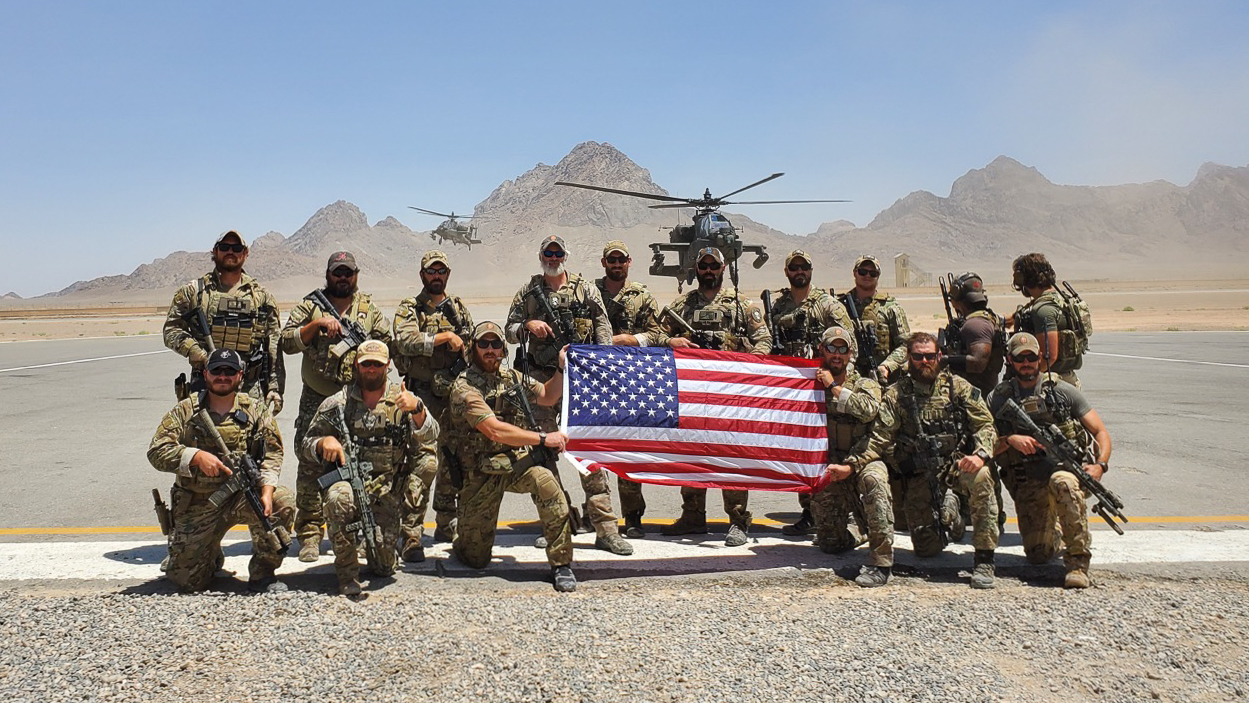
U.S. Army Special Forces (SF) engineer and intelligence sergeant Rob Kinard has “a tendency to kind of go overboard with stuff,” he admitted, while detailing how he juggles multiple business ventures and runs multiple in-demand training courses on sabotage operations.
The serial entrepreneur tells us how his working life led him to purchase a five-and-a-half-acre farm in western North Carolina, from which he runs a growing mead enterprise, Good Times Mead, and tactical support initiative, Good Times Tactical.
Kinard explains how he hopes to use both businesses to help his community and give back to veteran nonprofits that work to stem veteran suicide.
 Navy and Green Beret Service
Kinard’s 27 years of military service began when he joined the U.S. Navy. After several unsuccessful attempts to pass Basic Underwater Demolition/SEAL (BUD/S) training, Kinard was stationed in Guantanamo Bay for two years. He was on the base during the attacks of Sept. 11, 2001, and escorted some of the initial Global War on Terror-era Guantanamo Bay inmates by boat to what would become Camp X-Ray, a temporary detainee holding facility.
While working with Duane Dieter to teach the Close Quarters Defense fighting system, used exclusively by Naval Special Warfare personnel, Kinard heard about 20th Special Forces Group, a Green Beret unit attached to the U.S. Army National Guard.
Kinard joined the National Guard and went through the SF pipeline, graduating from the Special Forces Qualification Course (Q Course) in May 2008. By March 2009, he was deployed to Afghanistan as part of an Operational Detachment Alpha (ODA) in Ghazni province. During his deployment, four members of two of Kinard’s sister ODAs and his own team medic, Sgt. First Class Brian Woods, were killed.
Over the years that followed, Kinard would make 19 deployments to Iraq and Afghanistan, 16 of which he completed as a contractor. He lost several other fellow Americans during those overseas rotations.
During his final Afghanistan deployment to western Farah province between 2020 and 2021, Kinard said he took it upon himself to write intelligence situation reports to an ever-expanding email distribution list of American leaders to warn about the fragile state of affairs inside the province. He says he repeatedly explained that “if we leave, within two weeks, Farah is going to fall.”
Kinard’s predictions were later validated. The Taliban were able to re-take the Afghan capital on Aug. 15, 2021, before the U.S. fully withdrew from the country. Kinard feels that failure was not a foregone conclusion, and that with a force of between 5,000 and 10,000 personnel on the ground, the U.S. “could have kept [Afghanistan] going forever, to the point where there’s another generation that grew up under western influence that knew what freedom was and could have freed Afghanistan themselves.”
Like many Afghanistan veterans who lost fellow service members in and devoted years of their lives to Afghanistan, Kinard says that he’s “still really frustrated” about the way the war ended. He explained that he feels that the Afghanistan war will “be for us like the Vietnam War veterans.”
Kinard understands on a deeply personal level how the pain of the Vietnam War radiated through its veterans. His father was a Vietnam veteran, a graduate of the Citadel’s Veteran Students program, and a founder of the Vietnam Veterans Leadership Program. Like a heartbreaking number of Kinard’s friends, his father also ended his life by suicide, which is part of Kinard’s motivation for supporting groups who fight to improve veteran mental health and work to prevent veteran suicide.
 Giving Back
Kinard’s first batch of mead came from a brewing kit gifted to him on his birthday four years ago. It was “just honey and water, just the 5,000-year-old recipe,” he reported. He brought the results to a party in northern Virginia with his colleagues at the Defense Threat Reduction Agency (DTRA), who “kind of became my guinea pigs for the next couple of years.”
After he left DTRA, Kinard moved to North Carolina to work for a contracting agency based out of Fort Bragg. The irregular warfare intelligence analysis course that Kinard taught was taking off, more than doubling in student size after his arrival. Kinard regularly brought in high-level guest instructors, whom he thanked with bottles of mead that he was producing as he expanded Good Times Mead.
But when the number of courses likewise doubled, Kinard said it “was unsustainable.” In Fayetteville, Kinard was having struggles with his own mental health. He turned to the Special Forces Trust, whose Beyond the Battlefield program provided Kinard with paid therapy sessions that he says “probably saved my life, honestly.”
The therapist Kinard found “kind of talked me off the ledge a few times,” and also helped him “realize that I wasn’t happy living in a [Secret Compartmented Information Facility] being inside under fluorescent lights 60 hours, 70 hours a week.”
Eventually, Kinard left the contracting agency to keep up with his farm, where he has 63 fruit trees, cultivates shiitake and oyster mushrooms, and keeps four hives of bees. He recently retired from his reservist career, and now devotes most of his time to his Good Times Mead and Good Times Tactical while running a sabotage course for active-duty and reservist students several times a year. “I’m ruined now,” Kinard says. “I’ve tasted freedom on my mountain and just being my own boss and working on my own terms.”
Giving back is an important component of Kinard’s current work. In September, Kinard was invited to join the board of Veterans Healing Farm, an organization that uses agrotherapy to help veterans heal after trauma. Through his secondary business, Good Times Tactical, Kinard taught a seminar through Veterans Healing Farm on setting up a Meshtastic network, a self-healing mesh network that allows users to communicate when standard systems, including internet, cable, and phone lines, fail. He explained that this kind of skill and capability can save lives during disasters, like 2024’s Hurricane Helene.
Within five years, Kinard wants to be closer to his goal of having his own self-sustaining company, which will require 1,000 fruit trees and enough bees to produce 3,600 pounds of honey each year. As the business continues to expand and bring in more income, Kinard plans to increase contributions to the organizations that receive the proceeds from his work today: Special Forces Trust, the Green Beret Foundation, Veterans Healing Farm, and Stop Soldier Suicide.