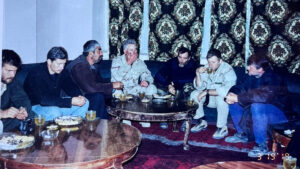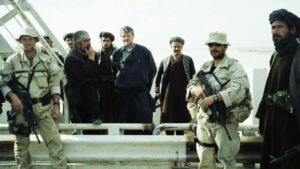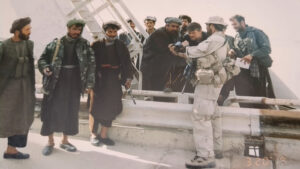

On the 25th anniversary of 9/11, members of CIA Team Alpha, the original eight-man team to arrive in Afghanistan following the world-changing terror attacks, and several Green Berets who arrived throughout the fall of 2001 in Afghanistan are gathering with their Northern Alliance counterparts for a remembrance ceremony to commemorate the efforts of the Afghan allies who enabled the earliest successes against the Taliban in 2001.
The Americans represent nonprofit Badger Six, which stood up to provide safety for those Afghan allies when their lives were endangered following the Taliban’s takeover of Afghanistan on Aug. 15, 2021.
The event will take place at the Horse Soldier Statue, next to Ground Zero, at 2 p.m. Eastern Time.
Retired U.S. Army Green Beret Col. Justin Sapp told SOAA that “on the 25th anniversary, particularly when you talk about…what became Operation Enduring Freedom in 2001, we need to highlight the role [the Northern Alliance] played because it was absolutely indispensable.”
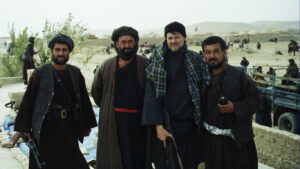
Arriving in Afghanistan
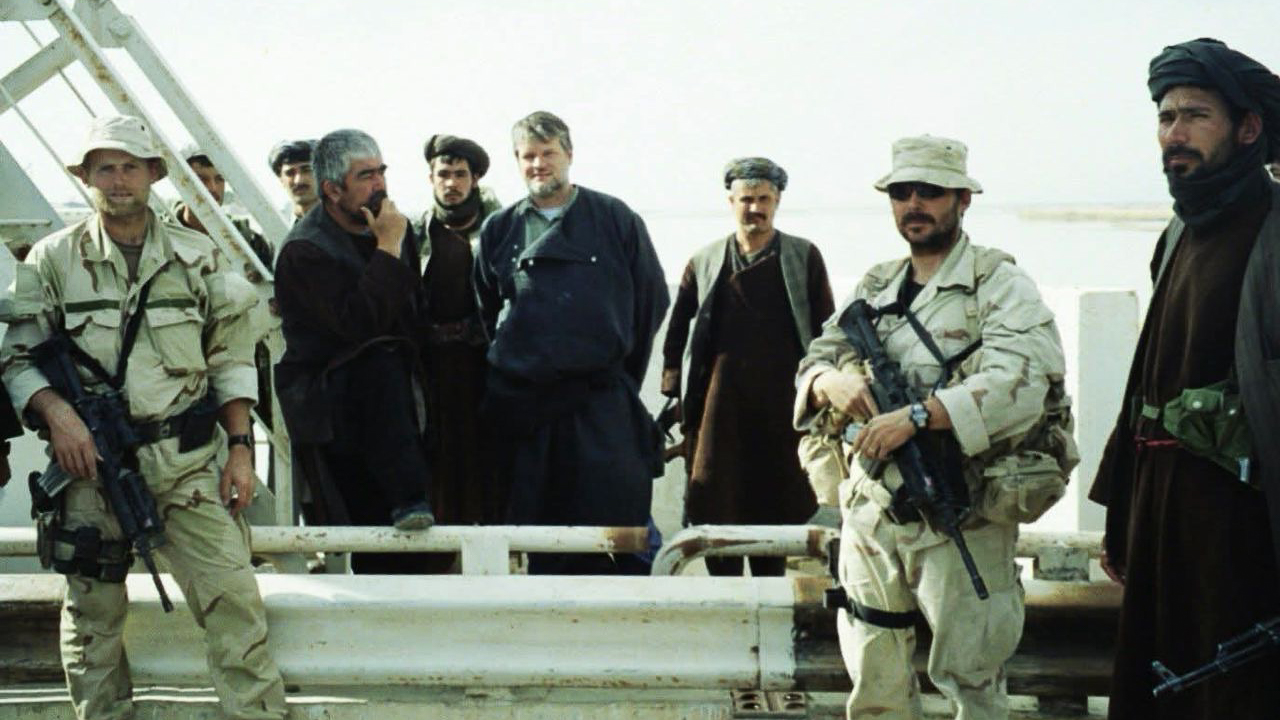
When Team Alpha landed in Afghanistan on the evening of October 16, they were the first Americans to arrive behind enemy lines and begin prosecuting what would become a nearly 20-year war. They did not do it alone.
On the ground, Team Alpha was met by General Abdul Rashid Dostum, who arrived with his Uzbek infantry mounted on horseback, Mohammad Atta Mohammad, accompanied by his Tajik fighters, and Hazara leader Haji Muhammad Muhaqiq, whose people had been subjected to ethnic cleansing and pushed into the mountains by the Taliban.
“We met them immediately that evening at midnight,” Sapp explained. We decided that we…would support them, and then pave the way for U.S. Army Special Forces who would arrive three days to four days later.”
Sapp says that Team Alpha, and later a number of Operational Detachment Alphas (ODAs) “relied on [the Northern Alliance] throughout our time, from October to December, for sustenance, for food, for water,” and for transportation in the form of horses.
At first, keeping up with the Afghan fighters was difficult. The allies “made fun of” their American counterparts, who “took a while to get conditioned” to riding on horseback for eight or more hours at a time.
Team Alpha members each brought personal skills to the unit. As a detailee from the Fifth Special Forces Group, Sapp was tasked with setting up helicopter landing zones and drop zones for the incoming Green Beret forces. The first Green Berets to come on scene, ODA 595, were tasked with calling in close air support to help the Northern Alliance forces take on a Taliban enemy that not only outnumbered them, but had more material support, including vehicles, tanks, rockets, rocket launchers, and anti-aircraft artillery that they repurposed as cannons to rip apart their enemy.
In concert with overhead ordnance, the Northern Alliance forces would conduct what were “basically cavalry charges” into Taliban forces. “We couldn’t have done it solely with air power,” Sapp said. “It was a synchronized effort.”
Team Alpha split into three elements not long after their arrival, with each group accompanying one of the three primary leaders.
Sapp’s three-person team was sent to Bamyan. He recalls that they could not have endured the 24-to-36-hour movement through the 12,000-foot pass in central Afghanistan without assistance from their Hazara guide.
As the fighting continued, Team Alpha attempted to help where they could, bringing in feed for horses who were burning extreme amounts of calories while ferrying soldiers through the mountains.
As the Uzbek, Tajik, and Hazara forces coalesced, Sapp said that their “spirit and the fighting…just got to the point where the Taliban could no longer resist.”
Eventually, the Taliban were forced to retreat to Mazar-e Sharif, where two ODAs and the Northern Alliance forces were able to break through and close around the city, forcing the Taliban to flee to Konduz province. The Northern Alliance continued the fight there until the Taliban were utterly defeated.
Not only did the Northern Alliance forces stay with their American counterparts during the entirety of the fight, but Sapp says they bore the brunt of the casualties. Sapp also noted that some allies’ lives were saved by the U.S. medical personnel who performed combat medicine, including amputations, after Taliban anti-personnel mines mangled allies and their horses.
Team Alpha also suffered a devastating loss when CIA paramilitary officer Johnny Micheal Spann was killed in a prisoner uprising at Qala-i-Jangi fortress on Nov. 25, 2001. Spann’s would be the 79th star on the CIA Memorial Wall, the first but not last attributed to the conflict in Afghanistan.
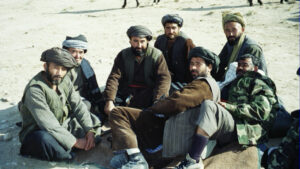
Calls Come In
Nonprofit Badger Six was born following the collapse of the former Afghan government. Micheal Spann’s wife Shannon would spearhead the effort. The name comes from Micheal’s call sign.
The group coalesced after its individual members began receiving frantic messages from their Afghan counterparts in August 2021. Sapp was at Walter Reed National Military Medical Center for an appointment when news broke on television that the Taliban were closing in on Kabul. “Shortly thereafter, I started getting WhatsApp messages from people in Afghanistan. [Retired CIA officer] David Tyson was getting them. Shannon Spann…she received them, and then it just…escalated.”
While a number of parallel efforts were underway to get allies from two decades of operations and government support to safety, Badger Six “was focused on our cohort of folks that had worked with us and their families. Many of them were actually quite senior,” Sapp said. He noted that Team Alpha’s earliest allies had not only aged 20 years, but had often risen to high echelons of government and parliament. This, in addition to their ethnic minority status, put them in incredible risk from the ethnically Pashtun Taliban.
Because most of the cohort was living in northern Afghanistan, getting to Kabul for the main airlift operation at Hamid Karzai International Airport was “mostly not an option.” The group worked to create an air bridge from Mazar-e Sharif, which “quickly was shut down,” leaving allies to egress out of Uzbekistan, Tajikistan, or Pakistan. “People were scattered everywhere, and this went on for months…a year at least of just trying to get these folks out.”
Part of the slowdown was due to the lack of bureaucratic infrastructure at the point when Team Alpha arrived on the ground. When local fighters agreed to support their American counterparts in 2001, there was no exchange of paperwork or contract numbers, which are now required to establish that an Afghan served by or on behalf of the U.S. government for a Special Immigrant Visa (SIV) or referral to the U.S. Refugee Admissions Program (USRAP). After 2021, the team at Badger Six was required “to write the narratives up to explain what they did, and who they were.”
Particularly for the allies who were making their way as refugees in third countries, Sapp says it has been an “agonizingly slow process.”
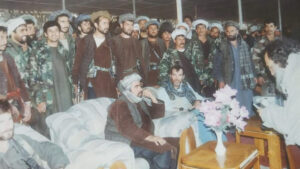
Five Years Later, Uncertainty Remains
Thus far, Badger Six is supporting about 400 people. Around half “are in limbo” overseas, because while their documentation has often been approved and they have been vetted, the programs they qualify for are no longer processing. USRAP ground to an immediate halt on Jan. 20, 2025, with the SIV program effectively shuttered after an SIV carveout was removed from the Trump administration’s travel ban in January 2026.
The other half of Badger Six’s allies have arrived in the U.S. and been resettled in northern Virginia, New York, New Jersey, Pennsylvania, and out West, Sapp reports. Getting them set up required working with established resettlement groups throughout the country who helped new arrivals find housing and work.
Sapp says that the families are doing incredibly well in the U.S., especially because their children often arrived with a knowledge of English and education that helped them assimilate quickly. Some have started businesses, and others are in college and university. A number are working in information technology, but many more are working in blue collar manufacturing jobs. Members of one family had graduated from medical school in Afghanistan just prior to the government’s collapse. They are now going through a three-year process of being certified as physicians to practice in the States.
The safety of Afghan allies who have made it to the U.S., however, is still not entirely assured. A pause in green card issuance in January has left some allies and family members without work authorization and unable to travel outside the country.
Badger Six has supported their allies by fundraising, with the majority of their funds devoted to the allies who still await assistance outside the U.S.
Five years after the U.S. withdrawal, Sapp reports that Badger Six is “going to continue to raise money. We are going to do everything we can for as long as possible until we get all our folks, the ones that worked with us, the ones that fought side-by-side with us, back to the United States.” While Sapp admits that the process “has become more difficult” while processing remains shuttered, he is adamant that Badger Six’s cohort “is an exception and they should be treated discretely.”
Sapp says that “it’s also important for future conflicts or future operations where we’re reliant on indigenous forces and indigenous people to support us. If we abandon people, we cut them loose at their time of need, that message is going to get out and it will have bad, negative implications for future operations or situations where we need the support of local folks.”