
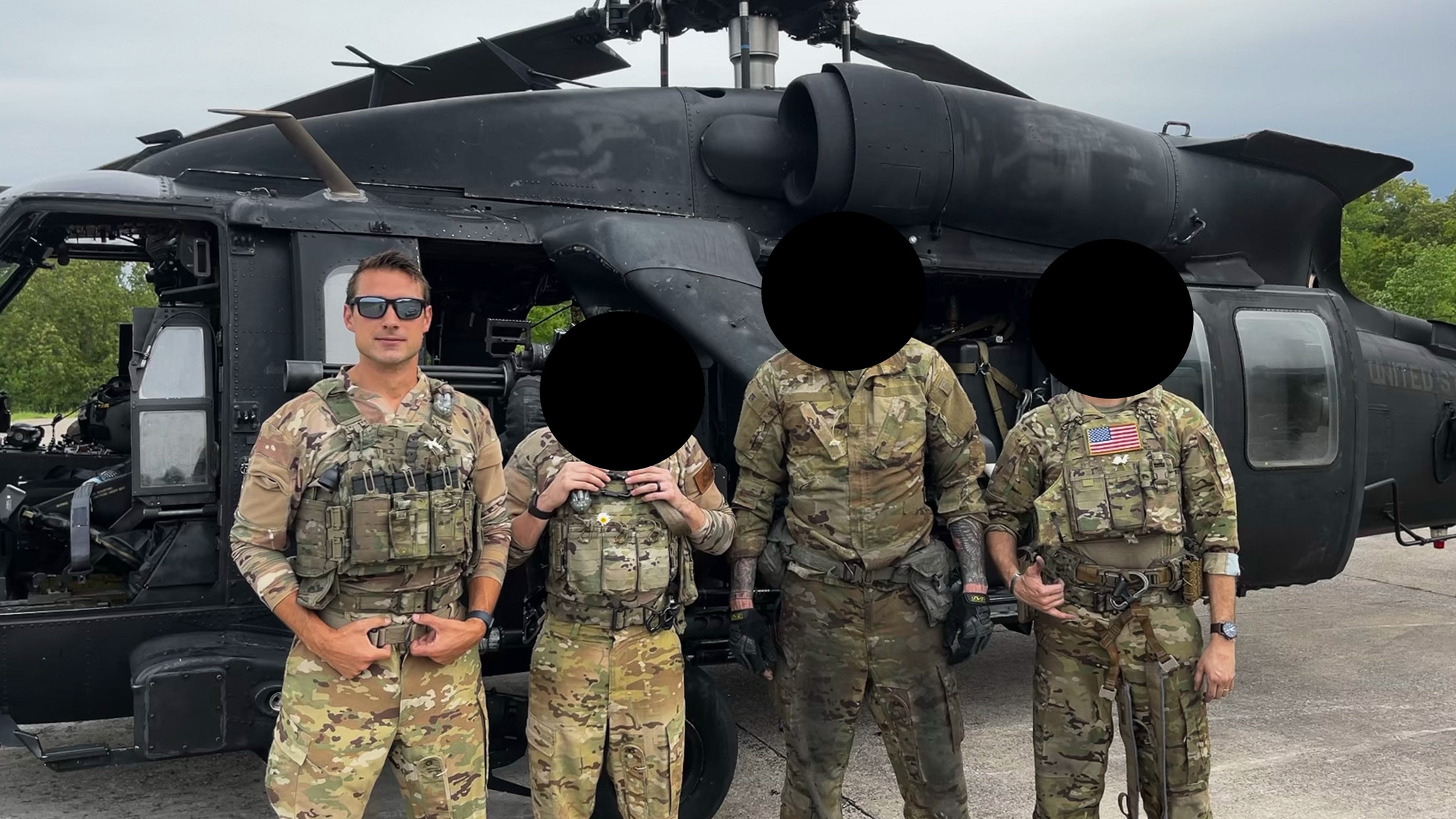
Last month, we welcomed our new president at SOAA, Jack Barry, a veteran of the U.S. Army’s 160th Special Operations Aviation Regiment (SOAR).
A longtime member of the SOAA ecosystem, Barry is already hard at work on furthering our mission and expanding our reach throughout a special operations community he knows well, especially as “irregularities” in his own special operations journey nearly led the former Night Stalker into a career as a Green Beret.
Leaving the Conventional Force
By 2017, after two years training and flying the UH-60M Black Hawk helicopter, Barry was ready to jump ship from the conventional side of operations. With the Global War on Terror winding down, he knew that “like the Night Stalkers’ creed, I wanted to be up front, where the fighting is hard.”
During his career as a pilot, Barry had submitted three packets to be considered for the assessment and selection process to join the 160th. Barry submitted his first packet in flight school, though he knew he had a “0% chance” of being invited to try out because he had yet to meet any of SOAR’s stringent requirements. By the time Barry sent in a third request, he was still short of the 160th’s required flight hours in night vision goggles (NVGs), “which aren’t easy to come by.”
When his third application was denied, Barry decided that he was tired of waiting to try out to be a Night Stalker. He decided to pursue a different special operations forces (SOF) unit and submitted a packet to join the Special Forces as a Green Beret.
Where the Night Stalkers had denied his applications, the Green Berets were happy to give Barry the chance to take part in the Special Forces Assessment and Selection (SFAS). The 24-day course at Fort Bragg was Barry’s “first exposure to SOF, and I was hooked,” he said.
The only real “suckfest” Barry had endured prior to SFAS was Survival, Evasion, Resistance and Escape (SERE) School. Though the course was grueling, in the end Barry likened the experience to a “conveyor belt” where the teachers “train you and move you along your way.”
The misery of SFAS came with a reward: the deep bonds that candidates developed while suffering as a unit through each new challenge. “I can look to my left and right and know that [my classmates] are pushing themselves to their limit to be at the front…These guys aren’t just letting the experience happen to them, they’re killing themselves to earn their place in the brotherhood. That’s such a unique and unshakable bond that’s hard to come by in today’s world,” Barry explained.
Being part of SFAS “pumped me up,” Barry said, reminding him of exactly why he wanted to escape the conventional military.
After he passed the course, Barry had orders in hand for a Permanent Change of Station (PCS) to Fort Bragg for the Special Forces Qualification Course (SFQC). Two months before his move, he received an unexpected offer from the 160th to be part of the SOAR assessment.
Though he was excited for the opportunity, Barry admitted that “it stung a little bit.” He had just dropped the bombshell on his wife that he would be leaving behind his career in aviation for the chance to serve at the tip of the spear from the ground. “She was already suffering from whiplash and then I gave her more whiplash by saying ‘Psych! I’m going to try for the 160th.’ There’s no way I was going to turn that opportunity down.”
Because the SOAR assessment would end prior to his planned PCS to Fort Bragg, Barry would still have to choose between the Green Berets and SOAR when he completed the 160th assessment. But once he was finished with the “extremely challenging” process of being assessed for the 160th, Barry said he felt “pretty confident…that I wanted to stay a pilot and fly with SOAR.”
Leaving behind the chance to become a Green Beret, Barry PCS’d to Fort Campbell for Green Platoon, the SOAR training pipeline.
Basic Flight Qualified
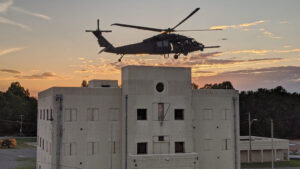
After Green Platoon, Barry was considered Basic Mission Qualified (BMQ). Assigned to his first unit as a pilot in the specially-outfitted MH-60 Black Hawk, he learned that “they don’t hand the new guy in the 160th the keys to the aircraft on the most high-profile, high-risk mission.”
BMQ pilots will “only be paired with a Fully Mission Qualified (FMQ) pilot for anything having to do with customer support, whether it’s a real mission or a training mission,” Barry explained. Customers, the moniker given to the elite units the Night Stalkers support, “will always know that, as a quality control measure, there is at least one senior pilot in the aircraft that has gone through years of additional training and evaluations within the unit.”
While he accumulated those additional qualifications, Barry saw “the secret sauce” that allowed SOAR pilots to take on unprecedented risk and “work miracles” from the air. From maintainers to crew chiefs to pilots, Barry said that all members of the 160th were “wired tight and unbelievably proficient at the fundamentals.” The high caliber of individuals in the community, the resources “to train ad nauseum,” and the specially modified equipment were a “trifecta” that enabled SOAR to “routinely do the impossible.”
The differences infiltrated all aspects of mission planning and fulfillment, beginning in the briefing environment. Barry reported that all pilots began pre-mission briefings by syncing their watches “to the second…because the service we provide is one of precision. Nightstalkers are famous for the line, ‘anytime, anywhere, arriving time on target plus or minus 30 seconds.’ I haven’t seen another organization where that level of precision is reflected in everything they do.”
The importance of combining assiduousness with technical innovations was drilled home when Barry and his co-pilot received a casualty evacuation (CASEVAC) call while performing routine nighttime deck landings to maintain currency. Several miles away, a SEAL had fallen into the ocean during training while boarding a nearby ship.
Flying a helicopter over water at night is an inherently dangerous undertaking. NVGs hardly offset the lack of illumination, and pilots can easily become spatially disoriented with darkness both above and below.
There was no margin for error in the operation to pick up the fallen crew member, but even as a brand new BMQ pilot out of Green Platoon, Barry was expected to have the proficiency to perform.
For Barry, the unexpected mission drove home the weight of the responsibility of flying for SOAR. “You have to be ready to respond in a moment’s notice and perform at a high level, in any environment, because that’s what the mission demands. Your mind, body, and equipment must be at a constant state of readiness. It’s just how it has to be.”
Blackbird Response
No matter how elite the Night Stalkers were, the unit was not immune to tragedy. Sometimes, the way that the 160th pushed the envelope in training scenarios to understand the “slim margin” between an airframe’s stated limits and how far it could truly be pushed to support SOAR’s customers could turn deadly.
Because of the crew-oriented nature of army aviation, when a fatality-producing catastrophic incident occurs, Barry explained that “typically, it’s more than one life being lost at a time.”
Barry was an FMQ pilot when an overseas training accident in 2023 led to the loss of five SOAR team members simultaneously, creating an immense challenge for team members who wanted to be present for the families of the fallen.
“In a special operations unit, it’s very common for guys to become very close,” Barry said. “When a death happens, the first funeral that occurs is not the military funeral. It’s the hometown funeral. And it’s inconceivable for a lot of us when a death happens to not attend the hometown funeral.”
Coordinating SOAR teammates’ travel to five hometown funerals quickly became a funding challenge. Though some organizations wanted to help, “none were capable of helping as quickly as we needed them.” Barry was able to raise a few thousand dollars to begin coordinating flights and rental cars that allowed members of the 160th to support the families of their fallen.
After the tragedy, Barry, a former SOAR crew chief, and the sister of a Night Stalker who had died in the accident formed Blackbird Response, a nonprofit that pays the travel costs for SOAR personnel to attend hometown funerals for their teammates.
Deciding to Depart
As Barry nurtured Blackbird Response, he and his wife had also grown their family. Deploying became more difficult as his children got older, leading Barry to think deeply about his future in the 160th. One moment of clarity about the decision ahead came on a weekend afternoon, as Barry went grocery shopping with his family.
Barry had left work on a Friday evening well aware that a looming overseas disaster was likely to require a rapid emergency contingency response. If the situation heated up and Barry were required to respond, a handheld alarm would alert him that he had one hour to arrive at his compound and prepare for departure.
Barry was at the store with two rambunctious toddlers and his wife, now experiencing a difficult third pregnancy, when the emergency buzzer began to blare. Racked with guilt, he dropped his family at their home before racing to the compound. “I felt so bad because I knew how much my wife was in the hurt locker as a pregnant young mother. She never complained, but I knew I couldn’t keep asking her to make these massive sacrifices.”
Though he “loved the mission,” Barry knew that it was time to begin transitioning out of the military.

An Off-Ramp to Transition
As he went through the transition process, Barry acknowledges that he was “about as fortunate as you could possibly get in terms of having amazing mentors and role models” and a suite of tools that were designed to increase the ease of the process. Still, he says that his departure from the military “felt so strange.”
“For the last five years, I lived with my phone on loud at night next to my head because I was petrified that I would miss a call in the middle of the night telling me that it was time to go. And that takes a real toll on you,” Barry explained.
Barry was also hit hard with the realization that “the show goes on without you” the moment a veteran departs the service.
Feeling he had “lost a sense of purpose, lost some pride, and lost an identity,” Barry arrived at the Harvard Kennedy School for a Master in Public Administration program just weeks after his final day at the 160th.
As it turned out, Barry found that “graduate school was a phenomenal transition, kind of an off-ramp from service where there’s some degree of structure, but much less than the military.” Just as he was “figuring out how to be an adult outside the military,” including determining how to dress himself in his new environment, Barry met SOAA founder Daniel Elkins on his first day of class.
Barry was wearing an outfit “one step up” from his typical default of board shorts and flip-flops when he reported “coming across this beast of a man,” dressed in a crisp suit complete with a Green Beret lapel pin.
When the two struck up a conversation, Elkins mentioned SOAA and its mission. “It was immediately apparent to me that SOAA was something I wanted to be a part of,” Barry explained. “I wanted to have an anchor in the mission that I came from,” and at the time was “running on faith knowing that I would eventually find something.”
Not long after beginning his program at Harvard, Barry joined SOAA’s Board of Advisors, and subsequently attended MIT Sloan for his MBA. As the organization began to expand, Elkins asked Barry to take a seat at the helm of the organization.
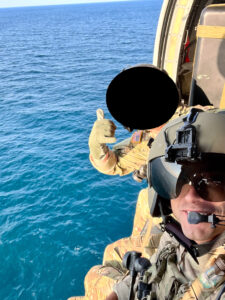 Now SOAA president, Barry is hitting the ground running. He has plans to continue the expansion that Elkins started. “I’ve always viewed myself as a connector, naturally. I love building diverse relationships across groups of people who maybe would not otherwise be in the same room.” From the relationships he formed in the Green Beret community through SFAS and the connections he made with SOF and Tier 1 units who were his customers in SOAR, Barry sees his mandate to grow the “vibrant community” of special operations personnel who make up our organization.
As that community continues to expand, Barry is intent on making sure that the quiet professionals serving at the tip of the spear are heard at the highest levels of government and protected throughout and following their service.