
If it weren’t for a weak handshake, former Marine Forces Special Operations Command (MARSOC) enabler Zac Compton may have joined the U.S. Air Force (USAF) to follow in the footsteps of his father and grandfather. SOAA’s social media and communications coordinator describes his about-face, the Marine Corps career that followed, and his post-service journey to become reacquainted with himself.
Preparing for Service
From his youth, Compton knew that he wanted to join the U.S. military. Though his early dreams of flying jets were out of reach because of red-green color blindness, Compton became a member of the Civil Air Patrol and decided to visit with a USAF recruiter to get the lay of the land about what job prospects might be available to him.
Between the recruiter’s “weak” handshake and his failure to answer Compton’s phone calls, Compton was left with an impression of unprofessionalism that made him turn to the military branch that many of his teenage friends in the small town of Milford, Nebraska, were pursuing: the U.S. Marine Corps.
The Marine Corps’ local recruiting team impressed Compton. He liked the way the Marines carried themselves and how they spoke to one another and the young Marine hopefuls. But after showing up for one of the recruiters’ workouts, Compton was unable to do a single pull-up and struggled to perform a sit-up. Instead of killing his aspirations, the recognition of how far he had to push himself “ignited something in me,” Compton said.
Compton’s father supported his son’s aspirations, but his mother was less enthusiastic. In a last-ditch effort to keep her son from the Corps, she offered to pay for his pilot training so that he could pursue a civilian aviation career. The effort was useless; Compton realized that there “was literally no other option” than to join the Marines.
At 17, he “became obsessed” with achieving peak physical condition, and by the time he left for boot camp a week after graduation in 2013, he was able to do more than 20 pull-ups and was “running a very high fitness test score.”
Compton signed a supply chain management contract, with the promise from his recruiter that he could “work [his] ass off” and move into another role if he truly wanted a different career.
Boot camp was “a huge adjustment,” but he made it through with few problems, only receiving extra Incentive Training (IT) for infractions twice in 13 weeks.
After two-and-a-half months of training for his Military Occupational Specialty (MOS), Compton volunteered for an overseas assignment with Combat Logistics Regiment 35 in Okinawa, Japan.
In Okinawa, Compton took on the Marine Corps Martial Arts Program (MCMAP) as a student, and found that he “sucked at fighting” and struggled to remember the techniques and moves. After buckling down and training harder, he attended the Martial Arts Instructor School and fell in love with MCMAP. “I didn’t want anyone to ever have to struggle as badly as I did. I wanted people to learn, and I wanted people to enjoy it,” he explained. In order to give his students “the tools they needed in their toolbox” to protect themselves in case of disaster, Compton “was running classes nonstop,” and awarded students more than 300 belts.
Compton’s efforts and early promotions were noted by his command, which decided to send Compton as one of two augments to ship off with the Command Element of the 31st Marine Expeditionary Unit (MEU).
On the boat, Compton assigned himself to the second shift, working four to midnight and enjoying MIDRATS, the midnight meal formed from leftovers of the day’s prior menu. But when the MEU leadership saw that Compton was dependable, good at logistics and operations, and competent with a radio, he was moved to morning shift. Deprived of MIDRATS, he instead began to see other doors open as he asked his Staff Non-Commissioned Officer (NCO) if he could find a way to deploy again, hopefully with an infantry unit.
Within weeks, Compton received an e-mail from a MARSOC logistics team chief, who introduced himself and told Compton that he now had orders to the elite Marine Corps special operations unit.
“First off, I’m like, ‘What’s a MARSOC?’” Compton explained. In 2015, the force was still “mythical, very much a bunch of cowboys running around.”
For a time, the MEU and MARSOC duked it out over whether Compton could depart the unit. Shortly after disembarking, he was promoted to sergeant at just 21 years old. Eventually, Compton arrived at Stone Bay, North Carolina on a Friday. He began the Survival, Evasion, Resistance, and Escape (SERE) school on Monday, with a class at the Individual Training Course (ITC) that contained aspiring operators.
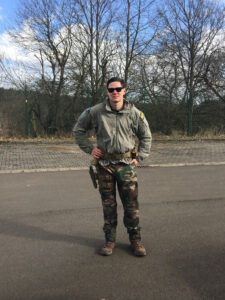
The courses gave Compton insight into the future operators he would soon be supporting and taught him “mental resilience and fortitude” and “how to be an adaptive leader.”
Part of MARSOC
The first few months in the MARSOC community “were pretty rough” for Compton. “No one really cared if you were an enabler, an operator, or what your job was. You were expected to perform at an extremely high level at all times, whatever the task was,” he explained.
Being in logistics added another wrinkle to the equation. If Compton did his job well, he “just met the standard,” but if he did it badly, then “everything is [his] fault.” To try to improve, Compton went through the uncomfortable process of seeking criticism and feedback from his peers.
When Compton’s Marine Special Operations Company (MSOC) deployed across Africa to support Special Operations Task Force North and West Africa, Compton expected to remain in Germany with several other operators and enablers for the duration of the rotation. He had been advised that logistics enablers rarely get to head into the continent. For months, Compton struggled with the contrast between his daily life on an Army base and the operations unfolding on the intelligence, surveillance, and reconnaissance (ISR) feeds he watched. He was well trained and eager to contribute, but felt far removed from the reality facing those he supported.
In mid-December, Compton got called upon to insert into Mauritania to assist in planning for reducing the U.S. footprint in the country. Compton and his friend Chris arrived at a civilian airport where they were told to “link up with this guy named Muhammad.”
Compton and Chris stood out like sore thumbs in the airport when they landed. Finding that his luggage had been stolen, Compton was left with just his cell phone and a SHOUT nano, a GPS tracker and satellite communications device that he could use to call back to command or raise alarms in the event of an emergency.
Eventually, a man walked up to Compton and Chris, introduced himself as Muhammad, and urged the men to come with him. Chris nonchalantly agreed that they had likely found the right point of contact, who told the men to hop into his Toyota Land Cruiser pickup.
When they arrived at the team house, the Operational Detachment Alpha (ODA) was conducting business as usual: shooting and training with the partner nation forces. Compton spent the remaining days of his one-week visit driving around to the facilities that had once been part of the U.S. presence in Mauritania and coming up with a plan to demobilize.
Leaving from Mauritania, Compton got a day of rest and relaxation at a beachside resort in Rota, Spain. The excursion was fun, but it highlighted the dichotomy of operators’ operational and private lives. “These guys were hitting targets one night and they would literally be slamming beers the next,” Compton said. “I’ve never seen anything like that before.”
Regardless, Compton’s time in Mauritania and with the MSOC left him wanting more. As soon as his company was getting ready to return home, he dropped a reenlistment package and was in the process of applying for the Marine Security Guard Program when his logistics chief named him for the next MSOC deployment.
Logistics enablers typically received just one deployment, while their communications and intelligence counterparts often got multiple deployments, so Compton accepted the opportunity and joined MSOC Lima for its next deployment to Africa. During a mission to Libya, he helped deliver boats to support the task force and fulfilled a less conventional but equally important logistics request: a beer run.
While deployed with MSOC Lima, Compton was selected to the rank of staff sergeant, becoming the second-youngest Marine in his MOS selected for the rank. After returning to Stone Bay, he and a friend were sitting in the barracks drinking beers and talking about the weight of their work when they decided to seek help together from the psychiatrist on base. As he began visiting his new doctor, Compton received orders to a reserve unit out of Pittsburgh, who called to inform him that they were set to deploy to the Middle East. Compton was excited for an opportunity to go overseas again, and related this to his psychiatrist during their second appointment.
The next thing he knew, Compton’s psychiatrist had informed his command that he was not fit for independent duty, and his orders were pulled.
Compton’s peers were livid about the decision. Despite multiple supporters calling both the psychiatrist and command to defend Compton in an effort to shift their opinion, nothing budged.
Compton was not only crushed by the decision, but by the fact that he was now going to leave MARSOC with “my tail between my legs” despite knowing that many of the operators and enablers he knew “were literally just drinking themselves to sleep every night, and because they never went to go see the shrink, they were considered ‘good’ in the eyes of the military.”

At Home in 29 Palms
Soon, Compton got new orders to head to 29 Palms in California to take on a new logistics role that had never been staffed and was intended to be allotted to a sergeant.
Trying to be optimistic and “make the best of everything,” Compton bought a home near his new base that he began to flip himself.
Life at 29 Palms was a significant adjustment after MARSOC. Beyond the different pace and expectations, Compton felt that many of his fellow staff NCOs were far removed from the realities of the ongoing operations he had supported. Those experiences had shaped his sense of urgency and responsibility, and he struggled to find that same perspective reflected in the priorities of his new command. The disconnect made an already difficult transition harder, leaving him increasingly certain that his own time in uniform was coming to an end.
In his new role, Compton was in charge of ensuring that all the equipment at his training command was operational. He was also responsible for training his platoon to become competent, prepared warfighters, which was a role he took seriously. Still, for months, Compton was “walking around, doing nothing” on the base, and he soon found that “an idle brain is the devil’s playground.”
When his command began seeking out volunteers to become Uniformed Victim Advocates, Compton was more than willing to volunteer for the additional responsibility.
Though he was told that he would not likely be involved in actual cases, Compton had the trust of the Marines and ended up taking on multiple cases during his appointment. In the midst of his anger and frustration, Compton said that helping Marines “was an amazing feeling” and gave him “a lot of purpose when I felt I really didn’t have any.”
Transition and Growth
Before leaving the Marine Corps in February 2022, Compton had devoted his last six months to preparing for his transition. He had been accepted into a new school, had finished his Department of Veterans Affairs (VA) disability claim, was making sure that all of his injuries were correctly documented, had money in the bank after selling his home, and had found a new place to live in Huntington Beach, California.
When he was chosen to meet with several Congressional members to talk about the experience of transition, Compton related that he was “probably going to have the most successful transition” out of anyone departing from 29 Palms in the next twelve months.
Not long after Compton showed up at Concordia University’s Irvine campus, he got a call from an old team member named Chuck.
“Yo, Compton, what up, man?” Chuck asked. “How you feeling”
“I’m so good right now,” Compton told him.
Chuck scoffed. “Ah, that’s your honeymoon phase,” he told him. “It’s gonna wear out real soon. I’m gonna check in with you in three months,” Chuck said, and promptly hung up the phone.
“Sure enough, a few more months roll around, and stuff just starts coming up from service…just flashing before my eyes, experiences, emotions. A lot of stuff dropped right in front of me,” Compton explained, and he was forced “to finally deal with this now.”
During the spring semester in 2023, he reached a breaking point where he struggled to sit in class, or even sometimes leave his house. The VA suggested that Compton was a good candidate for a stellate ganglion block (SGB) to quiet his nervous system, but when they put in the paperwork to schedule the appointment, errors pushed the procedure back another month.
Waiting for the block, Compton says, was “one of the worst moments of my life because I needed a break.”
After a month of forcing himself to keep pushing until the procedure could occur, several things happened simultaneously on the day of his appointment that made him feel as though the skies were lifting.
First, he got a call from a Marine he had met in a bar about six months before his SGB, whom he had advised to seek medical help and document his mental health struggles. The Marine messaged Compton, telling him that with help from the VA, he had gotten the appropriate disability rating and the assistance he needed to heal from his trauma. On a day when he felt he “had no gas left in the tank,” Compton said that he appreciated the message enormously.
While he waited for his procedure to begin, Compton talked with the son of the Vietnam veteran sitting with him in the waiting room and found that he was a Marine Raider and knew many of the same people Compton had deployed with. “That was just also so comforting,” Compton reported.
Getting the SGB was an easy process. Once Compton arrived back home, he was able to take a nap, marking “the first time in a year” that his nervous system was calm long enough for a rest.
“I knew that I had a fighting chance after that, and I was back…I could start being human again. I could start being myself again.”
After the block, Compton’s life took off. While running SOAA’s social media presence and bringing operators’ voices to millions of viewers per month, he has drawn thousands of followers to his personal Instagram account through his passion for photography.
Compton says that he advises anyone transitioning from the military “to give yourself time to figure out who you are and what you actually want out of life. I had school lined up, my benefits handled, and money saved. But there were still so many questions I hadn’t answered about myself, and having a plan didn’t mean I had all of that figured out.”
In his case, Compton says, “that meant moving to South America for almost three years, learning Spanish, volunteering, picking up a camera, meeting new people and trying things simply because I was interested in them. Some things stuck and some didn’t, but I started discovering what made me happy and who I was beyond becoming a Marine.”
“I’m proud of my service, and I’ll always carry it with me,” Compton says. “But I was 27 when I got out, and there was still so much life ahead of me. We leave with experiences, friendships, and things we’ve learned about ourselves that we can build on. Give yourself permission to explore what that can look like. You can be proud of who you were and still be excited about who you’re becoming.”