
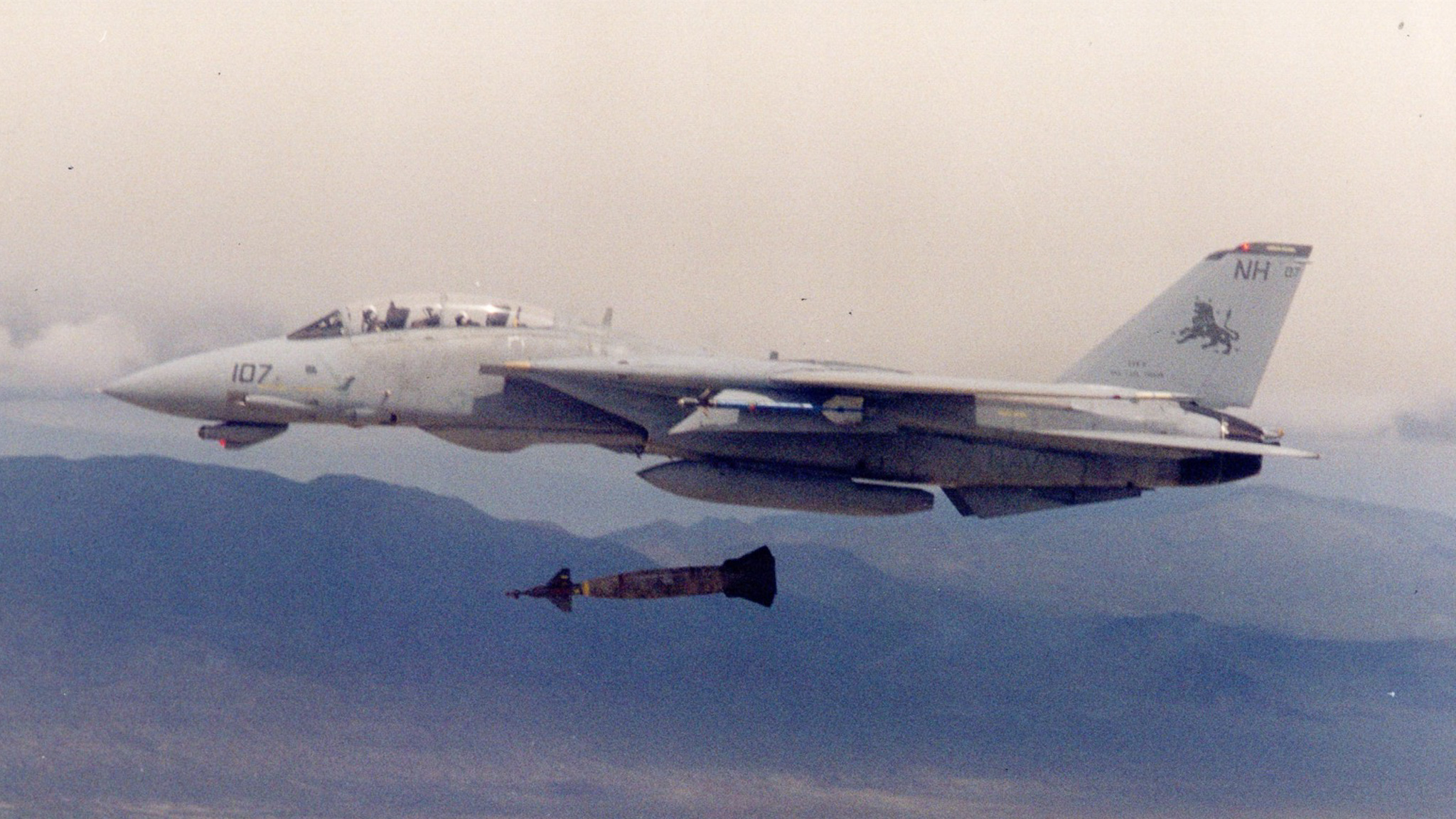
In the immediate aftermath of 9/11, a small number of conventional and special operations forces (SOF) assets had the vital task of ridding Afghanistan of Taliban forces, both from the air and on the ground. Despite dated intelligence, they manufactured success through sheer force of will and a host of miscellaneous tools like horses, battery-powered GPS systems, and repurposed weaponry.
Though the history of the early months of Operation Enduring Freedom has been commemorated in films, documentaries and books alike, one aspect has received little attention: how and when fighter jets began to use their air-to-air cannons in an air-to-ground setting to support Operational Detachment Alphas (ODAs) spread throughout the country.
The tactic first came into use in November 2001, when two F-14D Tomcats from U.S. Navy Fighter Squadron 213, the Fighting Blacklions, were called to support a small cadre of Green Berets from ODA 595 in northern Afghanistan’s Darya Suf Valley as they beat back a Taliban assault with their Northern Alliance counterparts. After each jet deployed its full loadout of laser-guided bombs, enemy forces failed to disperse. With no other friendly aircraft in the vicinity, one of the jets dipped far below the established hard deck, exposing themselves to enemy fire and using their air-to-air M61 Vulcan cannon to push back the enemy.
To gather perspectives on the little-known tactic that became commonplace during the first months of OEF, my cohost at The Fighter Pilots’ Guide to Living, F/A-18 Weapon Systems Officer Cmdr. Mitch ‘TACO’ Parmentier, and I gathered three members of ODA 595 and three members of VF-213 for a virtual fact-finding mission. While TACO and I knew that Lt. Cmdr. Michael ‘Tung’ Peterson and Cmdr. Chip ‘Biff’ King were in the first Tomcat to strafe for ground forces, we were less sure whether they had personally interacted with Capt. Mark Nutsch, Team Sgt. Paul Evans, and Junior Weapons Sgt. Mike Elmore during their tours of duty.
Unraveling that 25-year mystery started with an observation from Peterson, who explained that when people ask him about his best and worst moments in the Tomcat, he tells them that both instances “were separated by about fifteen minutes.”
“I thought I’d killed some friendlies that we were tasked to support,” he explained. “And then it turned out we wound up saving their butts.”
Peterson was the radar intercept officer (RIO) in the Tomcat’s backseat when he and his pilot, King, the skipper of VF-213, received the radio call requesting close air support (CAS) from a Joint Terminal Attack Controller (JTAC) in a jam.
“When we first get involved, it is probably one of your guys that calls us and has us walk a bunch of bombs up the hill,” Peterson said. “We can hear the gunfight going on in the background…he basically says ‘Put it on my position.’”
Peterson said that he responded by asking the JTAC to confirm that the target was danger-close to the Green Berets on the ground, meaning the team would be inside the effects of the bombs to be employed.
The response from the radio was abrupt. “Shut up and put the fucking bomb on the top of the hill,” the JTAC snapped.
After King and Peterson’s wingman dropped their final bomb on the target in question, Peterson said they asked for feedback about the effects, but “didn’t hear from” the JTAC. “We thought ‘Oh no,’” Peterson explained. “It seemed like we’d killed him.”
After “a rough fifteen minutes,” Peterson explained that the JTAC came back on the radio. “I remember him saying something to the effect of, ‘Hey, that was awesome. I’m okay, my guys are okay, my horse is okay.’” With a laugh, Peterson asked, “When do you hear a guy say, ‘My horse is okay’ in combat in 2001?”
Though Peterson was elated, he had a problem. The JTAC was requesting more support from overhead, but the Tomcat had dropped all its bombs.
“Well, what do you got?” the JTAC asked.
“Just 20 millimeter,” Peterson replied.
“They don’t know that,” the JTAC responded, referencing the Taliban forces massing on the hillside.
As Peterson described gaining permission to spray the Taliban forces with semi armor-piercing high-explosive incendiary air-to-air rounds, ODA 595 commander Mark Nutsch broke in.
“Tung, do you know what day that was?” asked Nutsch.
“It was November 5th,” Peterson replied.
“You’re talking to two of those fellas,” Nutsch said as the other ODA members on the screen smiled. “That would have been our team, and it was specifically Mike and Paul’s Tiger Two Charlie cell.”
Goosebumps broke out along my arms as TACO and I exchanged a smile on the crowded podcasting screen. Almost a quarter of a century later, we’d found the men whose lives had briefly depended on one another on and over the battlefield.
9/11 Changes the Mission
Now the highest ranking in the cohort as a U.S. Navy captain, Aviation Intelligence Officer (AI) Nate Bailey was a Lt. j.g., fresh out of intelligence school when VF-213 departed for a cruise headed toward the Persian Gulf on the USS Carl Vinson (CVN-70) in July 2001 as part of Carrier Air Wing ELEVEN (CVW-11).
Prior to their cruise, King had authorized Bailey to attend both Joint Targeting School and the ground school portion of the U.S. Navy Strike Fighter Tactics Instructor program, better known as TOPGUN. Bailey hoped the training programs would help him be prepared to put together “one or two” strike packages during VF-213’s cruise. “Little did I know that it would end up being a pretty important thing that I was a qualified targeteer,” Bailey said, explaining that CVW-11 was “sending eight strike packages a day off the Vinson starting October 7.”
As the USS Carl Vinson was underway, ODA 595 was training for personnel recovery missions on Hurlburt Field in Florida in August 2001. On the morning of Sept. 11, Elmore’s fellow Green Berets were loading their Zodiac boats onto trailers for their return to Fort Campbell when the planes hit the towers.
“We went back to the team room and we really went straight to palletizing equipment,” Elmore said. From that point on, Elmore said that the team spent every day preparing for their departure for Afghanistan, with physical training, operational training, and range time running from five in the morning until long into the night.
In the leadup to the post-9/11 Afghanistan missions, the U.S. military believed that the most important task for ground units would be locating pilots who were shot down while operating over enemy territory. Though Nutsch departed the team on Sept. 10 and Evans was slotted to depart soon after, in the aftermath of the attacks, ODA 595 was reconstituted because the Green Berets’ recent deployment to Uzbekistan and their understanding of the personnel recovery mission made them an indispensable asset.
Intelligence Preparation
At the outset of VF-213’s cruise, Bailey described how the intelligence teams within the USS Carl Vinson’s Carrier Strike Group had divvied up subject matter expertise on countries where the strike group would be operating. Bailey was asked to familiarize himself with Iran. As a reflection of its low priority at the time, a young Intelligence Specialist Seaman (E-3) was assigned to be the Afghanistan subject matter expert.
After the attacks of Sept. 11, Bailey watched the intelligence collections demands pouring in from various combatant commands and the White House and realized that their new target would be Afghanistan.
As the aircraft carrier increased speed to head toward the Northern Arabian Sea, the appointed Afghanistan expert brought out her binder and briefed the entire Carrier Intelligence Center on the country, to include the Taliban’s order of battle, their tactics, techniques, and procedures, and even the locations where the Taliban were known to emplace Surface-to-Air Missiles (SAMs) and Anti-Aircraft Artillery (AAA) like the ZSU-23-2.
The incident stuck out to Bailey throughout his career. He often uses it to inform junior personnel that “you never know when you’re going to be the smartest person in the room on the most important thing that everyone is concerned about.”
Bailey said that preparations for Operation Infinite Justice, the initial name for the foray into Afghanistan, took place quickly. As VF-213 pilots and RIOs prepared themselves for a possible air war with Afghan MiG fighter jets, Bailey informed them that every Afghan pilot carried the rank of Mullah, “which is essentially the equivalent of being a flag officer.”
“I had a little joke on the first night of the war and said, ‘So, guys, if you shoot down a MiG, not only are you a MiG killer, but you’re a flag killer.’”
That evening, Bailey walked up to the USS Carl Vinson’s flag bridge. Tomcats on the deck were engaging their afterburners in preparation for launch. It was “pitch black, other than afterburners and the lights of the carrier,” Bailey said. “As the Tomahawk [cruise missiles] started to launch out in the dark horizon, that’s when I knew, it’s real.”
Beginning on Oct. 7, Peterson said that the “first thing we did was blow up all the aircraft they had,” followed by taking out the “one semi-operational radar-guided missile site” to ensure total air superiority in the battlespace.
The Tomcats were also using their Tactical Air Reconnaissance Pod System (TARPS) to gather imagery of Taliban Supreme Leader Mullah Mohamad Omar’s compound in Kandahar and other sites that intelligence professionals believed would be associated with planning and targeting.
With every passing day, VF-213 was making fast work of the large enemy targets that were visible from the air. Soon, they would rely on the ground personnel who were massing inside the country, starting with CIA Team Alpha, and eventually including a number of ODAs, to separate friendly from enemy forces and materiel as they switched to a mission heavy on performing CAS to support troops in contact.
The ODA Mission
ODA 595 was the first team to arrive at Karshi Khanabad (K2) airbase in Uzbekistan. As they awaited their mission, they used decades-old intelligence derived during the Soviet-Afghan War of the 1980s to prepare for insertion into the country, researching the region and identifying local militia leaders with whom they may be able to work.
As other teams began arriving in K2, ODA 595 wondered whether they would get tapped to insert into Afghanistan at all. Everything changed when an Army major stopped by the men’s tent one day and asked whether Evans’ team could call in air support from a B-52 bomber.
“Why, yes we can, Sir,” Evans responded.
“Okay, be prepared to be given a mission,” the major said, turning to leave.
His assurance had been a large bluff. Evans looked to Elmore and another teammate, telling them, “Get me the procedures for doing ground support with a B-52.”
As the men made their final preparations to insert into Afghanistan, they got a surprising final word from leadership: “You Americans need to be ready to ride horses.”
Those horses would become yet another line item in a long list of people and things inside Afghanistan that would be lying in wait to kill the Green Berets when the 160th Special Operations Aviation Regiment dropped them by Chinook into their landing zone on Oct. 20.
Each man carried a maximum of 100 pounds in his rucksack for a mission that was foretold to last a year. They now knew that they would not be conducting personnel recovery operations, but would be engaged instead in unconventional warfare, operating behind enemy lines to push the Taliban out of their strongholds.
The Green Berets hit the ground under nightfall amidst a sea of unfamiliar faces. They hoped that the two men who split out from the crowd were from CIA Team Alpha, whose members were meant to spin the men up on the region and the key players. The men walking towards them were in the right place and time for the appointed link-up, but they wore local garb and had no night vision goggles. “There were a couple laser dots on them in case they were not giving the right challenge password,” Nutsch explained, elaborating that the Green Berets were “ready to fight anyone and everyone at the drop of the hat.”
As the members of Team Alpha and ODA 595 exchanged information, Nutsch watched Uzbek warlord General Abdul Rashid Dostum ride up on horseback. He immediately dispelled intelligence warnings that he was “possibly frail and in ill health” as he swung down from his horse mid-gallop and greeted the Americans.
Splitting the Team
“Within hours” of their arrival, Nutsch split his team into two six-man elements. On day three, they split once more to go “into…cellular mode,” with Evans leading a team with Elmore and another cell led by the ODA’s intelligence sergeant.
Because of their spartan supplies, Evans said that “power battery management was a huge thing.” To make the most of their resources, the Green Berets only reached back to Task Force Dagger headquarters twice a day. At other times, they would “send a burst message out and then turn the radio off.” When it came to calling in for CAS, however, the radios were used often. “I know we’re going to need a morning set of CAS, a midday, an evening, and something through the night,” Evans explained.
Coordinating strikes was difficult, not least of which because ODA 595 was sent into Afghanistan without a Special Operations Forces Laser Acquisition Marker (SOFLAM) to help designate targets for air assets overhead. “We didn’t insert with one because we didn’t know what to expect,” Evans explained. “It came in 24 hours later, and then we got others air dropped into us.”
The Green Berets were also learning in real time how different air assets needed to be directed onto targets, which Nutsch said presented “a steep learning curve.”
The priority of fire for the ODA was “things that can hurt us,” Evans said, which included tanks, artillery tubes, and the ZSU 23-2 anti-aircraft weaponry that the Taliban “would use…in a direct fire role,” backing a truck onto a hillside, leveling the guns, and “laying into our partner force.”
Eventually, Evans said that his forces were able to capture the ZSUs, “like something from a Civil War battlefield.” After that point, they had “a couple of cannons, if you will,” Evans explained with a chuckle.
Fairly quickly, the Green Berets ran into a problem. Pilots were unwilling to come down to the altitude necessary for Green Berets to talk them on to their targets. In fact, Evans explained that he felt some pilots were “adding to” the established 15,000-foot hard deck, the artificial floor established to keep aviators safe from Taliban weaponry. A number refused to come down from 25,000 feet to support missions. Soon, the Green Berets had a list of call signs for pilots who they knew would go low enough to drop effective ordnance, and a list of those who would not.
Sometimes, the Green Berets got aggressive with pilots who refused to provide adequate support. After one pilot expressed concern about possible SAM sites nearby, Elmore told the pilot that the Green Berets had found no SAMs while operating in the mountains, “I don’t give a damn what they’re trying to shoot at you,” he told the pilot. “They’re not going to fucking hit you. Screw your hard deck.”
At one point, Nutsch said that he informed a pilot who was unsure about dropping low enough to provide effective CAS that his team would “have to withdraw” if they were not able to drive off an escalating Taliban counterattack. When that argument failed to move the aviator on the radio, Nutsch told him that “if there is a SAM, fly east and eject. It’s friendly and we’ll recover you.”
That night, Nutsch got a call from then Task Force Dagger headquarters informing him that two Air Force JTACs would soon arrive in country to support the ODA in calling in strikes.
Having two more men meant two more radios and another SOFLAM. But for Evans, the additions felt “forced down our throats.” He explained that Green Berets had been forward air controller qualified to call in aircraft since the First Gulf War. He felt that the Air Force was frustrated that the Green Berets were calling for strikes “on dirt” fighting positions rather than tanks and other equipment.
To this day, Evans “take[s] offense at” the suggestion the Green Berets were just bombing dirt. “We were killing some people. We were destroying the enemy. That was our mission. Did we put one [bomb] on the ground, use it as a spotting round? Yes, we did, but then the next ones were pretty much on target,” he said.
Translating a Brown-on-Brown World
Evans admitted that “it was very difficult” to convey what the Green Berets on the ground saw to the aviators overhead. “How to communicate and get on the same sheet of music…there’s a science to it,” he explained.
One of the easiest ways to differentiate friendly forces from foes in the early days was their mode of transit.
“I remember telling a pilot that all friendlies are on horseback, and any vehicle you see north of this canyon, west of this north-south grid line, you’re free to strike,” Nutsch said.
Peterson agreed, explaining that “the [vehicle] tracks stood out like sore thumbs.” If the pilots followed them back, they found the Taliban’s armored vehicles, “and we just put laser-guided bombs on them and took them all out.”
As they spoke all those decades later, the men uncovered one of the factors that may have made discerning targets more difficult. Because of the bulkiness of the 1:50,000 military maps that Evans said his team typically carried, which differentiate targets by MGRS sequences, he carried a larger-scale evasion and escape map, typically carried by pilots in case of crash or ejection in order to find their way to a safe zone for rescue, and which discerns points by latitude and longitude.
Peterson, however, said he was flying with one large 1:250,000 map, and multiple smaller 1:50,000 maps.
To make matters even more complicated, Air Force pilots required targets to be defined in degrees, minutes, and decimal minutes. Luckily, the Tomcats’ targeting pod and ODA 595’s state-of-the-art Garmin Vista GPS units or handhelds could do the work of translating coordinates to suit the needs of assets overhead.
But when a coordinate was not available, it could cause as much frustration in the air as it did on the ground. Peterson recalled a Green Beret from ODA 555 operating in the vicinity of Bagram Airfield trying to talk him onto a target.
“Do you see the big wadi?” the Green Beret asked, referring to one of a number of dried-out valleys that would temporarily flood during the rainy season.
“I see 50 big wadis,” Peterson replied.
To Peterson’s mounting frustration, the Green Beret continued to describe the location by way of naming and numbering the small wadis surrounding the airfield.
“I almost went Samuel L. Jackson. ‘Say wadi one more time!’” Peterson said. “Because you can’t use a wadi. You’ve got to use something big. I’m up here, figure this thing out,” he continued, the frustration still palpable more than two decades later.
Targeting complications were only one shortcoming in what was intended to be synthesis between ground forces and air assets overhead.
While VF-213 nabbed imagery of the battlespace, none of the intelligence was forwarded to Nutsch’s team. “All of the intel we got throughout the entirety of that mission was 100% generated by the ODA and our partner force,” Nutsch said. “We learned what was on the other side of the ridge because…Paul went and found out what was on the other side of the ridge.”
The Battle on Nov. 5, 2001
After a little over a week in country, Nutsch explained that the Green Berets had already “slammed the door on the [Darya Suf] Valley” in November by sending two three-man detachments deeper into the area.
For the next phase of their plan, Nutsch said that his four teams hosted an area commanders’ meeting to bring together local Afghan militias and gain their buy-in to cooperate in an uprising against the Taliban.
The signal to start the attack involved sending a B-52 to “wake everybody up early in the morning” before a C-130 dropped a 15,000-lb BLU-82 bomb atop a Taliban stronghold laced with an intricate trench and bunker system. The sight of the ordnance’s distinctive mushroom cloud was meant to be a sign for local militias and their Green Beret counterparts to coalesce and fight back against scattering Taliban forces. Afghan partner forces had been warned that they should lay in the direction of the blast to avoid rupturing their eardrums, but by the time the aircraft arrived, they were “so far away from us” that Nutsch said the blast “was unobserved.”
More importantly, because the ordnance did not destroy the Taliban’s well-protected fortification, the militias were now forced to fight against a full-strength Taliban force.
In preparation for the attack, Nutsch’s teams were stationed in an L-shaped formation in the mountains of Samangan province. Evans, Elmore, and JTAC Matt held down the right flank as the small leg of the formation, with Nutsch at the pivot point and several cells and another newly-arrived ODA holding ground far off to his left.
As the day progressed, Evans’ cell was about 10 kilometers back from a position near the end of a ridgeline where Air Force assets had dropped bombs earlier in the morning. At noon, Evans and team followed the ridgeline down with their Northern Alliance allies and found themselves “in a running gun battle.” Evans’ horse stopped “dead in its tracks” at the sound of the machine gun fire, placing him in the direct path of a hail of bullets. Evans finally prodded the obstinate horse into motion once more and made for a bomb crater.
As Elmore lazed a target for an overhead asset, the JTAC communicated by radio with Peterson and King. The gunfire continued as the Tomcat dropped its ordnance on each of the targets the JTAC identified.
“As soon as the bomb run ended, there was a counter attack by the Taliban maneuvering up the hill on us,” Evans said. As the team boxed up their equipment, Peterson’s and King’s connection with ground forces had gone dead.
As Evans explained, the disconnection was “because we had 70 pounds of equipment and we were running downhill trying not to kill ourselves.”
Breaking the Hard Deck
When the JTAC came back online, Peterson and King were relieved. But when the ground forces requested additional support, it posed an immediate complication. The nearest air asset was 25 minutes out, and deploying 20-millimeter ammunition would require breaking the hard deck by over 10,000 feet.
Over the radio, Peterson called back to the Combined Air Operations Center (CAOC), not asking for permission but simply announcing that they intended to make several low passes to support ODA 595 with strafing runs.
The lieutenant general in charge of the CAOC personally approved the “request,” telling King and Peterson to “prosecute as necessary.”
Peterson says the Tomcat was at around 2,500 feet over the ground as it started its dive to spray rounds on the Taliban forces assaulting American and Afghan ally forces. Peterson also released flares, eight at a time, and BOL IR (an IR decoy) to ensure that any lucky rounds fired from the ground or handheld IR missiles would find a target aside from the Tomcat. “I did see one or two kind of smoky launches from the enemy flank,” he said, “but anything that would launch would just go right back into that flare stack.”
After four runs following virtually the same flight path, the Tomcat returned to the USS Carl Vinson, where King said that de-arming personnel on the carrier flight deck were elated to see soot smeared across the Tomcat from using the cannon.
“They’re just high-fiving,” King explained. “It was their Super Bowl.”
Peterson had a different recollection of the experience. The ship’s beloved gunner had immediately begun to give Peterson grief because the flare launchers in the missile rail had turned the jet’s paint black.
“What the hell did you do?” the gunner asked.
“I tried to give them the finger signals of guys walking with a gun, and I think that’s when he finally looked up and saw the soot up around the gun,” Peterson recalled.
The Aftermath
Immediately following the attack, ODA 595’s Northern Alliance counterparts had retreated with the Green Berets’ belongings from the high ground. Now, Elmore watched a Talib sitting on a rock at the top of the hill eating the meal ready to eat (MRE) that he had opened prior to the engagement. The Green Berets were down to eating just one MRE per day, and as a result had each lost about 25 pounds during the first few weeks of operations. Elmore took the theft seriously.
“I lost my mind,” he explained. Elmore trained his SOFLAM on the Talib, who was directly in the crosshairs as a plane roared overhead. “The last thing I remember is the dude looking up as he’s holding my MRE,” Elmore said. “Two proximity fuse rounds and there was nothing left.”
As the members of the Northern Alliance celebrated, Elmore told them to go back and re-take the hill they had abandoned.
Meanwhile, Nutsch had been attempting to reach Evans and Elmore after spotting the Taliban counterattack coalescing to their right. Unable to reach them, Nutsch gathered the militia forces he was operating with and began “galloping” to their position. “I was pretty sure they were going to be our first American casualties,” Nutsch said. But when they arrived at the team’s location about 30 or 45 minutes later, Nutsch found the men “chilling” and “regrouping.”
After exchanging batteries and ammo, Nutsch’s team returned to their positions and set up a defensive perimeter to prepare for another day of operations.
Closing Out the Mission
Nutsch said that by the 10th of November, ODA 595 was able to make it to Mazar-e Sharif, where they went “from Wild West phase on horseback to Mad Max phase.” Rather than working as a 3,000-man force in groups of 300 to 750 as they had in the mountains, the Green Berets were now in ATVs and pick-up trucks, where they had “more adventures” and more calls where they wondered if “‘this is how it ends.’” They were fortunate, he said, “to survive it all.”
For VF-213, the mission continued until December. The squadron would drop over 400,000 lbs of ordnance over Afghanistan in their three-month mission.
King said that breaking the hard deck to strafe the enemy became such a routine for him that “every time [he] went back to the carrier, he “got [his] ass chewed.” On one occasion, he “got pulled off the schedule…as the skipper of the squadron because [he] went below the hard deck.”
As the skipper, however, King said he “wrote the schedule, so [he] put [himself] back on.”
Gratitude was abundant among the six men after they finished dissecting their deployments and discussed their various perspectives on the intersection of the air and ground war in 2001 Afghanistan. Almost a quarter of a century, lingering questions had been answered, voices paired with faces, and several lesser-known moments from the past fixed into the annals of history.
For anything that remains to be shared, the men plan to meet this summer at the opening of Nutsch’s new Horse Soldier Bourbon distillery location in Kentucky. King, who already made the trip to meet Nutsch at an event in Georgia in March, said the experience was among the most meaningful in his life.