
Much has been written about the strategic gap between the United States and China, with many commentators warning that the U.S. is dangerously underprepared for direct confrontation amid China’s growing assertiveness. Amid a flood of doomsday forecasts, SOAA turns to one of its own, retired U.S. Army Colonel Edward Croot, for a clear-eyed assessment of how the United States can begin to close the preparation gap.
Multiple experts point to the accidental U.S. bombing of the Chinese Embassy in Belgrade in May 1999 as a major turning point in U.S.-Chinese relations, resulting in riots against the U.S. Embassy in Beijing and the People’s Republic of China officially declaring that the U.S. was now its chief enemy.
At the time of this important declaration, Croot explained that the U.S. was “in our unipolar moment.” After defeating Russia in the Cold War and leading efforts to police disturbances worldwide, some in the U.S. had “a view of the world where there’s not going to be any more wars.”
Any chance that the U.S. might recognize the emerging Chinese threat was lost when the attacks of Sept. 11, 2001 launched the U.S. into nearly two decades of war. For the Chinese, there were no distractions as they began to “build an anti-access area denial (A2AD)” network that integrated “all the domains of modern warfare: air, land, sea, subsurface, space, cyberspace, and information” to “prevent any adversary from massing military forces within the Indo Pacific Theater.” Croot added that “those military efforts were complemented by a deniable, whole-of-government policy of leveraging economic, diplomatic, legal, and information tools to diminish and erode U.S. influence.”
Now, without ever entering direct military confrontation with the U.S., Croot explained that the Chinese “have a 20-plus-year running head start to creating military advantage with their Unrestricted Warfare approach.” As a result, he says that in terms of “traditional war, most observers believe that we remain in phase zero,” while “the Chinese are solidly in phase two of that traditional warfare paradigm, having shaped the environment, deterred U.S. preparations, and seized the initiative across the Indo Pacific Theater.”
Croot further argues that by “preparing the environment and setting the conditions for posture and movement,” our enemy is well prepared to “rapidly transition from competition to conflict, or into phase three and total war.”
To counter this well-placed enemy’s “massive” advantage, Croot advocates for the rapid operationalization of a whole-of-government irregular warfare strategy. Although there is alignment across irregular warfare law, policy, and doctrine that the joint forces should begin taking part in Irregular Warfare in the competition space, Croot says that in the present moment, the special operations community “remains the only entity trained, manned, and equipped in Irregular Warfare.”
Realist view of Chinese territorial acquisition
Much of the Chinese strategy involves maintaining supremacy in the South China Sea, which “they see as their territory.” Irrespective of international law and the boundaries recognized in the international community, the Chinese base their maritime claims on the Nine-Dash Line, a historical boundary they believe demonstrates the limits of the kingdom.
Citing the Nine-Dash Line borders, the Chinese have built up a number of alleged commercial fishing and research endeavors on atolls throughout the territorial waters of the Philippines, Malaysia, Indonesia, and Vietnam. Croot says the manmade features are anything but innocent with their “built-out full runways that can support a C-17 type of an aircraft,” dredged-out deep water ports, and barracks. Croot says the “dual purpose nature” of the structures is most strikingly illustrated by the deployment of defense systems, including the movement of YJ-12B Anti-Ship Cruise Missiles and HQ-9B Surface-to-Air Missiles to Subi Reef, Mischief Reef, and Fiery Cross Reef in the Spratly Islands in May 2018.
The buildup in the Spratly and Paracel Islands has extended the Chinese military’s radar, missile, and combat aircraft range well into the Philippine Sea, the Bay of Bengal, and into Singapore, Malaysia, and Indonesia.
Extending its surveillance reach still further, in 2024, the Chinese conducted a second launch of classified, apparently dual-use Yaogan-43 satellites which are “understood to include optical imaging, synthetic aperture radar (SAR) and electronic intelligence (ELINT)” capabilities.
Taiwan exercise
Croot noted that in August 2022, following Speaker of the House Nancy Pelosi’s (D-CA) visit to Taiwan, the PRC demonstrated how quickly it could launch military operations on the contested island.
On Aug. 3, the People’s Liberation Army (PLA) fired 11 ballistic missiles in multiple waves across the waters surrounding Taiwan and launched “unprecedented live-fire drills in six zones” around the country. Drills on Aug. 7 involved 14 Chinese warships and 66 combat aircraft, with 13 warships and 39 aircraft continuing maneuvers the following day.
Croot described the PRC’s maneuvers as “almost a full rehearsal” of China’s capabilities, “absent the assault force crossing the Strait of Taiwan.” The rehearsal also demonstrated that the U.S.’ timeline to respond to such a maneuver is woefully inadequate. “None of the math lines up,” Croot said. “We are at a massive disadvantage in the theater.”
In February and March 2025, the PLA went still further, conducting a live-fire exercise between New Zealand and Australia in the Tasman Sea. During the exercise, the Chinese Navy circumnavigated Australia, which The Diplomat explained “suggests the PLAN is getting closer to operationalizing theater-level concepts such as blocking key archipelagic maritime chokepoints and disrupting U.S. and allied force flow and sustainment in the South Pacific, part of the PLAN desire to defeat the U.S. navy in a potential future ‘high end naval war.’”
Irregular Warfare on the Second Thomas Shoal
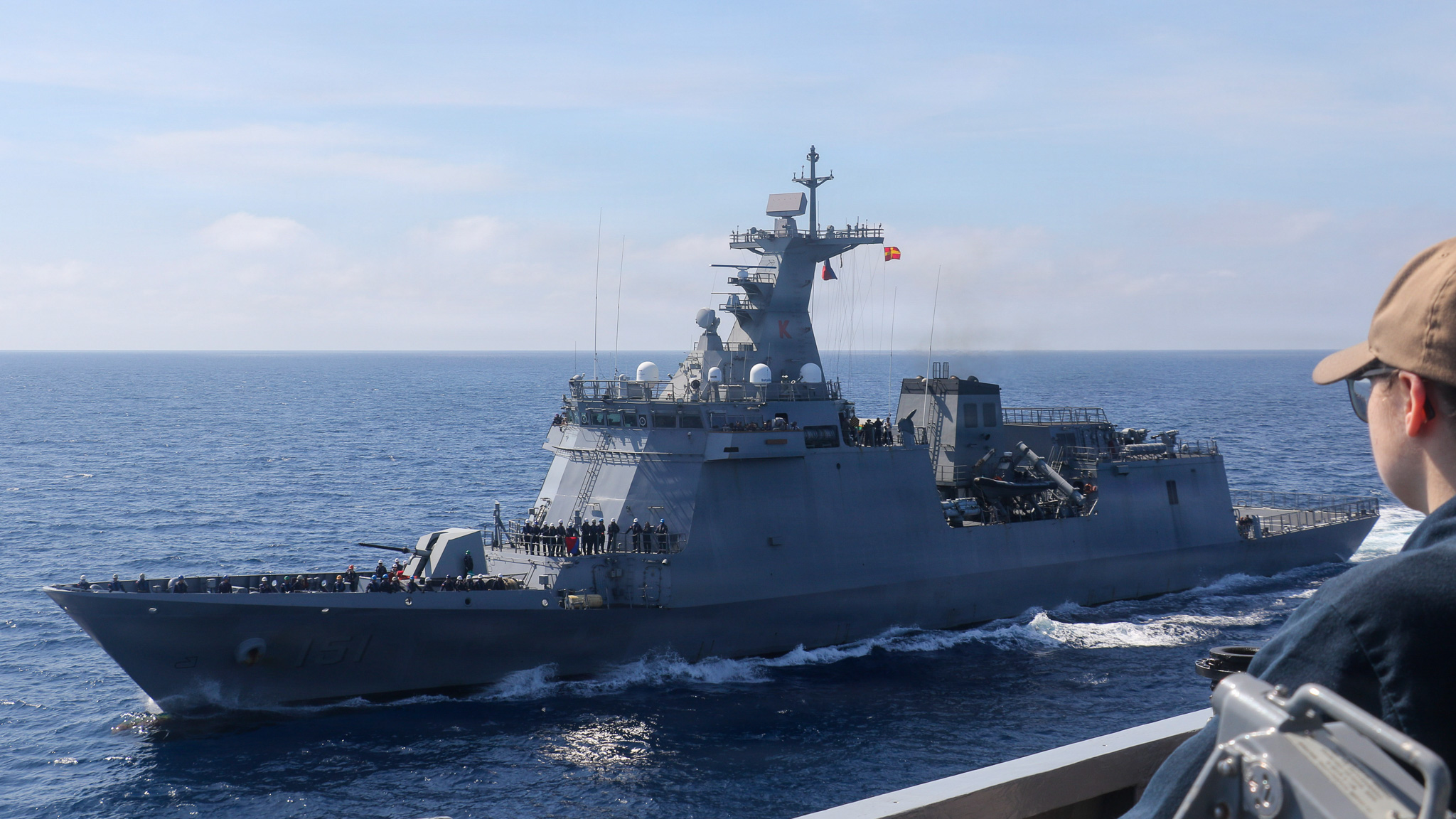
After the Chinese “gobbled up” the Second Thomas Shoal, an island that falls under Vietnamese, Malaysian, and Philippine territorial waters, Croot says the government of the Philippines decided in 1999 that they had “had enough.” The country “decided to go David vs. Goliath” by running a former U.S. icebreaker vessel ashore on the Second Thomas Shoal, stationing a company of Marines aboard the ship, and planting the flag of the Philippines to stake their claim on the island.
After placing a coast guard patrol around the shoal in 2013, the PRC began regularly harassing resupply ships. Incidents escalated in 2022, when the PRC began assaulting the vessel with water cannons and ramming the resupply boats that arrived with supplies for Marines. Meanwhile, Croot says the PRC shaped the narrative of the incidents, using video of the island and “putting their slant on it in the information space [and] in the diplomatic space.”
INDOPACOM’s Staff Judge Advocate has released updates about PRC behavior in the Second Thomas Shoal. Combining imagery of “lawless” incidents and explanations of how the PRC’s behavior breaches international law, the office, in coordination with the Armed Forces of the Philippines, seeks to “preserve peace and stability, uphold freedom of the seas in accordance with international law, and oppose any attempt to use coercion or force to settle disputes.”
Recommendations
Through RAND, the Office of Naval Research, and DARPA, Croot is working on a joint, inter-government, interagency, multinational, and commercial counter-PRC campaign to ensure that “we operationalize a targeting model that provides the commander of INDOPACOM with whole of government options….to gain and maintain positional advantage, impose costs on the adversary, influence the adversary and strategic leaders, and/or set conditions for tactical and operational disruption.”
Croot’s effort would expand the current array of instruments of national power from the typical diplomatic, informational, military, economic, financial, intelligence, and law enforcement (DIME-FIL) activities to include the involvement of commercial and other spheres.
“We need to act now to counter the advantage the PRC has built over the last 20 years” Croot said. “We need to stitch together indirect, non-attributed, asymmetric options to be able to promote, protect, or punish the adversary and provide flexible deterrent or response options to the INDOPACOM commander and the national command authority.”