
On Nov. 18, Rep. Darrell Issa (R-Calif.) reintroduced the Jax Act, legislation that would finally acknowledge an elite group of women who worked in conjunction with special operations forces (SOF) units to perform culturally sensitive tasks in both Afghanistan and Iraq.
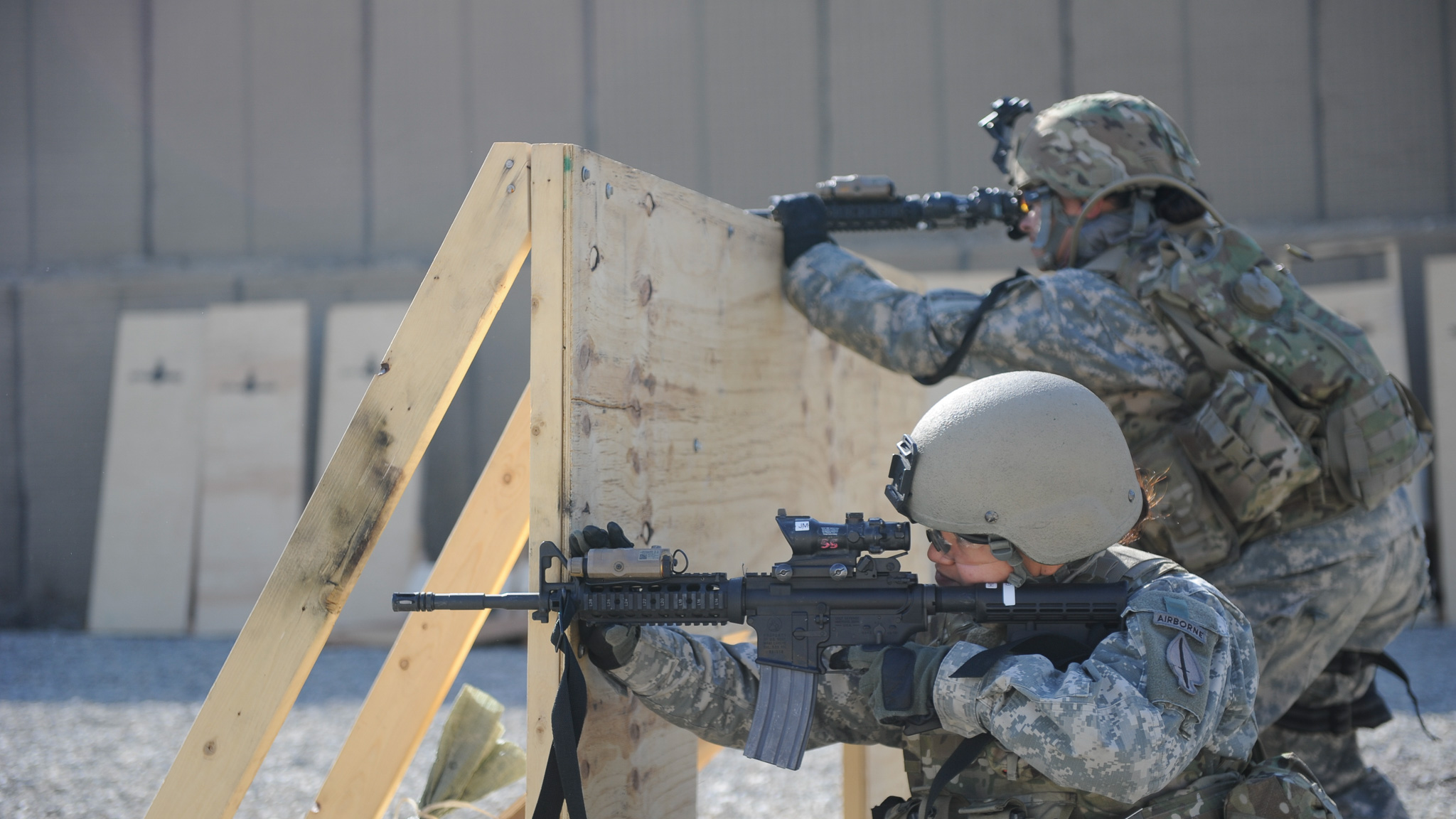
Cultural Support Teams (CSTs) were designed to give SOF teams access to women and children, a portion of the local populace which was previously off-limits due to cultural norms. Between 2011 and 2021, 310 women were sent downrange, working in groups of two or three to augment SOF units.
CST members were trained for one of two distinct missions. While forward-deployed, some conducted village stability operations (VSO) to build up host government capabilities, while others were engaged in direct action (DA) operations alongside U.S. Army Rangers, Green Berets, and other SOF personnel. Sometimes CST members also supported training for local SOF teams.
Because of the sensitive nature of their work, CST members often faced challenges upon returning home in documenting their participation in combat operations and receiving care for the injuries sustained during their service.
Former CST members Rebekah Edmondson, CEO of NXT Mission, and Special Operations Association of America (SOAA) board member Jaclyn ‘Jax’ Scott, after whom the Jax Act is named, talked with SOAA about their experiences as CST members, the importance of the Jax Act, and the need for recognition of all women who stepped up to augment combat units in Afghanistan and Iraq since 2004.
Training for Combat
Training for the CSTs was designed to be “both mentally and physically demanding,” Jax explained. The women got little sleep, because “they wanted to see how we were going to operate when we were really stressed out.” Jax said that she “didn’t realize how valuable that was until [she] was actually in combat.”
Given the dangers that the CSTs faced, Rebekah remembered that during training, instructors “really wanted to make sure that we were as prepared as possible” to avoid being “a liability to their guys who were downrange.”
As part of the training regimen, both women explained that a pervasive atmosphere of needing to prove oneself created an adversarial environment between women.
“We’re working so hard to prove ourselves and to fit in, essentially to prove our worth because historically speaking there weren’t women in that environment,” Rebekah elaborated. “So for us to try and open that door and be met with something other than resistance was pretty challenging, but it created this real climate of competition in a way.”
During training, Rebekah described how women were asked to evaluate one another, with some members being “voted off” because only a certain number of billets were available for the CST. “I think it created something of a divide amongst our own community where we didn’t trust each other, even downrange and on deployments,” she explained.
Jax brought up an additional force she has witnessed driving CST members apart. “We have the ‘Ranger girls’ and we have the ‘VSO girls,’ and I hate that divide.”
Part of the Mission
Jax saw both sides of the CST mission, first working on the VSO mission as part of CST-2 in August 2011. During her VSO deployment, Jax said she was involved in “a political, diplomatic role,” hosting numerous meetings with Afghan government personnel and locals and giving medical training. “If we didn’t have an operation that day, we were doing something on the camp to make it better,” Jax said.
During CST-2, 1 Lt. Ashley White was killed in action while supporting the 2/75th Ranger Regiment in Kandahar province on Oct. 22, 2011. Almost two years later on Oct. 6, 2013, CST-5 member Capt. Jennifer Moreno would be killed in action in Kandahar while supporting the 3/75th Ranger Regiment. Moreno was awarded the Bronze Star for valor posthumously.
Moreno’s and White’s deaths would serve as a reminder of the dangers CST members took on in direct action roles.
After CST-2 ended, senior leaders asked Jax if she would join CST-3 to support the Green Berets in direct action missions. Jax agreed, but said she “had no idea what [she] was getting into.”
Starting in early 2012, Jax supported Green Berets in seven Operational Detachment Alphas (ODAs) across northern Afghanistan. During this second deployment, Jax participated in night raids seeking out high value assets and targets and supported training for a contingent of Afghan commandos.
As a CST member, Jax participated in every aspect of the missions, from the “super detailed” planning process, to dropping from helicopters into hostile terrain with a team of Green Berets, a bomb-sniffing dog, and an interpreter. For up to four days, generally without resupply, team members would traverse unforgiving terrain under cover of night, loaded down with heavy equipment.
Rebekah was part of CST-4, deploying in November 2012 to work on a direct action mission with Rangers who were training elite Afghan Ktah Khas units. As part of her efforts, Rebekah also helped to train her female Afghan counterparts, members of the Female Tactical Platoon (FTP).
“It was utter chaos,” Rebekah recalled, explaining that the dangers of the mission aside, it was a challenge in and of itself to be “going after bad guys at night with limited visibility…trying to walk around the mountains of Afghanistan at night under night vision and not bust your ass constantly.”
Jax explained that the CST program transitioned from U.S. Army Special Operations Command (USASOC) control to Joint Special Operations Command (JSOC) ownership after 2014. While the program was administered by JSOC, Rebekah continued to redeploy with the Rangers and FTPs over several subsequent missions. She grew closer to the members of the FTP out of a shared understanding of how their gender impacted their perception in a combat environment. Over the years, Rebekah would watch as the women of the FTP took increasing ownership of operations and came into their own as a unit.
Today, Rebekah continues to support the FTP personnel she trained as a CST through nonprofit NXT Mission. Though many are in the U.S., they face serious challenges with status and many have not been successful at reunifying with their families in Afghanistan. “All the advocacy in the world has felt almost hopeless. We’re still trying to brainstorm and think of ways to show up for them,” Rebekah explained.
Proving Oneself Becomes Dangerous
Both Jax and Rebekah explained that being part of the CST meant demonstrating their value while deployed. For Jax, that meant doing more than carrying her standard 100 pounds of gear on missions by volunteering to carry a 35-pound THOR, an improvised explosive device jamming system. “I wrecked my knees a lot,” she explained.
Jax described walking during missions in spread-out lines across uneven irrigation ditches with night vision goggles, and occasionally falling face-first to the ground, getting up, and continuing to march on as her SOF brothers checked in via radio.
“I’ve gotta prove myself. I’ve gotta prove that I’m strong, I gotta prove that I’m capable. I’m putting all this literal extra weight on myself just to be able to show up in that space…it did lasting damage,” Jax explained.
Taking part in direct action missions brought on other serious injuries.
During one mission, Rebekah was concussed after a wall crumbled on top of her when a flash-bang thrown over a compound wall set off the grenade held by someone on the wall’s opposite side, creating “a double explosion effect.”
Rebekah said she recalled “being pulled from the rubble, being shaken awake, [and] not knowing what the fuck was going on.” In the middle of a mission, Rebekah still had to do her job. Fortunately, the incident was logged in Rebekah’s medical record while she was still deployed.
Jax experienced a host of injuries to her head during her deployments, which included exposure to concussive weapon overpressure. Additionally, Jax recalled crossing into a compound using a portal ladder to climb over a wall and falling headfirst to the rocky ground, jamming her night vision goggles into her head. When she stood up, Jax said she felt as though she had “a marble in [her] head, just kind of shaking around.”
The initial pain of that injury eventually faded, to be replaced by short-term memory loss, severe social anxiety, and other side effects that are the hallmark of traumatic brain injury (TBI).
Finding Support – and Acknowledgement – After Service
The CST program was not intended to be an enduring mission, and it had many points of failure. Without an official after-action review process, there was no means to identify or improve upon problems with the program. More strikingly, there was no system in place to administratively support CST members from the outset of the program through its conclusion. This meant that the units CST members served with were tasked with documenting their participation. In cases like Rebekah’s, CST service was documented well. For Jax and many other CST members, it was not. Given the clandestine nature of their operations and the lack of understanding in the wider military that women did participate in combat operations, proving combat service and receiving appropriate benefits and medical care for CST members is often a struggle.
When Jax sought care at the Department of Veterans Affairs for her rucking-related knee problems, her records contained no proof of her combat service with the Green Berets. “Nothing was documented properly,” she explained. As a 27- or 28-year old Staff Sgt., she said that she “didn’t know that [she] could basically push back and ask for proper documentation.”
When Jax subsequently sought care for TBI, she says the Colorado National Guard forced her to “go through and start a formal investigation” despite having multiple letters attesting to her injuries.
Where the VA failed to assist her, Jax says that SOAA helped her access two different TBI clinics that “literally changed [her] life,” helping with the injury that had “crippled [her] for years.”
Overwhelmed by the uphill battle with the VA, Jax reached out to Representative Issa’s office for assistance in 2022. While Jax told one of Issa’s staffers about her issues, the staffer asked how many other women were dealing with the same problem. Jax told the staffer that a better question would be how many women do not have the same issues.
It was at that moment that the Jax Act was born.
While supporting the Jax Act’s passage, Jax also hopes to expand efforts to all the groups of women who have augmented their male counterparts in battle during the Global War on Terror. “All the women that served in these roles, the Lioness, female searchers, the Female Engagement Teams, we all had an impact and everything that we did mattered,” Jax explained.
“The Jax Act is the starting point, not the finish line,” Jax said. “Once we can get this started and we can pass this, we can continue that push, the momentum. I would love to see in my lifetime more bills that support more of these programs, more of these women.”