
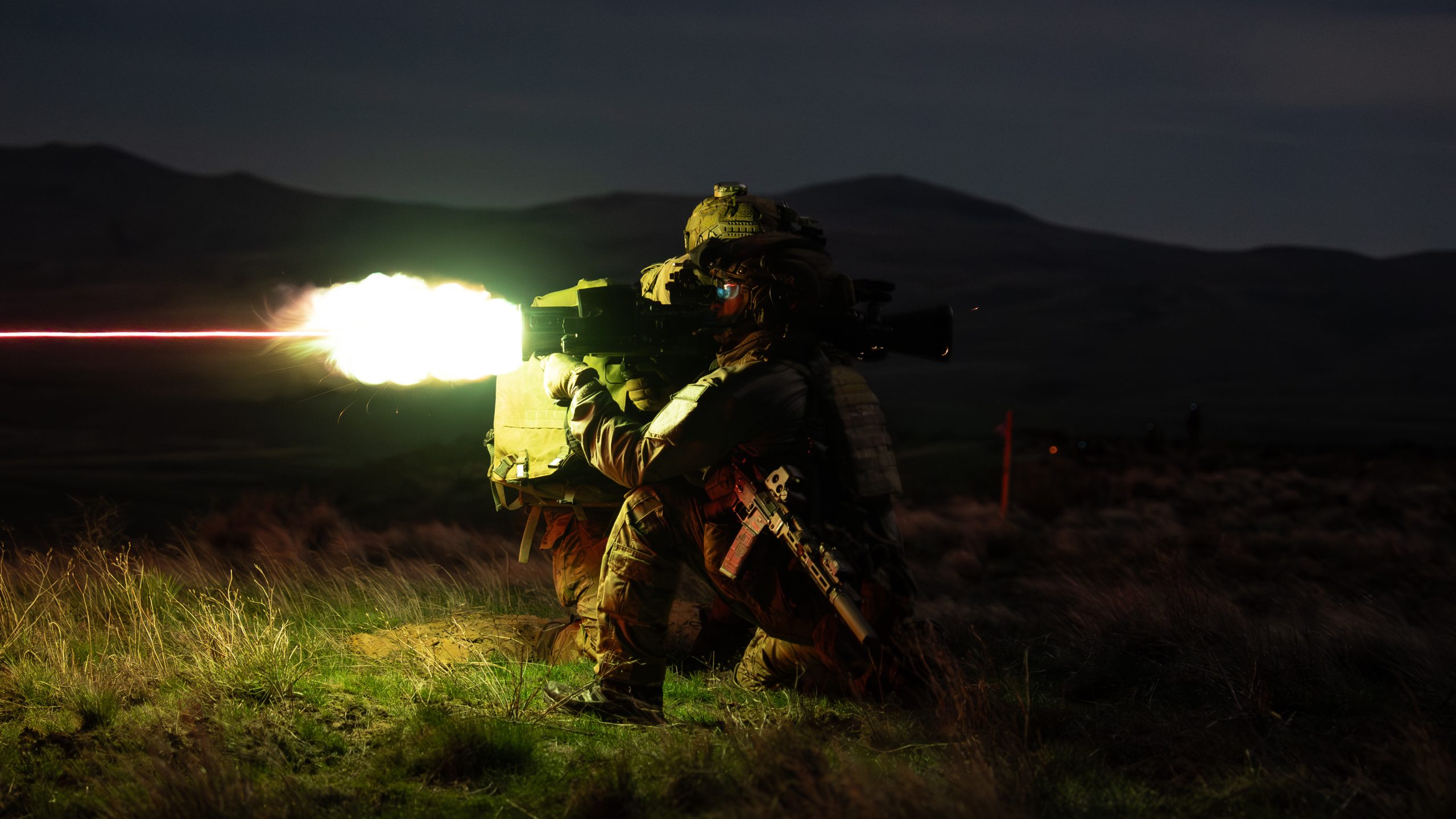
There are few weapons systems as respected and beloved by warfighters as the Multi-Role Anti-Armor Anti-Personnel Weapon System (MAAWS), better known as the Carl Gustaf 84 mm recoilless rifle. The man-portable, multi-purpose weapons system packs a punch in combat. It can also strike back on the special operations forces (SOF) personnel who wield it.
The 22-pound M3 Carl Gustaf system was introduced to the 75th Ranger Regiment in 1993, and came into use by the U.S. Special Operations Command (SOCOM) four years later. A 2016 conditional materiel release approved the system for use by conventional forces.
Tracking usage of the Carl Gustaf is vital. A U.S. Army Special Operations Command (USASOC) spokesperson told the Special Operations Association of America that the M3 system has a service life of 500 full-strength rounds, with each shot recorded in a physical logbook. The spokesperson said that the newer M3A1 and M4 models “have an extended service life of 1,000 rounds due to design improvements and the inclusion of an automatic shot counter.”
In addition to ticking off trigger pulls on the weapon, service members are instructed to limit their daily usage of the Carl Gustaf because of the overpressure the system generates. For SOF personnel like Jens Rippy, a retired 18 Bravo (Weapons Sergeant) from the 3rd Special Forces Group, the weapon was too important on the battlefield to adhere to limitations.
Carl Gustaf on the Battlefield
Rippy told SOAA that he used the Carl Gustaf in operations between 2009 and 2019. At the time, he said gunners were directed not to put more than six rounds through the Carl Gustaf in a 24-hour period, with an assistant gunner’s max exposure capped at ten rounds.
“The way we utilize the round in a firefight, especially SOF, you can’t abide by that standard,” Rippy said. “I shot 18 rounds in an hour and a half at one point myself.”
On another occasion, Rippy described training an entire infantry uplift platoon to operate the Carl Gustaf in the course of one day to prepare for an upcoming operation. That meant acting as assistant gunner while 32 infantrymen put a single round through the Carl Gustaf.
When he returned to base, Rippy reported throwing up, then being “pretty much down for the count…for two days.”
Up until this point of his career, Rippy said he was always “the one pulling the trigger.” He now believes that assistant gunners are “more exposed to overpressure than the gunner,” given how they are “buttoned up directly to the back of the system as it’s getting fired.”
Rippy also noted that there were different regulations on shooting the Carl Gustaf in the prone position when he utilized the system, with a cap of one exposure per day for a gunner. Rippy said that with the weapon “diagonally over your back,” the blast wave compresses the chest cavity “way down to the point where you kind of feel like your heart stopped for a second.”
Despite the dangers of using the Carl Gustaf, Rippy says it is an irreplaceable asset in the battlespace. “The mental effect, the sheer fear of getting a recoilless rifle fired upon you is way greater than a rocket-propelled grenade (RPG). The RPG is almost comical, because it’s a very slow-moving round. You can kind of see it. With a recoilless rifle, you hear the noise and the next thing, there’s an impact.”
The use of the Carl Gustaf noticeably impacts the enemy’s desire to fight: “Just by having the weapon system introduced…they don’t want to play anymore,” Rippy said.
Feeling the Effects
Between exposure to explosive breach charges, incoming RPG rounds, and pressure waves from the Carl Gustaf, Rippy said that operations sometimes left him “disoriented and dizzy” and experiencing “immediate short-term memory loss.”
This impacted him on the battlefield. “I had to be told things numerous times,” Rippy said, with teammates sometimes “actually grab[bing] [him]” asking him what was happening.
“After a few operations in a row with heavy exposure,” Rippy reported having medium-term memory loss that left him confused about the events he participated in. After operations, if Rippy did not write down details, he said “they would all bleed over. I would throw facts from four different operations thinking it was one, not being able to really identify when it was, where it was…it just kind of all gets jumbled up.”
Rippy “came up with systems” to help himself manage the situation in combat, but later in life, his brain would continue to mix up events going all the way back to his childhood. He says the scrambling “has affected me making stronger bonds,” explaining that he can “come off as standoffish” when he does not volunteer information about his life. “It’s really just because I don’t want to lie to the person that I care about,” he said. “If I don’t know the information or can’t unscramble it, then I’m just not going to put it out there.”
Rippy did not want to address these issues when he returned home because he wanted to return forward with his teammates. Like fellow SOF personnel, Rippy said that to remain deployable, he “had the vision test completely memorized,” “knew exactly when to push the button” on the hearing test, and “knew exactly what to click on during the TBI test.”
In recent years, Rippy sought help for persistent issues at an Intrepid Spirit Clinic for traumatic brain injury support. A year of therapy helped Rippy address vestibular connectivity complications on his left side. He also reports regaining some of his balance after previously being unable to turn quickly “without falling over.”
Now, Rippy hopes to get continued care from the Department of Veterans Affairs to support ongoing recovery.
Although Rippy is now retired from SOF, the Carl Gustaf is not.
Research on the Carl Gustaf
The last decade has seen increased efforts to research and mitigate the impacts of overpressure.
In a 2015 joint research study, investigators used sensors to track overpressure generated by the Carl Gustaf, the Light Anti-Tank Weapon, the RPG, the MK19 40-millimeter Grenade Launcher, and fragmentation grenades. In testing, 87 percent of blasts exceeded 4 pounds per square inch (PSI), the ‘safe’ threshold for blast exposure. The Carl Gustaf produced more overpressure than any other tested system, with 56 percent of blasts exceeding the testing threshold.
A 2018 report from the Center for New American Security noted that 7 percent of service members exposed to three rounds of Carl Gustaf fire experienced small brain hemorrhages. The report recommended enforcing firing limitations and having service members utilize sub-caliber training rounds whenever possible.
A November 2023 study in Military Medicine journal suggested alternate physical positioning for those manning the Carl Gustaf to lower their overpressure exposure.
This research appears to have led to changes. USASOC’s spokesperson mentioned a number of tactics for reducing overpressure exposure, including redesigning shoot house firing positions, increasing distance between shooters, stopping Tier 1 weapons from being fired simultaneously on the range, using more virtual reality and simulation during training, changing breaching techniques, and using suppressors and other materials that reduce blast impact.
USASOC’s spokesperson also told SOAA that USASOC personnel “strictly follow the guidance” from a training manual that limits gunner and assistant gunner to six points in one 24-hour period, with points determined by firing position and ammunition type. As an example, the spokesperson described how firing a 3.2 kg HE 441D RS 84 mm round would translate to 1 point for a kneeling shooter, 1.5 points for a standing shooter, and 3 points for a prone shooter.
The spokesperson explained that if the 6-point limit is exceeded in combat, “impacted individuals and teams” must take a break from firing the weapon and be cleared by medical staff before resuming operations.
The USASOC spokesperson said that “our people are our competitive advantage and therefore their optimal health is our responsibility. As new techniques, technologies, and medical best practices emerge, we will continue to incorporate them quickly to ensure we continue to provide unequalled Special Operations Forces to the joint force and to the nation.”
Lt. Cmdr. Kassie Collins, U.S. Special Operations Command spokesperson, told SOAA that there is “currently no lower-overpressure variant of the MAAWS up for procurement.” Collins explained that the newer variant of the MAAWS system was not designed to decrease overpressure, but “aimed at lowering the weight, shortening the barrel, and providing a new sight system”
Breakthroughs will help protect warfighters on active duty, but for those whose exposures predate new guidelines, additional research on brain care and access to treatment are needed.
Although the point system adopted by USASOC is praiseworthy and represents a meaningful step forward, combat rarely affords the luxury of adhering to ideal limits. As Rippy’s own experience illustrates, when the fight demands overwhelming firepower, SOF personnel will reach for whatever system gives them the decisive advantage–overpressure risk or not.
No soldier plans to fire eighteen Carl Gustaf rounds in ninety minutes or act as an assistant gunner for an entire uplift platoon in a single day, but battle does not unfold according to policy. Rippy’s long-term struggles with memory, balance, and cognition show the human cost of those moments when mission requirements override safety guidelines.
Efforts to minimize exposures, refine firing positions, and integrate new technologies are essential, but they must be paired with a commitment to fielding future weapons that deliver the same battlefield dominance with far less physiological harm. For the next generation of operators to fight–and return home–at full strength, reducing overpressure at the source is not just prudent; it is imperative.