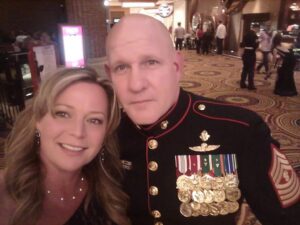

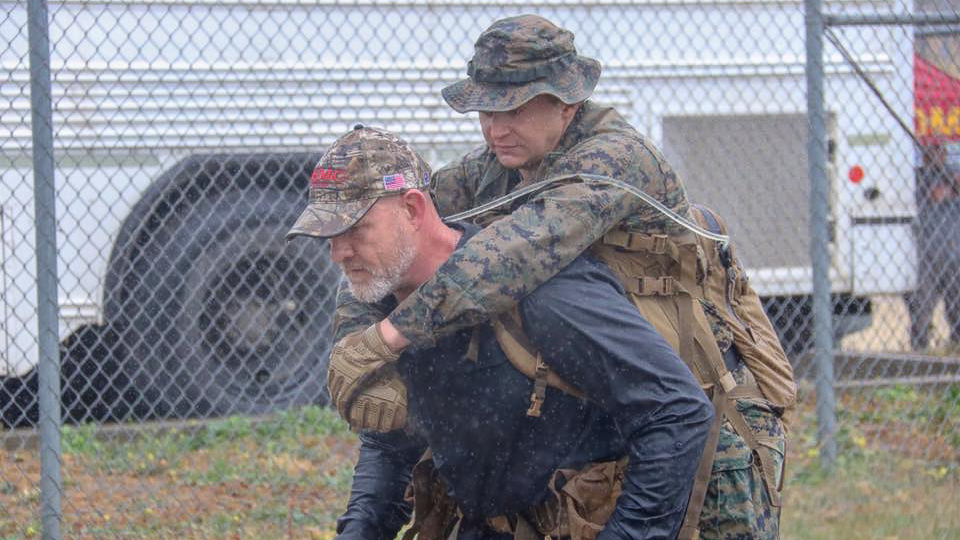
When Master Gunnery Sgt. Chris May left the service after six years in the Marine Corps infantry and 18 years as a Reconnaissance Marine, he never gave much thought to how the accumulation of exposures across his service impacted his life. But when he went through the INVICTA Project in July 2023, May tells SOAA about how he found healing, and how he now brings that path to other veterans and law enforcement personnel looking to improve their lives.
 Service Leaves A Mark
Before finding the INVICTA Project, May tried a number of methods to combat the traumatic brain injuries he accumulated during six combat tours. Over nearly a quarter century of high-intensity deployments, free-fall operations, breaching activities, shoot houses, and mortar and rocket use, May said that “We were overexposing ourselves for years, on a daily basis.”
Towards the end of his active duty career, May was a guest speaker at a Panama City U.S. Marine Corps Ball when then base commander Hung Cao, now Acting Secretary of the U.S. Navy, personally recommended that May visit a hyperbaric oxygen therapy (HBOT) chamber.
During his 40 HBOT dives, May found improvement. By the 11th or 12th dive, he explained “I came out and my vision came back, my clarity, everything was clear.” It was the first time that May recognized how “miserable” he and many of his service member friends had felt for years as “whatever element we wake up with that morning is the new normal.”
After retirement, May checked in at an outpatient traumatic brain injury (TBI) clinic to assess his brain health. After just half an hour, staff informed him that he was “going to be here for a while.”
For four months, May was working to improve his brain health in the TBI clinic prior to retirement. He later entered the contracting world before joining corporate America and climbing the ladder to become the owner of three large primary accounts for a major brand. Before long, May was struggling with burnout as he realized that “my attention to detail was lapsing, my ability to multitask was reduced. I was getting frustrated, and I finally told them…I’ll step back a little bit.”
At the time, the Marine Reconnaissance Foundation (MRF), of which May is one of the founding board members, had partnered with Parker University to participate in the INVICTA Project. May was the third participant in the INVICTA Project in 2023 and said the program “literally was a game-changer.”
The INVICTA Project invites participants to bring in individualized goals based on their own passions. May, a competitive shooter, wanted to sharpen his vision, which had been growing noticeably weaker.
After undergoing the program, he came out feeling mentally clearer. At his first long gun shoot after completing the program, he cleared all his targets within 83 seconds. “I was like a 12-year-old kid,” he enthused. “I was like, ‘This works!’” Invigorated by his success and not wanting to return to his prior level of commitment, May told his company they had 45 days to hire someone to help with his workload, or that he would leave.
While May began sending other friends and sponsors to the INVICTA Project, he returned to contracting in 2024. While home between contracts, the president of Parker University contacted May to inform him that the previous program administrator had departed.
May’s wife told the president that May was available to assist.
For the next 90 days, Parker University brought May on as a contractor to rewrite all the INVICTA Project’s processes and procedures. The changes helped the program expand participation from 9 participants in 2024 to 36 participants in 2025. With around 40 participants so far in 2026, May hopes to close the year with 50 successful completions.
Thus far, the INVICTA Project has hosted members of every service branch, with the exception of the U.S. Space Force and the U.S. Coast Guard. It has also welcomed members of the law enforcement, fire, and EMS communities.
 How INVICTA Project Works
The INVICTA Project is a two-week neurorehabilitation program designed to combat not only the effects of TBI, but of the overall allostatic load that veterans carry after a career in service. The program involves multi-modal care from doctors, chiropractors, neurologists, and physical therapists.
One month prior to arriving for outpatient care, all participants go through a mental health screening. A sleep study determines whether and what sleep aids participants would benefit from, and provides participants with a 12-month plan to improve the quality of their sleep. Baseline lab panels also examine each participant’s hormonal, metabolic, micronutrient and gut health, allowing supplementation to be in place prior to the intensive two-week program.
The main component of the INVICTA Project is the two-week outpatient care regimen. This begins with an additional testing battery to determine each participants’ gait, balance, oculomotor function, cognitive performance, musculoskeletal issues, and neuromuscular performance.
Every day, participants go through a three-and-a-half-hour workup to target areas of concern. First, participants undergo a half-hour cardiovascular warmup followed by an hour of activities focused on neurological health, including oculomotor work, balance stabilization, or addressing other baseline deficits. An hour of musculoskeletal work follows, using sports rehabilitation modalities to address mobility or structural issues. Finally, a one-hour recovery concludes the day with functionalities like red light therapy, massage, or localized cryotherapy. At the end of each day of support, participants return to a local hotel rather than living in an inpatient therapy center.
May says that failure is built into the program on purpose because it is important for Type A personalities who have “never failed anything in their life” to experience a shortcoming. Local mental health practitioners are on call for participants to manage the frustration they feel, but May said that the cohorts who go through the program together also bond over their shared struggles. “It alleviates all those negative thoughts right away because then it’s a couple of guys who have issues,” he explained.
Prior to departure, clinicians come up with individualized plans for each participant to follow so that they can keep improving on their goals after they return home.
Though the program itself is brief, participants sign a one-year contract when they agree to go through the INVICTA Project. Following their completion of the two-week program, participants get monthly check-ins from program administrators to ask whether they are doing their homework, or if they need additional support from a physician. The neurologist checks in at 30 days post-program, and then at 90 days, six months, and one year out from finishing. The INVICTA Project can also help participants if they find they need inpatient mental health care after completing the initial program.
 Success and Follow-Through
Among the many success stories the INVICTA Project has shared online, one comes from retired Navy SEAL Hershel Davis. Davis said he was recommended for the INVICTA Project by his chiropractor based on memory issues that came on in his early 80s. He reports that the program not only helped with his balance and his gait, but “covered me from stem to stern.”
The self-reported results of participants in the INVICTA Project demonstrate the impact the program has on those who go through it. Post-concussion symptoms improved for 87.5% of patients, anxiety scores improved for 92.3% of participants, and depression scores improved for 100% of participants.
The INVICTA Project falls under Parker University, but May is now overseeing the creation of a foundation that will give the INVICTA Project 501(c)3 status, allowing it to fundraise outside of Parker University and continue to grow in years to come.
Part of that growth involves keeping up with their previous participants. May notes that TBI “can subside and come back,” underscoring how important it is for the INVICTA Project to maintain touchpoints with previous participants, teaching them to be “engaged enough when they start to see that they’re having issues” so “they can raise their hand and go, ‘Hey, I need a tune-up.’”
May, in fact, has gone through the program twice. “I literally walked into the clinic one day, and they’re like ‘You’re going back through the program,’ because a lot of those symptoms had started to come back.”