
When Americans abroad find themselves kidnapped or detained by a foreign government, navigating the long path to safety requires a highly specialized toolkit of knowledge and expertise. The four-person team at the nonprofit organization Global Reach brings well-honed skills from the CIA, the Department of Defense, the National Security Council (NSC), the FBI, and the Israel Defense Forces to bear in the delicate interplay of leveraging domestic institutions and foreign governments to help Americans detained by terrorist groups, criminal gangs, and unfriendly nations worldwide come home again. And unlike organizations that ask families to pay for their services, Global Reach provides their assistance at no charge.
When a family calls on Global Reach after a loved one has been taken by a foreign terror organization or by a hostile government, the organization’s work starts by determining the background of the case. “We have to do a lot of due diligence,” Global Reach Chief Strategy Officer Eric Lebson told SOAA. “We have to make sure that this person wasn’t going there to commit a crime, that they were targeted because they are American or that they were treated worse because they are American.”
From this point on, Global Reach works with one immediate family member of the detained individual and coordinates with responsible agencies in the U.S. government, including the State Department, the FBI, the NSC, and the intelligence community, to provide context on the detainee’s situation. On occasion, Lebson says the organization works through and with third countries.
One primary tasker for the nonprofit is to train family members to advocate for their loved one. “Most don’t have experience navigating Washington,” he explained. “Oftentimes they’re so respectful that they miss the opportunity to press for action. We help train them on how to go into a meeting, how to share information, how to get information, how to recognize what they have learned.”
If the family decides to share their loved one’s story with the media, it often entails countering domestic victim-shaming narratives and outright smear campaigns designed to give foreign countries cover for utilizing American citizens as leverage. “When foreign governments grab Americans as political bargaining chips, they like to operate under the veneer of legitimacy by alleging they broke a law. They even sometimes put out disinformation to make the detained American appear less sympathetic,” Lebson said.
With all those tools engaged, Global Reach is often able to achieve a positive outcome for Americans taken hostage.
A Success – Bringing Robert Gilman Home
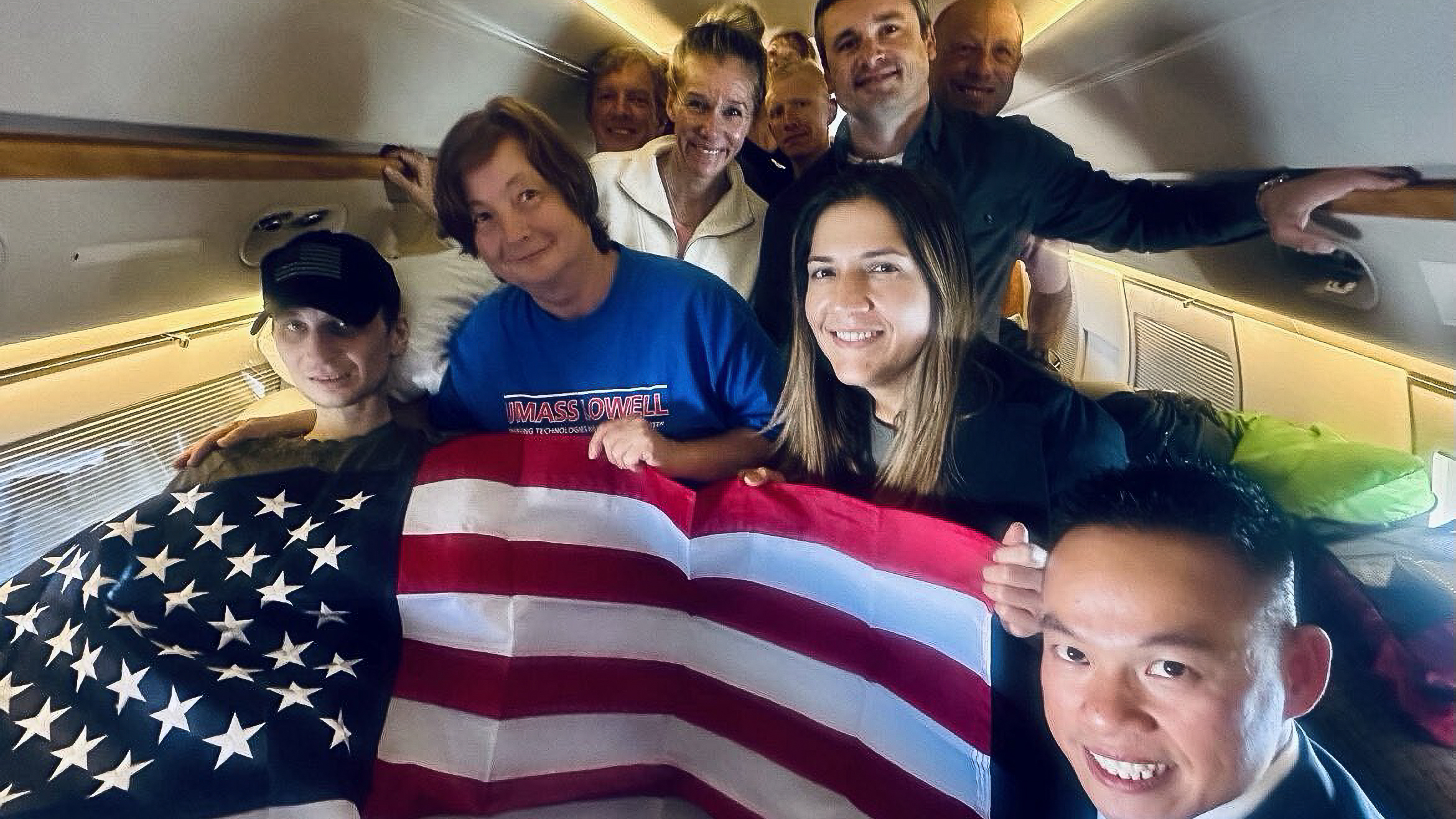
Global Reach’s latest success came on August 11, when they welcomed home American teacher Robert Gilman after 26 months of tirelessly advocating for his return during a four-year detention in Russia.
The margin for that victory was too narrow for Lebson, who told SOAA that the former Marine was near death in a Russian hospital by the time a deal could be reached to obtain his release.
When Lebson related the story of Global Reach’s quest to bring Gilman home, he started with an anecdote from his visit last week to check in on Gilman and his family.
Lebson explained that visiting released Americans after they return to their country is “a difficult part of the job.” While Lebson becomes close with a detained American’s family, Global Reach always insists that the imprisoned family members are not informed of the organization working on their behalf. Only after their release do Global Reach’s beneficiaries learn of the relentless efforts undertaken on their behalf.
“We never want to involve the detainee in the advocacy effort because we don’t know who is listening on the phone and we don’t want to create false hope that a release is imminent,” Lebson said. “The detainee has all day long to think about what is or what could be done to get them out. We just want them to remain physically healthy and mentally optimistic.”
A success can also shift the dynamic that necessarily develops between a hostage family and the Global Reach team. Lebson grew close with Gilman’s father during the course of his son’s detention, with the two sometimes talking on the phone up to three times a day. But Lebson said that last week, he finally let Gilman’s father do something “I’d never let him do” while Gilman was detained. “I let him buy me something,” Lebson explained. “He bought me an ice cream cone, and it was the best ice cream cone I’ve had in forever.”
Lebson explained the significance of the event to Robert. “Your father pulled his money out and handed it to the clerk before I could even put my order in, and he did that because in all the time we’ve been working together, I haven’t let him pay for anything,” he told Gilman.
“When you’re being held overseas, your parents are fighting for you every single day, and they’ll do anything. It puts a special burden on people like me to not allow them to be exploited. And your father and I both know exactly what happened. I let him buy the ice cream because you’re home and you’re free.”
Finding Help
For an American overseas to receive special assistance from the U.S. government to achieve their release, they must typically be designated as wrongfully detained. The process for such a designation begins with submitting a letter to the Secretary of State invoking the Robert Levinson Hostage-Recovery and Hostage-Taking Accountability Act, signed into law in 2020.
This act contains eleven criteria that can help inform whether a person qualifies for designation, but Lebson says “it often falls on the family to make the argument for which of the criteria apply and encourage the State Department to act on the designation.”
Wrongful detention can be established on a number of grounds, including when the U.S. has information to establish an American detainee’s innocence, proof that the detainee is being detained because of their citizenship or in order to extract policy-related or monetary concessions from the U.S., or detainees being denied due process or subjected to inhumane treatment and conditions.
Once the Secretary of State officially designates an American as a wrongful detainee, the Special Presidential Envoy for Hostage Affairs (SPEHA) can begin advocating on their behalf with a foreign government. Lebson says that many families of Americans in overseas detention “engage with the Bureau of Consular Affairs for years” without understanding “that the officials they are talking to are not advocating for a release,” which only occurs if the SPEHA is engaged.
When Gilman first was sentenced to four-and-a-half years in a Russian prison on a bogus charge of “hooliganism” in 2022, his family secured a large, well-respected law firm to submit a letter to the State Department to request Gilman’s designation. Lebson said the firm charged $67,000 to write the letter, but never achieved a formal designation for Gilman.
Global Reach, which compiles such letters for no charge, was “disturbed” to hear about the fee the Gilmans paid, Lebson said.
Once Global Reach became involved in the case, Lebson and his team developed sources who “helped us build a profile of how [Gilman] was being mistreated.” That file would be provided to the State Department as a confidential addendum to Gilman’s letter to the Secretary of State in 2024. It went into detail about the psychological torture inflicted upon Gilman, the drugs he was forced to take, and the treatment he was receiving, including being forced into isolation or compelled to exercise for up to 16 hours per day.
Despite the vast evidence of Gilman’s torture, Lebson says that the Biden administration’s NSC “did nothing about it.”
By the time that Gilman was officially designated during his last 50 days of captivity, he had another five-and-a-half years tacked on to his sentence for striking back against guards who were physically provoking him. The constant stress and trauma of his circumstances had also caused him to fall into a dissociative stupor, a condition in which the body physically shuts down. A dissociative stupor can be deadly, and Gilman had to be fed through a feeding tube for the 47-day duration of the condition, Lebson reports. As Global Reach continually received updates about Gilman’s diagnosis, a doctor eventually warned that he was not certain whether Gilman would survive to see the following day.
“We eventually got to a point where we were thinking that he was either already dead or was going to come out of this in such a bad situation that he would resemble Otto Warmbier,” Lebson said, referencing the University of Virginia student held captive in North Korea who was in “a vegetative state” when American officials finally obtained his release. Warmbier died six days after returning home.
In a last-ditch effort that Lebson described as “heroic,” Gilman’s mother, Nina, decided to fly to Russia to attempt to see her son, hoping that her voice would draw him out of the stupor.
When Nina arrived in Russia, she obtained a Russian court order to visit her son. When guards outside refused to allow her to enter Gilman’s hospital room, it only amplified concerns about Gilman’s state. Global Reach flagged the development to the Trump administration and alerted a Reuters reporter to Gilman’s precarious health. For two weeks, the reporter waited on elusive attempts at a back-channel dialogue that never elicited a Russian response. When Reuters finally went public with Gilman’s story, it was enough to “break things free” and achieve a solution between Russian and American authorities, Lebson explained.
Gilman was moved to Moscow, where his mother waited with personnel from the U.S. Embassy. Though her son was non-ambulatory, gaunt, and pallid, he was able to speak as they helped him board the American plane that took Nina and Gilman home.
“I can tell you that if we had been one or two days later, he would have died,” Lebson said. “That’s the opinion of medical professionals. We’ve done cases in Russia for years, and this is the worst treatment of an American we’ve ever seen. This was active terrorism.”
Global Reach’s Cases
Today, Global Reach’s advocacy continues for Americans in other “habitual offender countries.” These include Mahmood Habibi, who was taken by the Taliban’s General Directorate of Intelligence in Afghanistan in August 2022 following the U.S. airstrike that killed al Qaeda senior leader Ayman al Zawahiri, seismologist Dr. Youlin Chen in China, and Kamran Hekmati in Iran.
In Russia, Global Reach is fighting to bring home another five Americans: Andre Khachatoorian, Aleksandr Antonov, David Barnes, Chuck Zimmerman, and Olga Jezler. To make matters more difficult, some detainees are held in facilities that are in “high-risk areas close to Ukraine,” making it impossible for U.S. Embassy staff to visit them and check their conditions. Lebson reports that the U.S. Embassy “has never spoken with Olga Jezler, a Legal Permanent Resident of the U.S., whose status is protected under the Levinson Act.”
Lebson especially noted that none of the five Russian detainees the group is assisting has been designated as wrongfully detained, despite each detainee “qualifying for designation.” He also reports that many of these detainees are also experiencing diminishing health conditions.
While he applauds the Trump administration for bringing over 100 Americans home since he took office in 2025, Lebson implores them to formally designate detainees in Russia so that the State Department can have the needed leverage to achieve their return.