
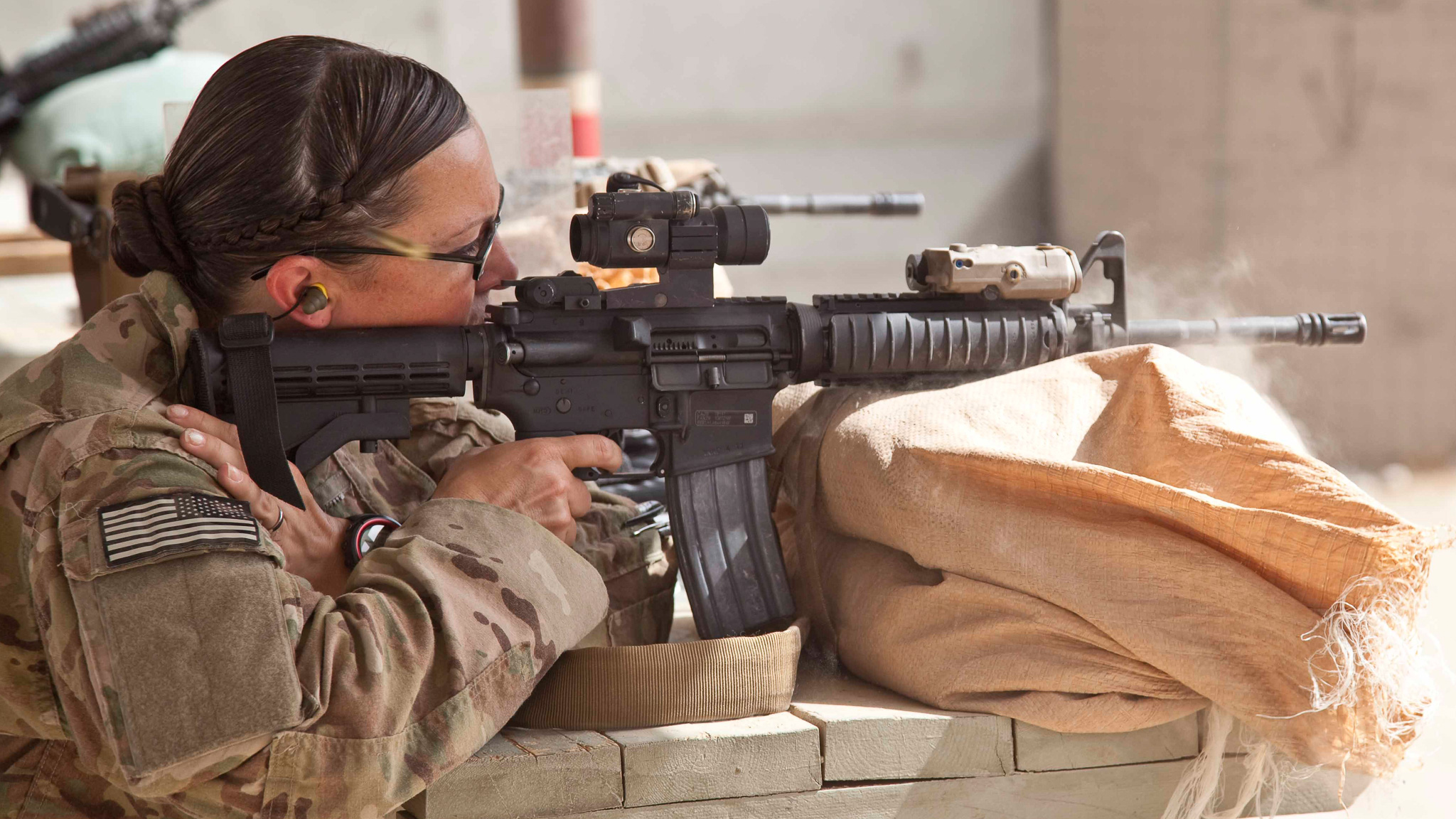
Jaclyn ‘Jax’ Scott served with the Cultural Support Teams (CSTs), groups of women who received elite special operations training to take part in village stability operations or augment special operations forces (SOF) on multi-day, direct action missions to nab high-value enemy targets.
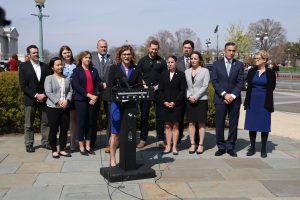
Following her special operations service, Jax and other CST members fought to prove their combat service and to receive proper medical care for injuries sustained while operating in the CSTs. Rep. Darrell Issa (R-CA) championed their fight, introducing the Jax Act as a means to secure recognition for all women who took part in the CST mission.
In support of the Jax Act and in acknowledgement of the unique and invaluable role the CSTs played on the battlefield, SOAA is sharing insights from CST members who spoke to Jax, a SOAA board member, about their roles in Afghanistan and what recognition of service would mean to them. Some members, marked with an asterisk, chose to use pseudonyms to protect their identity.
Meghan* – CST 2
As part of CST 2, Meghan deployed to Afghanistan to support direct action missions in August 2011. Those missions required fast-roping into battlespaces alongside SOF teammates, moving to compounds where high-value enemy targets were known to be located, engaging with an enemy who did not hesitate to return fire, and taking part in site exploitation, to include gathering biometric information from the dead. If members of her team were wounded during a mission, Meghan and other CSTs added more gear to their full loads and returned to base.
On one occasion, when Meghan found a vital piece of information stashed in an infant’s garments, it was proof that expanding SOF’s cultural access was indispensable.
Unfortunately, when Meghan returned to her unit after her CST mission ended, it was not to the recognition that she had enhanced the military’s SOF arsenal and gained valuable skills. Instead, other unit members suggested that Meghan’s CST deployment harmed her promotion prospects and diminished her ability to support her unit. Some leaders wanted Meghan to remain quiet about her CST role, which was never officially described in her military record.
More trouble came when Meghan sought her disability rating from the Department of Veterans Affairs and found that none of the medical support she received in Afghanistan had been logged in her records.
Despite the difficulties she has faced as a result of her service, Meghan wants neither praise nor sympathy. Through the Jax Act, she hopes the world will acknowledge that women in the SOF space are “professionals whose work directly shapes outcomes.”
Theresa*
In her direct action role on the CSTs, veterinarian Theresa was paired with a Pashto-speaking partner and an interpreter. Their team was tasked with searching Afghan women and entering Afghan compounds to speak with local women about the Taliban’s intimidation tactics. Establishing an easy rapport with the women, Theresa reported that behind closed doors, “they would tell us everything.” Once the Taliban got wind of the CST’s work, however, Theresa said they began targeting the locations the CST visited.
Despite her success during the mission, Theresa reported being frustrated by gender discrimination, which led to “major issues with depression and anxiety” both during and following her deployment.
Because there was limited knowledge of the CSTs back home, Theresa said she “just stopped talking about it and tried to put it all behind [her.]”
Lisa*
During three rotations with Tier 1 units as a CST member, Lisa reported that she “secured, safeguarded, and engaged with approximately 1,700 women and children.” On one occasion, she described how her efforts kept her strike force leader from detaining a man who had allowed the Taliban into his compound, not out of malice towards the U.S., but because the Talib had threatened to kill his family if he did not offer hospitality in accordance with the local custom of Pashtunwali. Her decision that night helped U.S. forces “win hearts and minds instead of creating more enemies.”
When Lisa eventually transitioned out of the military and began to pursue a doctorate, she said that she “felt like an outsider” and that “the hidden and suppressed wounds of war began to surface.”
Starting her “personal journey toward post-traumatic growth” helped Lisa integrate into civilian life. Now, she calls for civilian institutions to bring on veterans, who are “strong leaders who know how to accomplish the mission while taking care of our teams” because “we still live to serve.”
Molly* – CST 3
As part of CST 3, Molly never doubted that leaders saw her as a valuable, respected, and essential part of the team. She explained that when her company commander saw that a platoon leader had taken Molly off the manifest for an upcoming mission to save weight, he told the platoon leader to take him off the manifest instead.
Still, being part of the CSTs has had its difficulties for Molly, putting a strain on her personal life on account of tensions with her partner. She said it was “difficult to reconcile the confidence, autonomy, and responsibility [she] had in combat with the expectations waiting for [her] at home.”
In addition, because there is so little societal understanding of the CSTs, Molly reported that she often feels “like [she] is walking a fine line between clearly articulating” the CST mission “while also not wanting to come across as arrogant or self-promoting.” She believes that “true recognition would remove that burden” and allow CST service to be “understood without constant explanation.”
Raquel – CST 2
Between 2011 and 2012, Raquel served with CST 2 to ensure that SOF personnel had access and influence to and within the female Afghan population which “routinely changed the intelligence picture.” According to Raquel, “our contributions were not nice to have. They were operational requirements” and “unquestionably altered outcomes on the ground.”
Raquel pointed to one mission, when she “revealed a threat the team had not detected” by quickly gaining the trust of women inside a compound the team was clearing.
Returning home, Raquel said, was “more difficult than the deployment itself.” With “no MOS, no doctrinal home, and limited understanding of the [CST] mission,” she had no clear pathway, and “found [herself] having to justify [her] service while trying to reintegrate.”
For Raquel, the Jax Act “corrects a gap in the historical record,” ensuring that the women of the CSTs are acknowledged for “perform[ing] combat-essential duties” like “execut[ing] mission-critical tasks under fire” and “carr[ying] the same risks and operational burdens as our male teammates.”
Col. Amanda Clare – CST 2
Operating with MARSOC, Green Beret, and SEAL teams as part of CST 2, Col. Amanda Clare explained that her “access and understanding…could not be replicated by a male teammate, no matter how well trained.” Building a bridge with a female population which had not been reached in a decade, Clare argued that she and her teammates “added understanding of the environment, improved decision-making, and provided a relational layer that tactics alone could never achieve.”
A lack of understanding and care on return from her CST mission left Clare struggling. Physically, a badly healed ankle sprain received in the field would send chronic pain reverberating through her body for years. With no mental health support for processing her combat deployment, Clare developed post-traumatic stress disorder (PTSD), severe depression, an alcohol use disorder, and panic attacks and anxiety.
While trying to receive assistance, Clare said that she had to “constantly justify [her] service,” explaining that “where male SOF veterans are often met with admiration, I have been met with skepticism.”
Claree explained that, for her, recognition means not having to justify her story for it to be honored, and “acknowledging that what I did helped pave the way for the women who followed, including those attending Ranger School or SOF assessments today.”
Gladys – CST 2
Gladys reported that while working with SOF units in Afghanistan, she “was able to bring de-escalation through [her] presence alone, because female operators can shift the energy of a room instantly.” By reading body language, microexpressions, and interpersonal tensions, she said she “obtained information that was otherwise unattainable and ensured a more accurate understanding of the human terrain.”
In her CST role, Gladys said she “spoke with Afghan women who were terrified [and] held children who did not know who to trust,” while searching rooms men could not enter, gathering “intelligence that changed missions,” and making “decisions that carried real-world consequences.”
Her role “was not easier, gentler, or less dangerous. It was the same risk, with additional cultural complexity, emotional weight, and the pressure of being one of the only women in the room while carrying yourself like you belonged there.”
Being “part of the fight,” Gladys said, “cost [her] pieces of [herself she is] still recovering.”
After three deployments over four years, Gladys said that returning to her role as mother to a high schooler was difficult, and she had trouble being present as she relearned “how to breathe without scanning a room” and “how to be needed in ways that did not involve missions, intelligence, or life-and-death decisions.”
For Gladys, recognition is not about parades and awards, but about being able to “bridge the woman who fought in Afghanistan with the woman who returned to the United States and was expected to be the same.”
At SOAA, in addition to advocating for the passage of the Jax Act, we strive to honor women’s participation in SOF. If you are a woman with SOF service, please reach out to our staff writer at [email protected] so we can help share your experience with our audience.