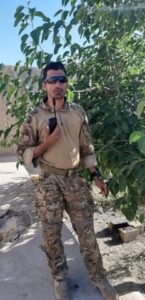

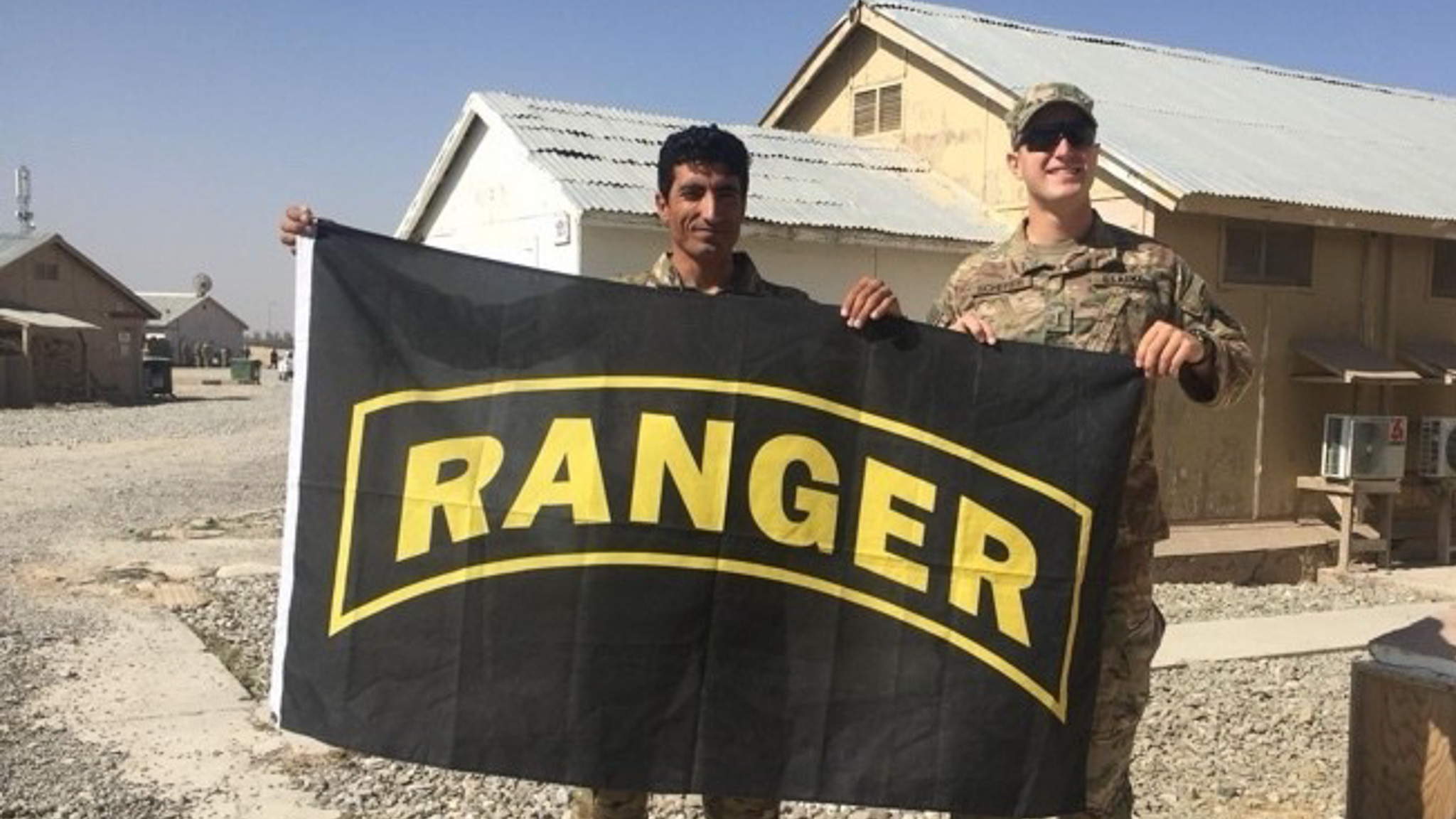
As a child growing up under the Taliban’s first regime, Yaser Yarghal learned English by kerosene lamp long after his siblings, and the rest of his rural village, were asleep. Family and friends derided Yarghal’s father for imparting a skill they thought would prove useless, but long after the Taliban were ousted from power, the former Afghan National Army (ANA) Major told the Special Operations Association of America (SOAA) that his English skills and his incredible drive to succeed landed him a spot at Ranger School in Fort Benning, Georgia, which he passed without being recycled in October 2015.
Seeking a Scholarship
In 2014, Yarghal was given the opportunity to test for a scholarship at one of several U.S. military development courses. Passing with aplomb the battery of assessments that tested his English proficiency and military aptitude, Yarghal received a scholarship to attend the 19-week Infantry Basic Officer Leadership Course (IBOLC) at Fort Benning, Georgia. In March 2015, the young officer headed to the U.S. with two other Afghans who had qualified for courses that would take place at Fort Benning. One would join Yarghal at IBOLC. The other, an Afghan commando, was headed to Ranger School.
Yarghal knew little about either course prior to his departure, but during their journey overseas, his compatriots waxed poetic about American Rangers, and the vaunted Ranger School. The other Afghan officer who was slated for IBOLC had previously attempted Ranger School, but had failed the course. As the IBOLC student joked that the commando would never pass Ranger School, Yarghal was filled with the desire not to undergo the IBOLC, but to earn the Ranger tab.
As soon as he arrived at Fort Benning, Yarghal asked to change course selections. He was told that because he was not a commando, he would have to attend the IBOLC.
Yarghal not only excelled in the IBOLC, but earned a perfect 300 on the Army Physical Fitness Test (APFT). He used his success to once again press for a place at Ranger School. Already, the commando who had come to Fort Benning with him had failed the course. Though the commando claimed that he failed on account of a broken leg, Yarghal said he never saw proof of “anything like that.”
During the last phase of the IBOLC, Yarghal received a message telling him that he was selected for Ranger School. By now, his excitement was blunted by his satisfaction with his achievements at the IBOLC.
The news “hit me a little bit hard because I was already mentally detached,” Yarghal explained. “I was not thinking that I will be going to Ranger School, and I was taking preparations…to go back home.”
Ranger Training Assessment Course
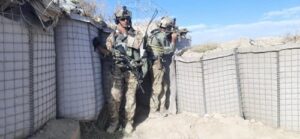
Before he could start Ranger School, Yarghal had to attend the Ranger Training Assessment Course (RTAC) with four or five of his classmates from the IBOLC. During the first week, candidates were presented with increasingly difficult physical challenges and given very little time to sleep. By the second week, Yarghal said that instructors “were going harder and harder.”
At one point, Yarghal was certain that “if [Ranger School] is harder than this,” he might not be able to handle the course.
The physical components of RTAC presented little difficulty, but land navigation was a true challenge. Candidates had three chances to pass the land navigation component of RTAC before they risked failing the entire course. Yarghal failed the land navigation test on his first attempt, but was able to pass on his second try.
By the time he finished RTAC, an instructor who had kept a close eye on Yarghal’s performance told him that he would do well at Ranger School, and that “the only problem” he might have would be with land navigation.
As he assembled the long list of items that he was required to bring to Ranger School, Yarghal wondered whether he would be successful. One thing he knew for certain: he “was not the kind of person” to tell people he failed by making up a broken limb. If he could not pass the course, he would be “straightforward” about it.
Darby Phase
The first 21 days of Ranger School, the Darby Phase, began on August 16, 2015 in Fort Moore, Georgia. Grueling weeks were filled with physical testing, land navigation, and long ruck marches. Instructors also tested candidates’ mental strength. Yarghal explained that at one point, candidates had to accomplish 50 push-ups, but as instructors counted them off, they called out “49” over and over so that candidates never knew when the instructor would finally call out “50.”
Some of the obstacles were difficult. Candidates had three attempts to walk along a set of rotating logs that were part of the Darby Queen Obstacle Course. If they failed, they would be recycled and forced to start the phase again. For Yarghal, it took two tries to conquer the moving logs.
Equipment maintenance and setting up radios and frequencies also presented a challenge, but Yarghal’s greatest difficulty came while working with C4. After the candidates had set up their charges and were preparing to set them off simultaneously, Yarghal listened attentively to instructors. As they discussed triggering the C4, Yarghal thought they were issuing a command to detonate their devices, so he set his explosives off. “That was a very big spotlight on me,” Yarghal explained. But because of the language barrier, instructors decided not to recycle him and to let him continue with the course.
Ranger candidates had plenty of food during RTAC, so Yarghal had not been particularly concerned about warnings given to candidates that they eat a lot before coming to Ranger School. By the time that Darby Phase ended, Yarghal was famished. Frantic to find something to eat, Yarghal immediately returned to Abrams Hall, the hotel where foreign students were lodged during courses at Fort Benning. With his head shaved and carrying two huge bags, he begged employees at the front desk to help him locate his Afghan friends, who were certain to have food in their rooms. Citing protocol, the employees refused to call Yarghal’s friends at first. Eventually, they took pity on Yarghal.
When one friend came out to greet Yarghal, he held a green tea and asked Yarghal to join him for a smoke. Feeling like he was “almost dying from hunger,” Yarghal was grateful when his friend finally invited him into his room and began to cook a meal. Unable to wait for the meat and rice to cook, Yarghal began rooting through his friends’ drawers in search of something he could immediately consume. Though he was “really ashamed,” he tore into the nuts and cakes he found in one drawer. Yarghal then packed away all the food his friends had cooked for him before calling a Fort Benning employee named Debbie who took the Afghan students to an Indian restaurant and a coffee shop. As he continued to eat, Yarghal wondered if he would make it through the next 40 days of training.
Mountain Phase
The second phase of Ranger School, the 21-days Mountain Phase, took place at Camp Frank D. Merrill in Dahlonega, Georgia. Because fall was drawing closer, the days were getting colder. Candidates were constantly on the move, conducting patrols, setting up operations, learning to tie knots and climb in the mountains, and calling in mock casualty evacuations.
Some of the most valuable lessons Yarghal took away from Mountain Phase were about making decisions in austere environments. During a night operation, one team of candidates attacked and another team flanked an objective. Yarghal was moving towards the objective, but was unable to reach it because of a continuous wall of concertina wire that blocked his path. Finally, with the attack soon set to commence, Yarghal made the command decision to give up on reaching the target and returned to the patrol base. Though Yarghal’s squad leader received a failing grade for the mission, Yarghal got rare praise for recognizing that the planned movement was impossible and returning to regroup.
Another time, he was not so lucky. Yarghal was filling the role of squad leader as his squad prepared for a helicopter to pick them up for a mission. Yarghal told the squad to put on all their gear and helmets to prepare for the helicopter’s arrival, but when the helicopter failed to arrive on time, one of Yarghal’s team leaders asked if the squad members could remove their helmets. Yarghal agreed, allowing candidates to remove their gear. After the mission, a Ranger instructor who had been watching from afar gave Yarghal a failing grade because he had changed his decision. “He gave me a good lesson that when you say something, just stick to it,” Yarghal explained.
During one of the exercises in Mountain Phase, a candidate lost his 12-foot rope. During accountability, instructors learned about the mishap. Referencing the Ranger Creed, the instructor said that Rangers care for their equipment. He told candidates that they would be returning to the mountain to find the lost rope. Yarghal thought the instructor was joking until suddenly two Ranger companies were assembled and headed into the mountains to search for the rope until about 3:00 a.m. The rope was never found.
Peer evaluation was part of the process for passing each phase of Ranger School. Yarghal had no trouble with peer evaluations in Darby Phase because he and his friends from IBOLC passed one another. In Mountain Phase, however, the situation was more difficult because if you make even a “small mistake, the other Ranger will take it against you.” Though Yarghal passed, he said it was “not a very good pass.” For some candidates, though, the peer evaluation led to being recycled and a return to the beginning of Mountain Phase.
Florida Phase
The final 20 days of Ranger School, Florida Phase, take place in the swamps of Eglin Air Force Base’s Camp James E. Rudder. As he prepared for the final phase, another candidate asked Yarghal whether he would restart the course if he failed. “I’m not staying,” he replied. “I’m going home.”
One mission during Florida Phase involved spending ten hours in the water, starting at 4:00 a.m. When the candidates finished the mission and prepared for the next day’s operation, one of the instructors made a remark that broke Yarghal’s spirit. “We have terrorists training here,” the instructor said. “They’re going to use the same training against us.”
The words hit Yarghal “very, very hard.” He wondered if he should quit the course right away, but instead sat quietly with his fellow candidates. After everyone dispersed, another classmate came up to Yarghal and told him that the instructor did not speak for everyone. He gave Yarghal a small piece of paper, a verse from the Quran that his Muslim wife had given to him prior to the beginning of the course. “After we graduate from the school, you’re going to give it back to me,” he told Yarghal. “You’re not here to fight. You’re here to get the tab.”
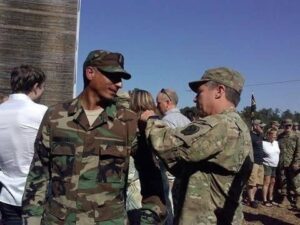
His spirits reinvigorated, Yarghal continued on with Ranger School, and was able to finish in 62 days without a single recycle. Instead of returning home, Yarghal took on Airborne School in November 2015 and added another American military tab to his ANA uniform.
Returning Home
When Yarghal came home, he felt like “a very qualified officer” and asked leaders to assign him to a Special Forces or commando unit. Leaders listened, but only in essence, assigning Yarghal to a maintenance position with the Ktah Khas (KKA), a light infantry special missions unit. Unfamiliar with vehicle maintenance, Yarghal resigned in frustration.
About 15 days later, he was asked to return and given command of a company in the garrison. The ANA attempted to send him back to the U.S. for more training, but Yarghal refused.
Finally, he was given command of a KKA company, but ran into continuous issues as he was given missions that were impossible to complete successfully. The final straw for Yarghal came when his unit was dropped into a location for a mission not meant to exceed 48 hours. For the next seven days, Yarghal and his unit were stranded, with ANA leaders forced to send in resupply through “unknown persons.” Upon returning home, Yarghal resigned out of frustration with the Afghan military, which he felt was beyond the point of repair.
Now an owner of a business in Canada, Yarghal is grateful for the chance to talk about his service and its myriad lessons, to “prevent [similar situations] in the future.” His memoir about growing up in Afghanistan and serving in the ANA, Unsabotaged, emerges in early 2027.