

SOAA Editor’s note:
In the following article we are going to talk a lot about HUXWRX and their suppressor technology. This is not a marketing message, nor do we have a financial position in their technology. We mention HUXWRX because their products are novel, and may save the lives of our SOF personnel by reducing their exposure to toxic chemicals. We invite the greater suppressor industry to find new ways of reducing the toxic exposure that covers operators after shooting, often as little as three rounds.
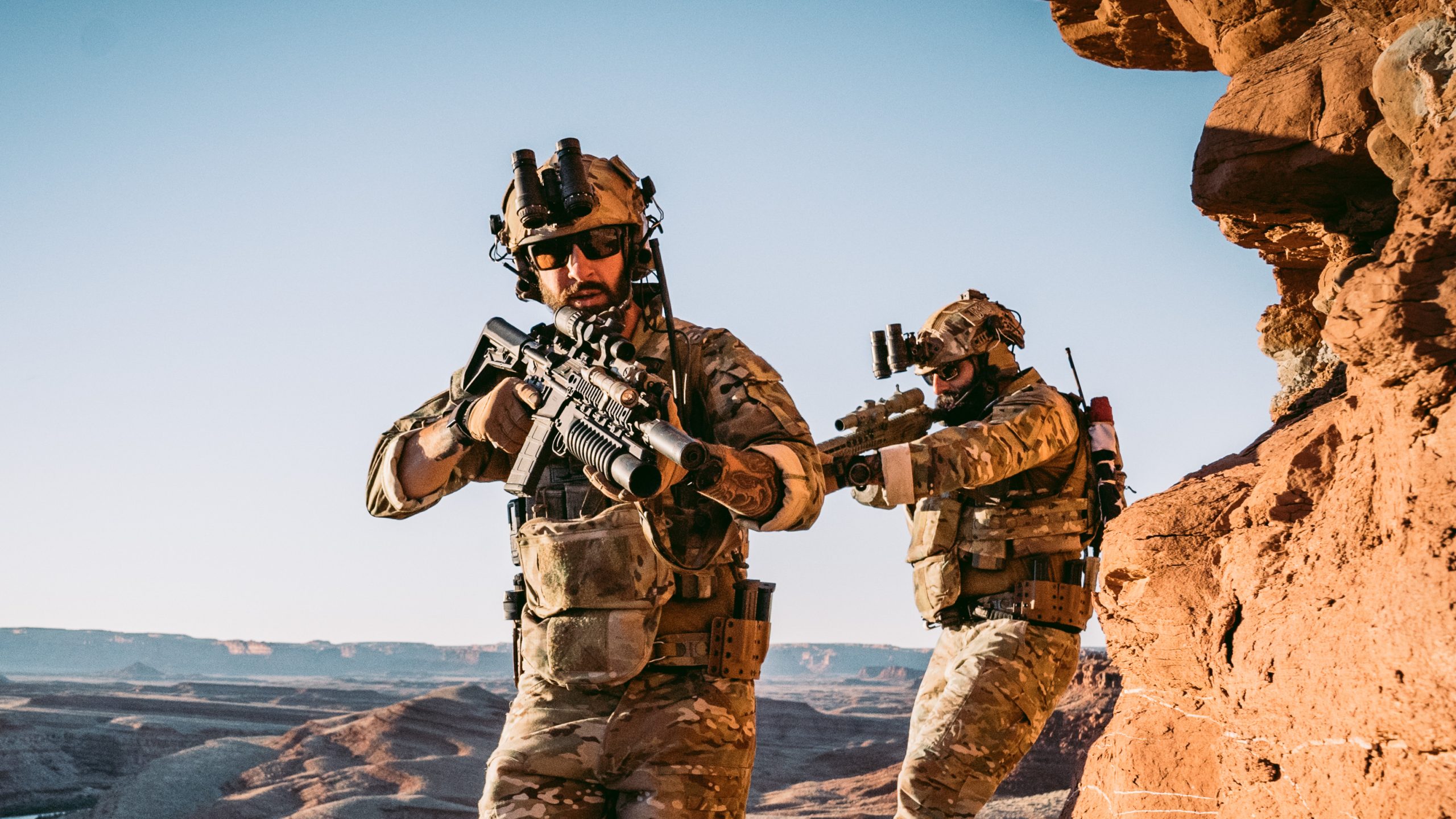
Suppressors are an integral component of the operator’s arsenal, reducing muzzle flash and deadening sounds so that special operations forces (SOF) can avoid detection and minimize distractions in the battlespace. Most suppressors also share another common feature: they blow toxic particulate matter back into operators’ faces.
Operators who spoke to the Special Operations Association of America (SOAA) uniformly described coming off the range after a long day of shooting, covered in what can only be described as ballistic pollution.
One operator described “a thick grime or dust that covers your head, face, neck, and hands, and even gets in your mouth.” Though they admitted that “it can’t be good for us,” they also explained that they would “rather be covered in toxic grime than give an enemy an advantage by using an unsuppressed weapon system.”
Up until recently, that has been the tradeoff. That tradeoff is quickly becoming obsolete as suppressor technology progresses.
Since 2016, the U.S. Army Research, Development and Engineering Command has actively sought a solution for measuring the amount of toxic metals and gases that special operations forces are exposed to while utilizing suppressors.
One company is not only creating new ways to test exposures, but finding ways to reduce them. Informed by exhaustive scientific research, the Human Exposure Workshop Safety Co. (HUXWRX) has patented a flow-through technology that allows their suppressors to cut down on noxious gas blowback. The company’s studies show that traditional suppressors emitted 265% more toxic gas into shooters’ faces than the HUXWRX suppressor.
HUXWRX Chief Science Officer and consultant Dr. Chris Palmer told the Special Operations Association of America that HUXWRX doesn’t “give up lethality or accuracy” in order to protect users, and works “just as hard” at suppressing acoustic sounds and signature management “for counter detection against personnel and auto target recognition (ATR) systems.”
Currently, HUXWRX tells SOAA that its suppressors are already in the hands of elite units in the U.S. Special Operations Command (USSOCOM) using the USSOCOM M110 Semi-Automatic Sniper System and the USSOCOM MRGG-A/S Mid-range Gas Gun-Assault/Sniper variants.
USSOCOM spokesperson Lt. Cmdr. Kassie Collins told SOAA that USSOCOM “is committed to equipping SOF with suppressors that increase lethality and mission effectiveness, while protecting our operators’ long-term health.” Collins said that “USSOCOM’s requirements for suppressors and reduction of noxious fumes/particulate matter are covered through both individual weapon systems requirements and command operator health initiatives.”
Among the “improved suppressors with flow-through technology” are the “Suppressed Upper Receiver Group, the MK-1 Mid-Range Gas Gun-Sniper, and the M110 Sniper Support Rifle (6.5 CM)” Collins said. She explained that “weapons programs in development are leveraging advanced technologies and capabilities that offer better performance and increased health safety benefits to operators, reducing toxic fume exposure, dangerous sound pressure levels, and blast overpressure.”
Examining the Literature, Identifying the Problem
Palmer joined the HUXWRX team in 2020 to begin researching the effects of aerosolized gases and heavy metal particulates that warfighters are exposed to when utilizing their weapons. After taking a deep-dive into over 100 studies of operational literature, literature on adjacent industries where exposures were commonplace, and regulatory guidance from the Environmental Protection Agency (EPA), Palmer broke down the known side effects of exposure into four categories.
Palmer found that exposures created acute effects during weapon use, persistent effects lasting 24 to 72 hours, chronic effects lasting three to six months, and permanent effects lasting a lifetime.
Acute effects included “reduced aerobic performance” from diminished oxygen inhalation due to the body’s automatic response to Class II Asphyxiates in addition to increased lactic acid production and impacts at the cellular level from excessive hydrogen cyanide exposure in the mitochondria that shifts the body’s metabolism away from aerobic energy production.
Persistent impacts can include continued reduced lung function and metal fume fever, an outcome typically associated with welders that creates headaches, dizziness and fatigue. Palmer also found reductions in Central Nervous System (CNS) function and a marked increase in C-Reactive Proteins that indicate “a huge inflammatory response” inside the body up to 72 hours after shooting. Palmer says both of these contribute to reduced recovery and an “impeded ability to conduct the next operation.”
Palmer explained that the chronic and permanent effects documented in the literature can be attributed to a variety of exposures outside of weapons use, and can overlap with conditions like post-traumatic stress disorder (PTSD). Chronic conditions can include suppressed CNS function as well as reproductive and vision challenges. In women, Palmer noted that “some of the toxins cross the lactation barrier for bearing children.” Men may experience decreased sperm motility due to deformations in sperm head and tail shape, which reduces fertility.
Chronic conditions, especially reduced CNS function, can become permanent. Palmer said that studies of individuals in related career fields who had reduced CNS function following multiple years of exposure to toxins have found that eliminating continued exposure to toxins does not improve CNS function. This particular case study involved doses far smaller than those that SOF personnel are exposed to during training, and unlike in SOCOM range conditions, workers in the study were required to leave their work if they exceeded these minimal dosage exposures. This finding demonstrates the importance of finding and fielding effective solutions that limit operators’ further exposure to noxious matter.
Other permanent impacts documented in the literature include Parkinson’s Disease, Bradykinesia, dizziness, sleep problems, weight gain, and systemic fatigue.
Measuring the Impacts
Palmer showed SOAA testing results that demonstrate how HUXWRX’s suppressor, SOCOM’s current suppressor, and unsuppressed weapons mitigate the most harmful noxious particulates: hydrogen cyanide, carbon monoxide, ammonia, copper, lead, and zinc outputs.
Internal HUXWRX testing, conducted alone and in conjunction with the Joint Service Small Arms Program Office (JSSAPO), demonstrated the dosage exposures created by a single, three-round burst of fire. The test uniformly demonstrates that the HUXWRX suppressor cut down on more emissions than the former SOCOM suppressor, which created above-safe levels of both airborne gases and metal particulates.
Hydrogen cyanide, a Class II Asphyxiant, “is the worst of these,” Palmer said, explaining that “the ingestion of this exceeds EPA limits for our guys in SOF.”
Because SOF units “train more than anyone else,” and often train in teams and squads, Palmer said that they are “much more exposed for each one of these blasts” than testing of one three-round burst would indicate. HUXWRX designed a test to show a more accurate depiction of operators’ exposure by unloading an entire magazine in three-round bursts delivered every five to ten seconds into the testing environment.
HUXWRX suppressors registered escalating levels of particulates but remained below safety thresholds as additional rounds were fired. The SOCOM standard suppressor not only produced above-safe levels of toxins, but broke the ceiling for the levels of gaseous particulates that could be measured by the testing apparatus.
Only in the realm of lead production were the HUXWRX and SOCOM suppressor nearly equivalent in mitigation.
Improving Warfighter Safety
As increasing numbers of SOF units inquire about fielding HUXWRX’s suppressors, HUXWRX hopes to include its suppressors in the Special Operations Peculiar Modifications (SOPMOD) program, which delineates the accessories available for customizing SOF weaponry.
It also welcomes competition from fellow manufacturers in the realm of improving operator safety while maintaining lethality across all battlespaces. “We’d love to see a space where everyone is working just as hard. And if someone does better, then give [SOF units] their suppressor,” Palmer said.
SOAA applauds HUXWRX for proactively finding solutions to problems that will impact our warfighters during and after the battle. Our organization hopes that other manufacturers begin designing new products or augmenting their products to replicate efforts that protect SOF personnel while ensuring they maintain their battlefield advantage.
By Ryan Deal. Ryan advances SOAA’s mission to keep America safe by covering defense innovation, strategic partnerships, and national security issues.