
In the arms race against China, America increasingly finds itself dependent on the very adversary that threatens our current and future security.
As tensions heat up in the Indo-Pacific, China’s growing stranglehold on U.S. military-industrial capacity is exploiting a perfect storm of corporate consolidation, globalization, and lack of fresh capital. It’s a storm that’s been brewing for years: As SOAA has documented previously, the end of the Cold War brought about immense changes to our capacity with ramifications we are still feeling today.
A Two-Pronged Challenge
Today, our military-industrial capacity faces a dual threat. First, decades of deliberate consolidation among defense companies have weakened our defense base. Since the fall of the Iron Curtain, a thriving defense sector comprising more than 50 prime contractors has been reduced to just five, a Department of Defense (DoD) report found. Second, amid that downsizing, adversarial capital now targets what remains.
The globalization of supply chains and capital markets means that our capacity to defend ourselves relies on forces and countries outside of our control. In some cases, we are dependent on our own rivals for our defense supply chain. The notion of the U.S. war machine being dependent on Beijing for materiel during an active conflict is a defense planner’s worst nightmare.
Beijing’s Economic Warfare Playbook
While not the only culprit, China weaponizes economic and financial interdependence better than any adversary in history. Beijing’s extensive exploitation of adversarial capital for geopolitical gain poses the clearest threat to U.S. global power.
The Belt and Road Initiative (BRI) exemplifies this strategy. Beijing offers high-risk loans to economically vulnerable nations, then extracts strategic concessions when recipients cannot repay. This debt diplomacy has delivered control of ports in the strategic “String of Pearls” across the Indian Ocean, encircling India with Chinese-controlled chokepoints, as well as increased Chinese influence in Africa.
Sri Lanka’s experience in particular reveals the playbook, and how it exploits economically vulnerable nations. Unable to service Chinese loans, Colombo surrendered its key port of Hambantota to Beijing with a 99-year lease. The significance for the U.S.: China now controls a critical maritime gateway just 10 nautical miles from major Indian Ocean shipping lanes.
This threat extends beyond infrastructure. While many countries invest in U.S. industries, Chinese investment poses a unique and direct national security risk, because so many Chinese companies are state-owned and effectively act as extensions of the Chinese Communist Party (CCP). Even private Chinese companies must comply with CCP directives under Chinese national security laws.
Targeting America’s Critical Sectors
Largely unnoticed, Chinese capital has penetrated key American industries with military applications. Beijing has invested heavily in key sectors including health and pharmaceuticals, as well as advanced technologies with military applications such as artificial intelligence. These investments serve China’s Made in China 2025 strategy, which aims to dominate high-tech manufacturing and erode American technological superiority.
The risks are threefold. First, Chinese ownership provides direct access to sensitive American technologies and intellectual property. Second, it creates economic leverage that Beijing can use to deter confrontation even when other core U.S. interests are at stake. Third, if conflict does break out, it creates a rift between business profits and national security imperatives that provides China with a distinct gray-zone advantage.
Consider the pharmaceutical sector. China provides well over half of the active pharmaceutical ingredients used in American medications. During early COVID-19 outbreaks, Chinese officials threatened to restrict pharmaceutical exports, potentially plunging America into “the mighty sea of coronavirus.”
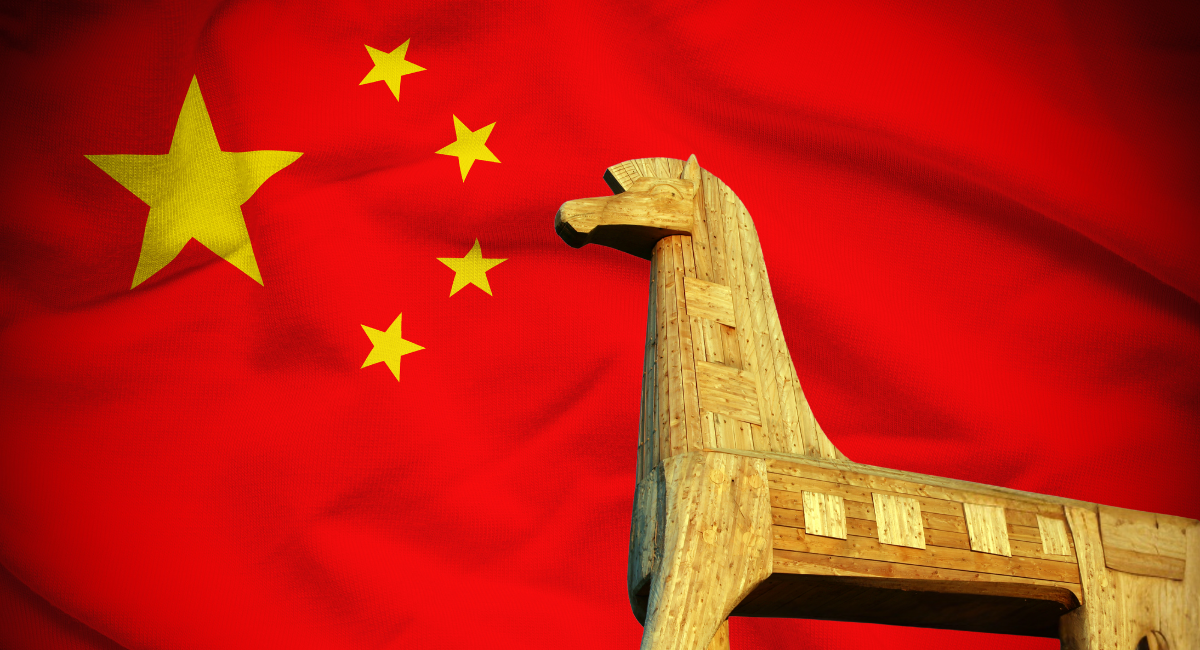
Defending Against Economic Trojan Horses
By treating adversarial investment as normal business, we risk handing Beijing the keys to our own defense-industrial base. Economic interdependence that benefits America financially during peacetime becomes a strategic liability during conflict.
Washington must urgently develop a clear set of regulations for safe capital flows to vital industries that mitigate foreign control or access to the engines of our current and future security. Using targeted policies, we must rebuild our domestic industrial policy spanning key sectors like pharmaceuticals, rare earth minerals, and advanced manufacturing.
In the Trojan War, Troy withstood years of Greek siege warfare, only to fall when it welcomed a wooden horse filled with enemy soldiers. America faces a similar choice: we can continue accepting adversarial capital as harmless investment, or recognize it as the economic warfare that it is.