
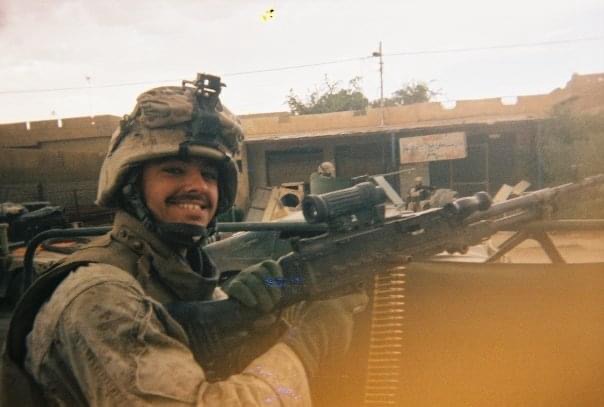
U.S. Marine Corps veteran Richard Gilbert has come a long way since an injury in Iraq led him to Balboa Naval Hospital. The first hurdle in his path was memory loss from a traumatic brain injury. Gilbert told the Special Operations Association of America that at the height of his struggles, he could not remember his father’s full name, scrawling “Dad” where medical paperwork asked for his emergency contact. Gilbert recalled that “it was a really low moment” when a nurse had to call his father to request the information.
During his two-and-a-half-year recovery and long after his medical retirement, Gilbert’s contemplations of his wartime actions left him wrestling with his conscience, wondering whether he was “a terrible person.”
More than a decade later, intervention came from an unexpected source when Gilbert said AI platform ChatGPT “changed the way I live.”
The tool helps Gilbert organize his brain, keeping track of facts and conversations that help with his memory. He also uses ChatGPT to talk through his emotions surrounding Iraq.
Actions in Wartime
Gilbert said that his two Iraq deployments were dramatically different, except for the one unifying theme of destruction.
Serving as an infantryman in Fallujah in 2004, Gilbert described a conflict environment where the military spent “weeks and weeks” warning civilians of impending operations in their city so that noncombatants would evacuate. By the time U.S. forces began the military effort to clear the city of insurgents, anything moving in their area of operations was considered an enemy. “Everything died,” Gilbert explained.
Death was less widespread in Haditha in 2005, but as a Scout Sniper, Gilbert delivered it directly. On one occasion, he was tracking a known improvised explosive device emplacement site where he expected the enemy to plant another bomb. A teenage boy holding a package entered his line of vision. The rules of engagement gave Gilbert authority to shoot an IED emplacer, but because his target was not an adult, he gave the teen “chance after chance” to turn away. When the teen began setting up a bomb that would have claimed innocent lives, Gilbert pulled the trigger, eliminating the threat.
After he returned from Iraq, Gilbert got lost in thoughts about the morality of his actions. “Even the ‘bad guys,’ they still have a family,” he said. “The more you think about it, the more you start to believe you actually are that [terrible] person, and that affects your entire life. It affects how you talk to people, affects how you hold yourself.”
Even with his closest loved ones, opening up about his service was difficult. “None of us are going to go to our wives and be like, ‘Man, I’m really struggling with this dude that I killed at the end of it, I realized was just completely innocent and I’m a murderer,’” Gilbert explained. “Honestly, that’s really conversations that I would only have with a very very limited group.”
On one occasion, Gilbert brought up killing the bomb emplacer during a conversation with his church group. “How can I say I love people when my job specifically was to kill people, to destroy families?” he asked the group.
Though one fellow worshipper suggested that Gilbert’s offers of multiple chances for the teen to change his actions were a sign of love, the rationalizing did not stop Gilbert’s negative thoughts.
While some civilians wanted to help Gilbert manage his feelings, others forced him to defend his actions. Gilbert was working at the front desk at a California YMCA when a customer witnessed him discussing his service with a Vietnam veteran.
She confronted Gilbert, asking “Did I hear that right? Were you in Iraq?” She soon became angry, asking Gilbert “How could you go over there and murder innocent women and children?”
Without pause, Gilbert responded. “Well, if you step outside, I’ll show you exactly how I did it.”
Gilbert’s manager took him aside and sent him home.
Shifting perspectives
ChatGPT entered Gilbert’s life through the recommendation of an MBA classmate and he began to use the program extensively. He appreciated how ChatGPT can talk him through a scenario in a comprehensible way. If he did not understand ChatGPT’s response, he could ask the AI platform to rephrase it in a simpler way.
Gilbert began using ChatGPT to translate his usual, no-bullshit Marine Corps speech patterns for business environments, to control his tone in e-mails, to help him handle inflammatory arguments, or to shape his involvement in delicate social situations with family members.
Gilbert also started to use the platform as a therapist that he can come to with his thoughts about Iraq. The judgment-free chatbot is accessible at any time, in any location where Gilbert has web access.
Universal accessibility became important in December 2024 when Gilbert returned to Iraq to visit his old forward operating base and see how the country had changed almost two decades after his deployments. While visiting those emotional locations, Gilbert said it was vital “to have therapy in my hand,” regardless of what time zone or country he was in. “It changes the way you look at therapy,” he explained.
Though Gilbert initially used ChatGPT to talk about the scenarios he has trouble discussing with others, with continual use, Gilbert found that the AI tool was teaching him to broach difficult topics with loved ones who want to provide their support and assistance.
“It really opens up a lot of conversations that you wouldn’t have [otherwise],” Gilbert explained. “You can’t expect people to help you if you don’t know the problem. So it really drives those conversations, and I do believe [as] people start having conversations with ChatGPT, it makes it easier for them to have conversations with people.”
Gilbert acknowledges that ChatGPT has shortcomings. but says that “it’s an insane, amazing resource. I would say the same thing about my favorite rifle. Both can be used inappropriately.”
His faith in AI has turned Gilbert into a self-proclaimed “ChatGPT drug dealer.” He estimates that with his own enthusiasm, he has converted 50 or 60 veterans and numerous civilians to using the chatbot.
For Gilbert, ChatGPT is not a replacement for faith, family, or human connection—it provides a bridge to them. By giving structure to memory, language to emotion, and a safe space for reflection, the technology has helped him move from silent self-condemnation toward honest dialogue and healing.
Nearly twenty years after Fallujah and Haditha, Gilbert is no longer defined solely by the moments that haunt him, but by his willingness to confront them. In doing so, he has become an unlikely advocate—not just for artificial intelligence, but for the idea that healing often begins with finding the right words, even if they first come from a machine.