
When Force Recon Marine John Dailey was asked if he would like to help the U.S. Marine Corps develop a special operations element to nest under U.S. Special Operations Command (SOCOM) in 2003, his answer was a resounding “Hell, yeah.”
Deciding to participate “was not a hard choice,” Dailey says.
Neither, apparently, was the decision to see the effort through to success, since Dailey has devoted the last 23 years, both in and out of uniform, to the development and sustainment of Marine Forces Special Operations Command (MARSOC).
On the heels of watching MARSOC celebrate its 20th anniversary, Dailey spoke to the Special Operations Association of America (SOAA) about his role with understated humility, explaining that “it was pretty awesome.”
Creating MARSOC
After the almighty success of the Marine Corps’ Raider units who conducted special operations missions in World War II’s Pacific theater between February 1942 and 1944, the Corps’ special operations capabilities were eventually taken up by Marine Force Reconnaissance units. Deploying alongside conventional Marine forces, Force Recon Marines undertook special missions while forward deployed, but fell under the direct command of the larger U.S. Marine Corps.
When SOCOM was established in 1987, it became the centralized command authority for elements of Air Force, Army, and Navy special operations forces (SOF). The Marine Corps, Dailey explained, did not supply forces. This was primarily because the Marine Corps was developing the Marine Expeditionary Unit to be special operations capable, but at least partially because the Marine Corps has always been reluctant to cede control of its forces.
After 9/11, Secretary of Defense Donald Rumsfeld recognized that the expansion of SOF elements was an immediate priority, and tasked the Marine Corps to create a force structure to nest under SOCOM. “Neither SOCOM nor the Marine Corps were terribly excited about the prospect,” Dailey reported, “so they tried to stall a little bit.”
Unable to skirt the issue forever, in 2002, Dailey said that the Marine Corps was tasked with “contributing a test unit” that they would refer to as “Detachment One.”
Dailey was one of about 100 initial members brought in. About a third of the unit consisted of operators from the Force Recon community. Another third were intelligence professionals, and a final third the communications, targeting, logistics, mechanics, and command structure that kept things running smoothly.
The men “were building out a unit from scratch,” Dailey reported, with “no equipment, no buildings, no anything.” For the first few months, he said that “the only thing that we could do was work out,” which meant long-distance rucks with heavy packs, and deciding what kinds of training they should undertake for the missions they were likely to receive.
Though they had no sense of where they might be sent, “we thought we would go to Afghanistan,” Dailey explained. The team focused on preparing for reconnaissance missions inside Afghanistan for several months before learning that they would be sent to Iraq, where they would be tasked with finding high-value targets.
“It certainly changed up how we were task organized, the equipment we needed, how we trained and prepared for the last six months before we deployed,” Dailey said.
When Detachment One deployed to Iraq in early 2004, Dailey expected that the requirements for working with SOCOM “would be a little bit different.” They soon found out how much as they found themselves occasionally working with Polish GROM units, Navy SEALs, and elements of Firth Special Forces Group.
The style of Detachment One’s operations was what differentiated it most clearly from operating under the Marine Corps. “We were put alone in our battle space and told to figure it out, to find out who the bad guys are and go after them.” That meant developing situational awareness and creating target packages as they operated, which required relying heavily on their intelligence professionals. “Having 30 of those guys on the case was remarkable. They were the ones that made us successful,” Dailey said.
Equally important were the joint terminal attack controllers (JTACs) who came out on missions to call in close air support. Even though every member of the detachment was trained to call in fire support, Dailey said that the JTACs were “the masters” of calling in Close Air Support (CAS).
On one particular mission in Najaf, Dailey said he brought a team of snipers and a JTAC, who “was instrumental in making sure that everybody knew where we were because we were a pretty small team well forward of any Coalition forces.” Even more importantly, “while we were doing our job, he was able to do his job successfully…with greater efficiency. You can kill a lot more people with the plane than you can with sniper rifles, so we were both very busy,” Dailey explained.
Testing Effectiveness
When Detachment One returned, they faced “about a year of uncertainty” as they waited for a U.S. Navy think tank to crunch the numbers and determine whether the deployment had accomplished its goals and “what their future was going to be.”
While the think tank found that Detachment One had been “a resounding success,” Dailey said that SOCOM and the Marine Corps were still not immediately on board with formalizing the initiative. After more prodding from the Secretary of Defense, Dailey said that both bodies finally moved forward with formalizing a Marine Corps structure for SOCOM.
As they were waiting to learn about their next steps, Detachment One had begun planning for a subsequent deployment, continuing to train in expectation that they would be sent next to Afghanistan. Working hard “to figure out a niche that we could fit in that wasn’t being fulfilled,” the unit had begun preparing to find and acquire targets in the rugged mountains of eastern Afghanistan while remaining undetected in an area where locals “know every rock.”
Rather than receiving deployment orders, in 2005, Detachment One got final word that it would be disbanded so that MARSOC could stand up as a separate unit. In March 2006, Detachment One was deactivated from its base at California’s Camp Pendleton. MARSOC stood up several weeks earlier on February 24, 2006 at Camp Lejeune in North Carolina.
Dailey was part of a roughly 20-man team tasked with standing up the Marine Raider Training Center to provide specialized training to prepare the early MARSOC units for deployment, including training in close quarter battle, sniping in urban environments, and urban reconnaissance operations.
The Training Center was also tasked with developing an assessment and selection program to provide “a consistent and effective assessment” of new MARSOC Marines. To support that effort, the team relied on lessons learned by its sister SOF components.
In constructing the Marine Raider Course (MRC), “the training pipeline that makes a Marine Raider,” Dailey said that “I think we got it mostly right.” He explained that as missions and wars have changed, the MRC has “certainly been tweaked.”
Over 20 years, Dailey described how “the school has grown from a few dozen instructors to a sizable staff of Marine instructors and civilians like myself,” providing courses in communications, language, intelligence disciplines, explosive ordnance disposal, lethal robotics, and other skills.
The MRC Today
The nine-month MRC is different from other SOF training assessments in that applicants must have several years of experience in conventional forces before they can try out.
Not only does Dailey say that it is “often quite valuable” for Marines to bring training from their military occupational specialty to their Raider career, but he finds that it helps for applicants to have maturity, and “a deployment or two under their belts before they come to us.”
Assessment and Selection has a relatively high attrition rate, Dailey says, while the MRC measures itself on how many students it can successfully train. If they do not complete the MRC on their first attempt, Dailey says that hopeful Raiders “generally get one more” chance to pass.
The Raiders of today “are far smarter than I was,” Dailey reports. Along with more computer skills, he says that they also have greater interpersonal skills, which were “not a priority in my day.”
With those advantages are some challenges, like being less likely to have taken part in group sports, and being less comfortable with discomfort. “There are certainly some generational differences that we’ve got to consider. We’re always looking for better ways to teach and, in some cases, provide a little longer runway to get them where they need to be.”
20 Years of Making Raiders
For the first ten years, Dailey said that MARSOC “still felt like we lived under the threat that we could go away.” But 20 years after its founding, Dailey says that MARSOC is “on very solid footing. The other components of SOCOM recognize the value we provide. There are more than enough missions to go around.” In addition, Dailey said that “we punch above our weight class.”
To celebrate 20 years of excellence, the Raider community held a reunion in April, bringing together about 15 original members of Detachment One, Raiders from the last 34 classes of trainees to go through the MRC, families of fallen Raiders, and even 103-year-old World War II Raider Cpl. Leonard Turner.
The two-day event was packed with meaningful moments. On Thursday, attendees got a tour of the training compound and an operational update on Raider activities. After a trip to the range and a group lunch, the group assembled to dedicate a new Raider Bell. Plaques were also on display showing the recently approved names for eight or nine new buildings and ranges to be named for fallen Raiders.
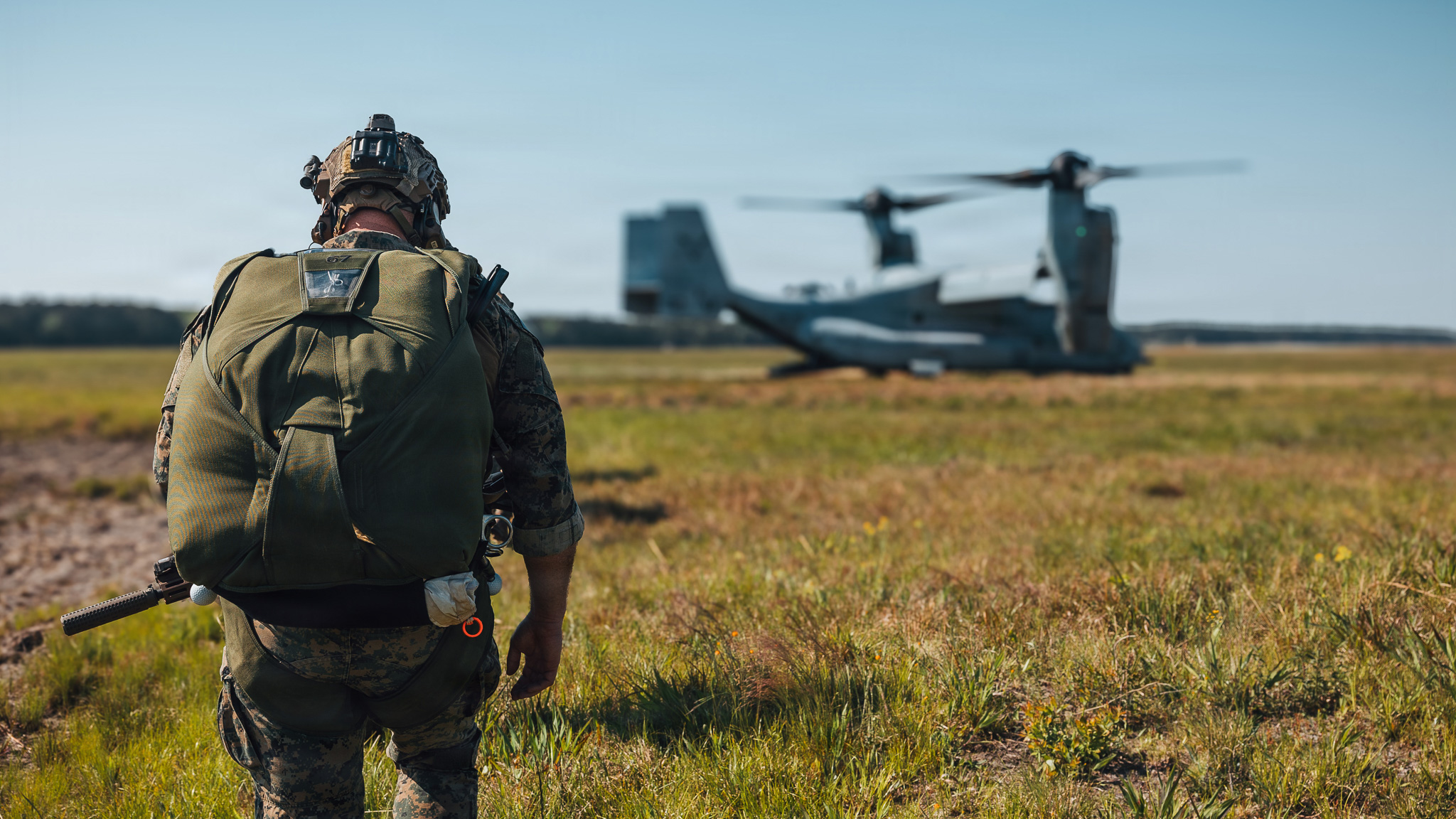
Friday’s events began with the battle streamers that the Raiders of World War II earned being assigned to current Raider units. Remarks from SOCOM Commander U.S. Navy Admiral Frank M. Bradley were followed by a capability exercise in which a team of Raiders conducted a free-fall operation into a mock battle space before engaging targets with explosives, weapons, and drones.
Dailey said that for the Marines of Detachment One and those who oversaw the earliest days of MARSOC, seeing the photographs of classes of graduates on the schoolhouse walls, the growth of the training facilities, and the skills of today’s Raiders was an emotional journey.
Dailey himself has now witnessed a kind of changing of the guard at MARSOC. “I’m now getting to the point where there are children of Marines that I knew and served with who are coming in and going through assessment and selection. In some cases, it’s a family business,” he explained.
As the former generations of Raiders shape the next, Dailey said that being raised with an attitude of self-reliance and being willing to do hard things are beneficial.
“We can teach everything else,” he promised.
The opinions expressed by John Dailey are his alone and do not represent the position of MARSOC or USSOCOM.