

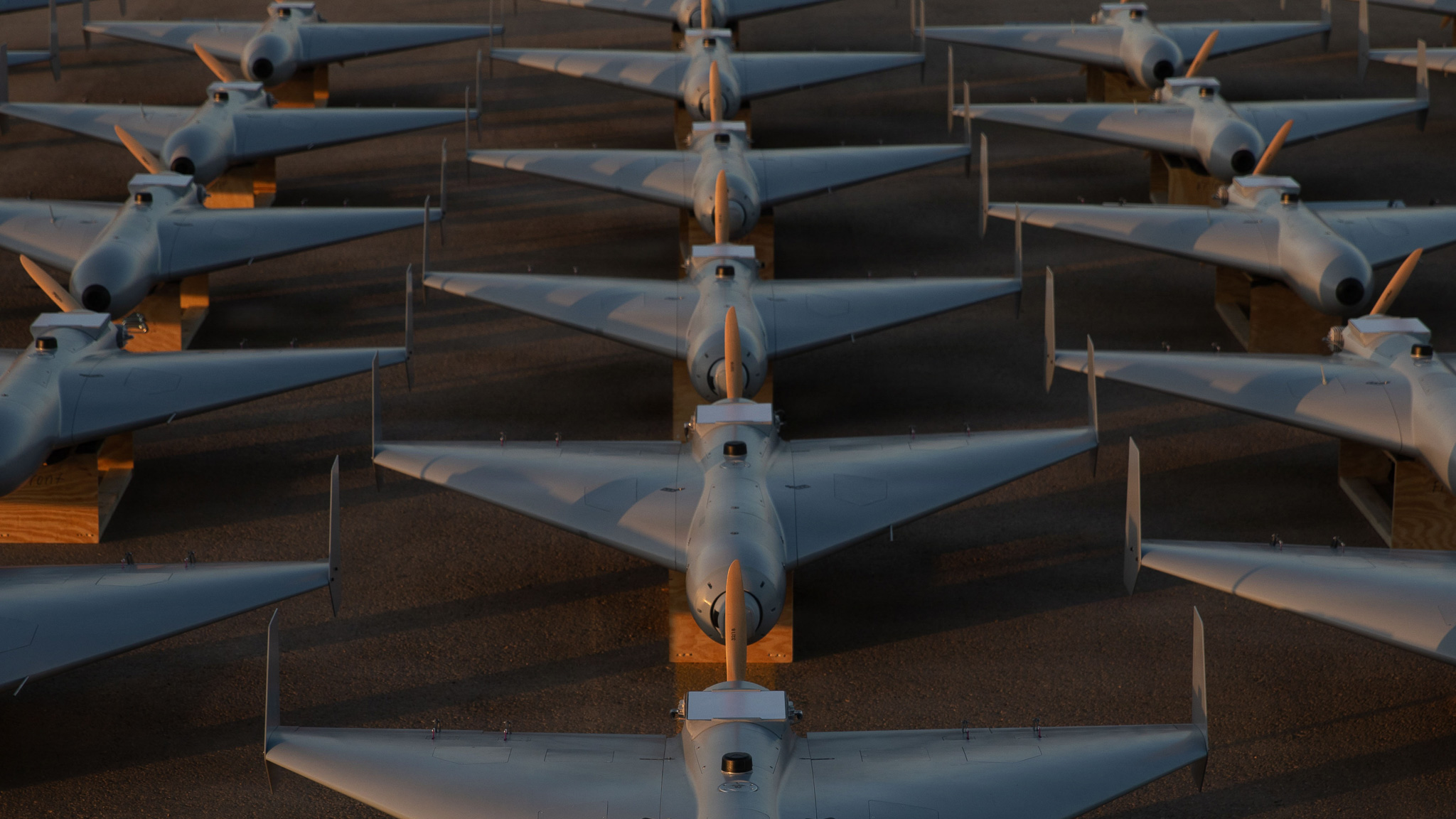
The Low-cost Unmanned Combat Attack System (LUCAS) drone underwent a successful initial launch in the Arabian Gulf on Dec. 16. U.S. Special Operations Command personnel affiliated with Task Force 59 of Naval Forces Central Command launched the device from the USS Santa Barbara as part of Task Force Scorpion Strike, a U.S. Central Command effort to create a squadron of one-way attack drones.
Reverse-engineered from the Iranian Shahed-136 kamikaze drone,the LUCAS went from concept to development in just 18 months, with the drone originally unveiled at the Pentagon in July. Featuring a delta wing and round nose cone like its Iranian predecessor, the LUCAS could be further adapted down the line for different missions, according to defense officials. The drone can be launched by multiple systems, and can be operated through the Multi-domain Unmanned Systems Communications (MUSIC) system, which allows U.S. personnel to communicate with various drone platforms.
American defense company SpektreWorks held a $30 million contract to manufacture the drones, which cost an estimated $35,000 to $40,000 to produce. The company also manufactures the FLM-136, which analysts suggest resembles the smaller Iranian Shahed-131 drone. SpektreWorks claims the FLM-136 is intended for “authentic threat emulation.”
SpektreWorks is not intended to be the sole manufacturer of the LUCAS. Col. Nicholas Law, Director of Experimentation in the Office of the Under Secretary of War for Research & Engineering, told Forbes that “we want to produce a lot of these in a rapid fashion. It’s not a single manufacturer: it’s designed to go to multiple manufacturers to be built in mass quantities.”
The Shahed-136 Gets Around
Iran’s Shahed-136 has been deployed to multiple theaters according to photo documentation by the Defense Intelligence Agency (DIA). The 200 kg system can be equipped with a warhead weighing up to 50 kg. Though the suspected cost of a single Shahed-136 ranges from $20,000 to $80,000, the Center for Strategic and International Studies estimates each drone costs around $35,000 to produce.
The Shahed-136 is an effective weapon system. In July 2021, Iranians used the Shahed-136 in an attack on the merchant vessel Mercer Street. In June, a Shahed-136 passed through Israel’s Iron Dome, David’s Sling, and Arrow defense systems and caused serious damage to a building.
The Iranians have shipped the weapon to their Houthi proxies, who have paraded the drone but have not appeared to utilize it in a conflict environment.
The most overwhelming application of the Shahed-136’s force has occurred in Ukraine. The Foundation for Defense for Democracies reports that Iran supplies Shahed components to Russia for assembly at a factory in Yelabuga. The facility is reportedly manned by North Korean slave laborers.
During November 2025, an estimated 5,400 Shahed drones, known in Russia as the Geran-2, were utilized in the Ukrainian theater. There are about 182 launches on a typical day, according to the Institute for Science and International Security. Some of these may be decoy drones intended to confuse Ukrainian forces.
Between 11.5 and 18.7 percent of strikes hit their target, except in instances of mass drone attacks, when “the effectiveness rate ranged from 40 percent to 50 percent.” Because the cost per drone is significantly lower than the cost per missile, the cost per target struck is likewise lower for the Shahed system than for Iranian missiles.
Imitation or Improvement?
Islamic Revolutionary Guard Corps senior spokesperson Abolfazl Shekarchi belittled the development of the LUCAS, saying that “There is no greater honor than seeing self‑proclaimed superpowers kneel before an Iranian drone and copy it.”
Shekarchi’s remark neglects the fact that the Shahed series of drones was developed in part from an American RQ-170, which Iranian forces managed to intercept and bring to ground over Iranian or western Afghan airspace in 2011.
Despite Iranian rhetoric, the U.S. military should view LUCAS as a success. Its rapid development and discussion of further specialization suggest the system will continue to evolve and improve. The existence of a separate FLM-136 model reinforces this view, indicating that as the U.S. advances LUCAS, SpektreWorks is maintaining a lower-capability replica of the Iranian threat. This approach allows U.S. forces to train realistically against a system they may encounter in operational environments around the world.
For the SOF community to wield this new technology is critical. Not only is there psychological value in deploying a likely superior technology in Iran’s back yard, but having the capacity to deploy a squadron of one-way drones in theater brings the U.S. a step closer to the state of drone dominance that the Department of War seeks to achieve across the U.S. military.