
By Dr. York Kleinhandler, CW5(R)
To assist with the training and advising the Afghan National Army and its various fighting forces, the U.S. Army stood up six Security Force Assistance Brigades (SFABs) between 2017 and 2020. In 2019, the SFABs were aligned to regional combatant commands to broaden their mission of advising worldwide partner forces.
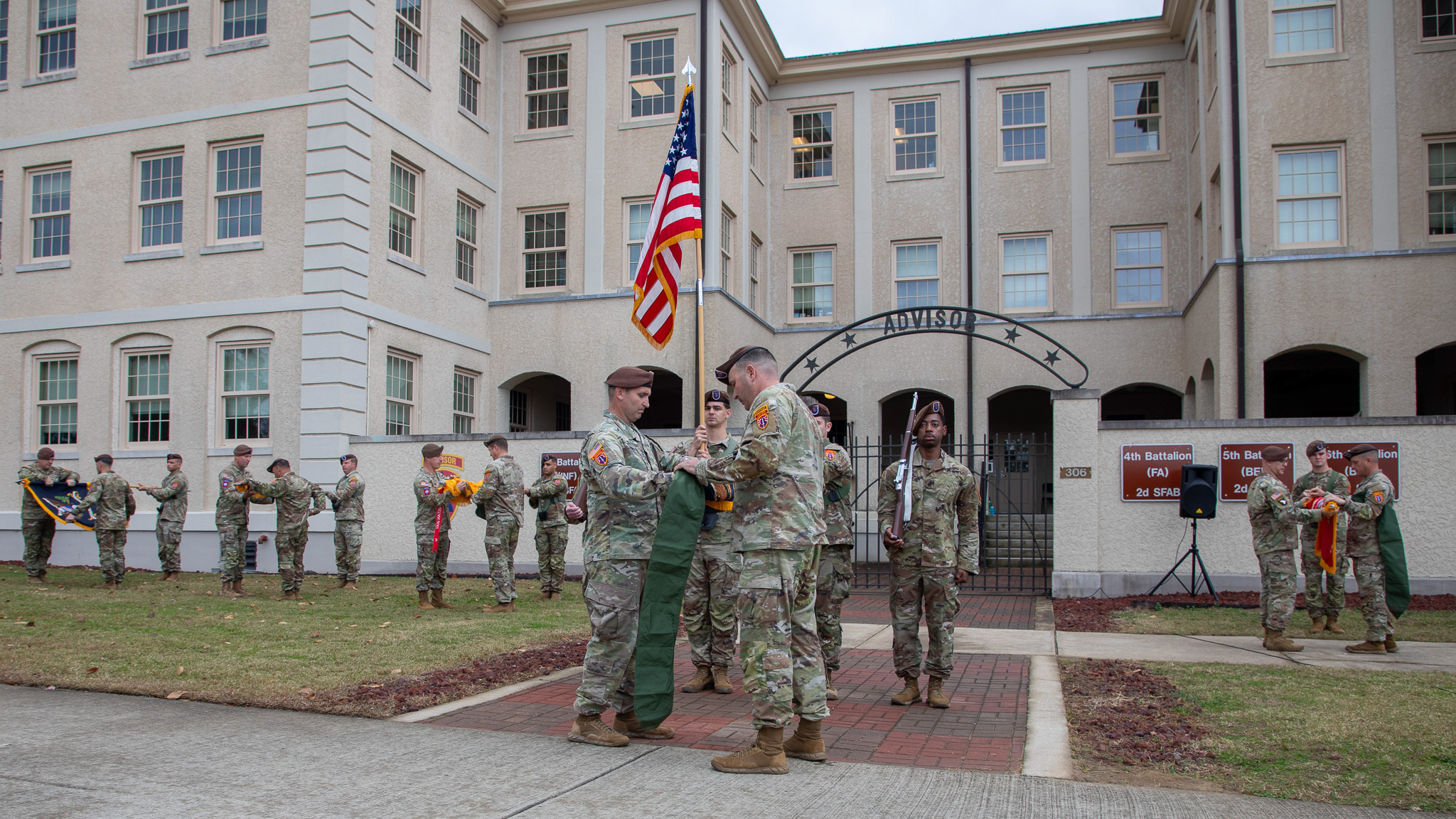
On Nov. 26, the 2nd SFAB cased its colors, not out of recognition that the Army’s partner forces had become suddenly self-sustaining, but because the Army lost the capacity to sustain the SFAB mission
After the SFAB is removed from the system, the Army is likely to revert to their usual approach: turning straight to the Green Berets. That reaction isn’t surprising. It’s also exactly how we end up right back in the same problem set.
Green Berets can advise anybody. That was never the debate. The real issue is the difference between capability and capacity. Capability is what a unit can do. Capacity is how long they can do it before you start dulling the edge you count on. When you fail to distinguish between the two, you end up with inferior results.
Special Forces personnel have been living, training, and teaching alongside partners since long before the escalation of the Vietnam War . Special Forces learned languages the slow way and earned trust the hard way. Advising was not just a task. It was their identity.
Vietnam exposed how the whole system needs to operate to be effective. Special Forces focused on and operated in the irregular warfare space, where it was necessary to live with partner forces and truly understand them. Meanwhile, the Army built an extensive advisory network of its own, spanning provinces, districts, and brigades. These were two interconnected lanes working toward a common goal. We understood our differences as our strengths. Then we forgot them.
In Iraq and Afghanistan, instead of rebuilding a system that had been effective in the past, we tried to improvise. Early on, Green Berets focused on building elite units and handling the missions that required precision and trust. But once the national objective shifted to building an Afghan army, we didn’t bring back the Vietnam model. Instead, we built an alphabet of different entities: OMLTs, ETTs, MiTTs, and PTT. Every rotation of these units started from scratch. Every handoff reset progress. It was a long-term requirement forced through a short-term structure, and everyone hoped the numbers would magically add up.
SFABs were supposed to be the fix. Neither a substitute for Special Forces nor a competitor focused on the same area,they were meant to give the system stability and continuity, the two things Green Berets shouldn’t be asked to provide at scale.
The Special Forces infrastructure has long been overstretched, the force shrinking while global demand kept rising. Regional alignment, which comes from returning to the same ground over and over until you know the people, the terrain, and the rhythm by heart, was ignored and broken
Pulling ODAs from all over the world to fill advisory gaps in Iraq and Afghanistan caused the alignment to collapse. Teams no longer returned to the same regions. Connection and trust disappeared. Access became temporary and limited. And the edge, the one that makes Special Forces different, started eroding. When the Army began to cut SFABs, the strain became impossible to ignore.
Once you break it down by geography, the picture becomes even clearer.
INDOPACOM
The Pacific is a shaping theater where China plays a long game. Quiet, consistent, and relationship-driven, Special Forces are built for this kind of engagement, which requires presence, access, and influence. The region’s massive size and the different levels of capabilities in partner forces require steady advising, not once-a-year touchpoints. Without SFABs, ODAs get pulled into the gap.When that happens, the U.S. loses its irregular advantage.
Europe
Europe runs on credibility. NATO interoperability occurs through the embedding of advisors within staffs and formations. Special Forces bring resistance, depth, and irregular capability, but Green Berets are not built for institutional development. Without continuity, Europe will drift in the wrong direction. Drift is more challenging to fix than failure.
CENTCOM
CENTCOM exposes misuse immediately. Some forces absolutely need Special Forces’ assistance. But building national-level logistics, training centers, and personnel systems is slow, administrative work. That was never a Special Forces mission. It was SFAB work. When you put that load on ODAs, you take the temper out of the steel, and once that’s gone, so is the edge.
Africa
Africa punishes inconsistency. Green Berets create real impact by building elite nodes that shift the fight. But country-level influence requires steady engagement. SFABs were the connective tissue. Without them, U.S. presence becomes episodic, one-step-forward, one-step-back, leaving space for competitors who don’t mind playing the long game.
Now add the returning Trump doctrine: smaller U.S. footprints, more responsibility on partners, alliances tied to performance. That doesn’t shrink advising requirements. It expands them.That work cannot fall on Special Forces alone.
The reality is, Green Berets are force multipliers. They were never built to create or reshape large military forces. Through cultural, operational, relational, and psychological depth, they establish access that no one else can. They strategically shift environments. When you stretch them across missions designed for mass and continuity, you lose the very thing you depend on. By the time someone realizes we have a problem, the damage is already baked into the system.
Revitalizing the system is about assigning the right capability to the right mission.
Fifty years ago, we understood the appropriate role for Special Forces. Somewhere along the way, we traded clarity for convenience. The U.S. Army must sustain separate lanes for advisory capabilities, using Special Forces for irregular problems and SFABs for institutional advising.
Eliminating SFABs stands to assign an additional role to an overburdened force that was not designed to support large host nation forces. This is not the moment for improvisation. The U.S. should examine with clarity the nature of threats around the world, and respond to those threats with the appropriate advisory tools in its arsenal. With multitudes of regional conflicts percolating, Congress must prioritize allocating funds to maintain the SFAB and support a robust Special Forces presence. Both advisory elements are needed to create stable partner forces to assist in the battles the U.S. is likely to face in the years to come.