
In the critical maritime corridor of the South China Sea (SCS), China aggressively pushes its claims to more than 90 percent of the waters. While America pushes back with freedom of navigation patrols, Beijing is winning by deploying political warfare that skirts just below the threshold of war. The solution isn’t more warships, but turning contested waters into governed space.
For more than a decade, China has succeeded in expanding its influence not through naval battles, but through maritime militia and artificial islands. Its claims clash with many other countries in the region, including American allies like the Philippines. Although a 2016 U.N. tribunal at The Hague declared that China’s claims had no legal basis, this has not stopped China from enforcing its perceived territorial boundaries.
A Maritime “Gray Zone” Strategy
The People’s Liberation Army Navy (PLAN) easily outclasses any challenger to its SCS claims. Still, the Chinese Communist Party shrewdly understands that it cannot simply take territory with brute military force, because doing so would constitute a clear and open war. Such a war would likely trigger economic sanctions, loss of influence and diplomatic clout, and even military intervention by powerful states like the United States. The West’s reaction to Russia’s invasion of Ukraine confirms the wisdom of China’s decision to hold back militarily.
Instead, Chinese President Xi Jinping has opted for political warfare over the conventional alternative. This does not mean Chinese conduct has been peaceful. Rather, China has pursued a clever strategy of pressuring neighbors just under the threshold of war.
The first step has been to assert an economic presence through a civilian fishing fleet that functions as a maritime militia, bullying other nations’ fishing ships and even Coast Guard vessels. China has also constructed bases on shoals across the sea to both project force further afield and improve its legal claims by transforming rocks into “islands.” As an added disincentive for escalation, China is the largest trading partner for other claimants and uses economic incentives as carrots to complement the sticks.
America’s Missed Opportunity
The Permanent Court of Arbitration in The Hague might say one thing, but it has no enforcement mechanism of its own. While China might not have a valid claim currently, possession is nine-tenths of the law.
Making matters worse, U.S. foreign policy squandered an opportunity to support our ally, the Philippines, by declining to energetically enforce the court’s ruling. As a result, others have been unwilling to press their claims legally for fear of Chinese economic retribution and doubts about our willingness to back them up. This skepticism about America’s commitment is one reason U.S. influence in the region has decreased over the past decade.
A New Approach
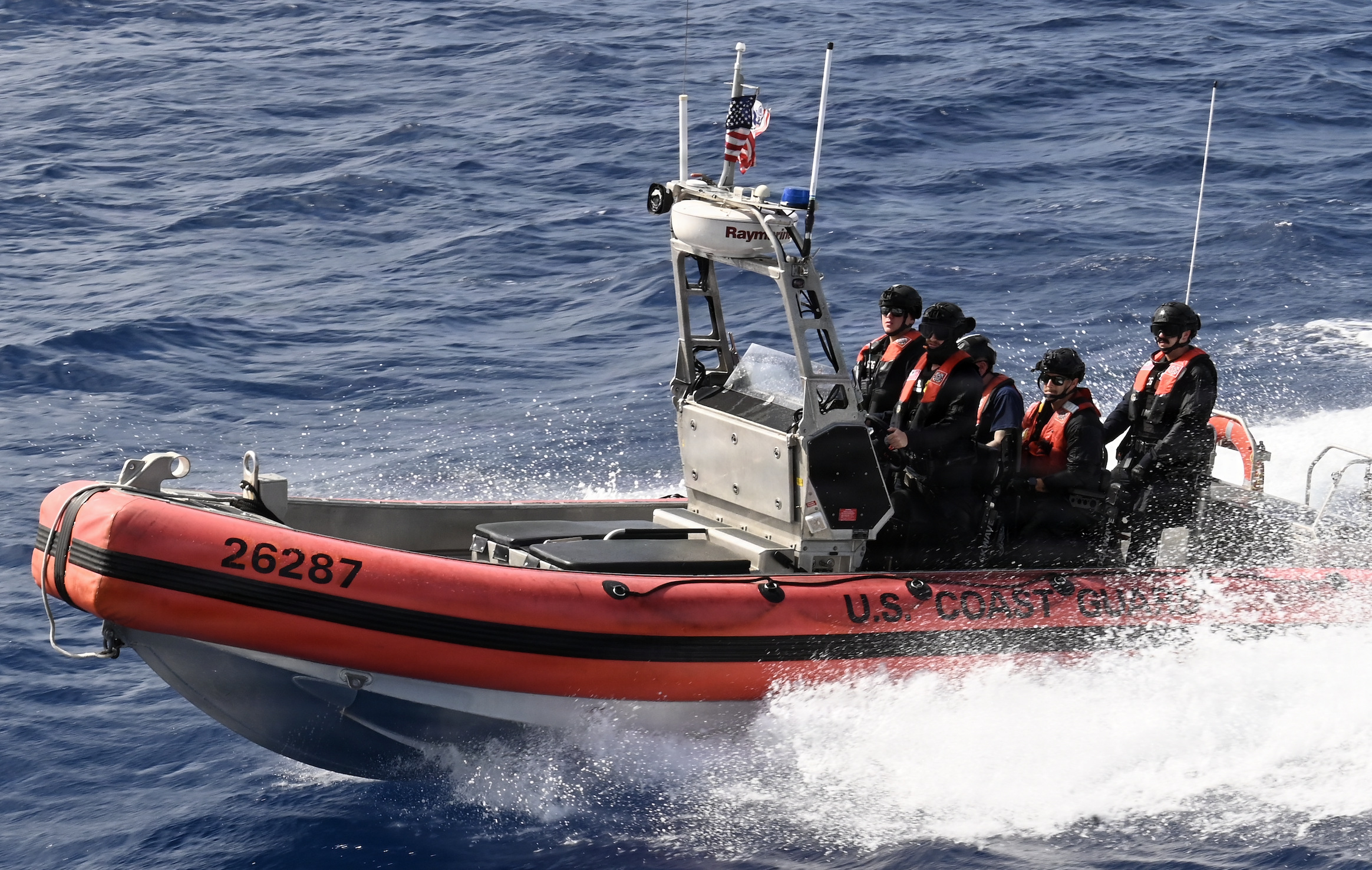
The U.S. needs to do more than mere freedom of navigation exercises in the SCS. We should match China’s political warfare strategy with one of our own. Using our navy is a blunt approach that gives the CCP political cover to complain about American military escalation and reinforces, rather than replaces, the law of the jungle. Instead, America should turn the SCS into a “governed space” through the velvet glove of the U.S. Coast Guard (USCG).
Use of the Coast Guard reframes U.S. presence in the region into one of law enforcement rather than purely selfish national interest. Under the mandate of preventing piracy, preserving fishing stocks, emergency disaster response, and so on, the USCG can help push back the legal and political gray zone that has allowed the CCP to throw its weight around. As a policing force, rather than a solely military organization, the Coast Guard can act without escalating or explicitly curbing Chinese expansion, which limits China’s ability to credibly object.
Building on What Works
Past success stories show this is possible. As part of a Combined Maritime Forces, the USCG and our allies effectively stopped piracy off the Horn of Africa. We already have most of the pieces in place to create such a force in the SCS. The Ocean Maritime Security Initiative, the Southeast Asia Maritime Law Enforcement Initiative, and the Southeast Asia Cooperation and Training exercise are just some of the joint law enforcement initiatives in the Southeast Asian region. Yet for now, these operate in piecemeal fashion and do not have the overall command structure to mount an effective counter to Chinese aggression.
Congress has already started taking steps in this direction by authorizing the expansion of Indo-Pacific Maritime Security Initiatives. To build on this momentum, Congress should further authorize and allocate funding for another Combined Maritime Forces initiative that will empower our regional allies and partners to stand up to China, and thereby reintroduce both American hard and soft power to the region.